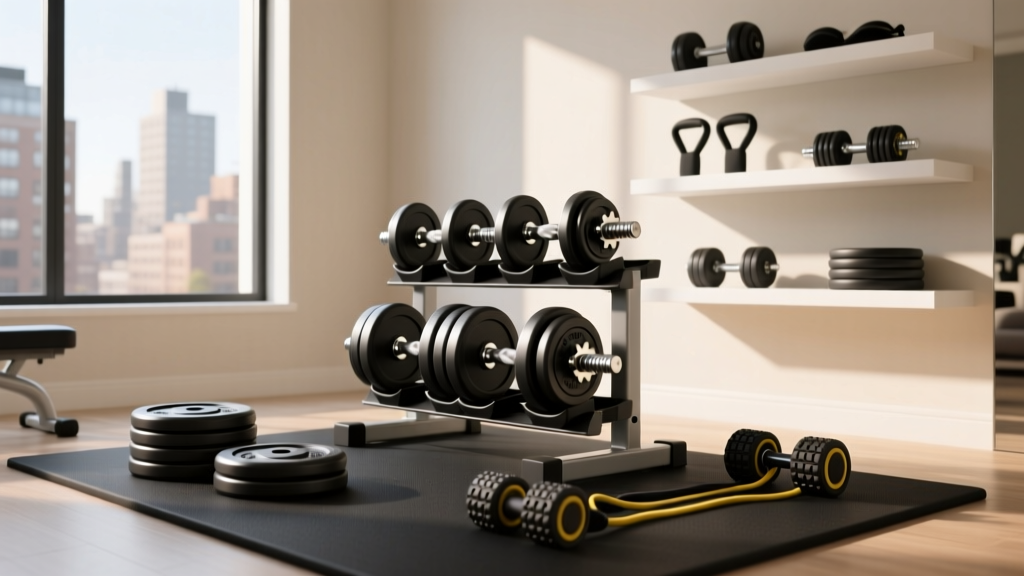
Space Optimization: Loadable Plates and Wrist Curls with Dumbbells
Maximize your compact home gym layout with loadable dumbbells. Learn space-saving storage tips and how to optimize interchangeable plates for wrist curls.

As urban home gyms in 2026 continue to shrink due to rising real estate costs and smaller dedicated floor plans, the traditional 15-rack fixed dumbbell set has become a spatial liability. Fitness enthusiasts are increasingly turning to the loadable dumbbell with interchangeable plates as the ultimate space-saving solution. However, while most lifters praise loadable systems for heavy compound movements like goblet squats and floor presses, their true ergonomic brilliance is often overlooked in isolation work. Specifically, when performing wrist curls with dumbbells, a loadable system offers distinct biomechanical and spatial advantages that neither fixed rubber dumbbells nor dial-adjustable systems can match.
This guide explores the spatial economics of interchangeable plate systems, provides a concrete layout blueprint for micro-gyms, and details why loadable handles are the superior tool for forearm isolation in tight spaces.
The Spatial Economics of Loadable Dumbbells
To understand why a loadable dumbbell with interchangeable plates is the cornerstone of a space-optimized gym, we must quantify the footprint of traditional alternatives. A standard fixed dumbbell set ranging from 5 to 50 lbs (in 5 lb increments) requires a multi-tier A-frame rack. This rack typically occupies a 4x4 foot footprint, consuming 16 square feet of valuable floor space, not including the clearance required to stand in front of it and select weights.
Conversely, a loadable system utilizes a vertical Olympic plate tree and a pair of compact handles. The handles can be stored on the tree's top pegs or hung on a simple wall-mounted bracket, effectively reducing the equipment's footprint to the base of the plate tree alone.
| System Type | Floor Footprint | Approx. 2026 Cost | Total Hardware Weight | Space Efficiency Rating |
|---|---|---|---|---|
| Fixed Rubber Set + Rack | 16 sq. ft. | $1,100 - $1,400 | ~320 lbs | Poor |
| Dial-Adjustable (Pair) | 4 sq. ft. | $800 - $950 | ~100 lbs | Good |
| Loadable Handles + 200 lbs Plates + Vertical Tree | 2.25 sq. ft. | $450 - $650 | ~220 lbs | Excellent |
By utilizing a vertical tree with an 18x18 inch base, you reclaim over 13 square feet of floor space compared to a fixed rack. In a 6x8 foot micro-gym, this reclaimed space is the difference between a claustrophobic storage closet and a functional training environment.
Why Interchangeable Plates Excel for Forearm Isolation
While saving space is the primary driver for purchasing a loadable dumbbell with interchangeable plates, the secondary benefit—ergonomic precision—is what makes them ideal for wrist curls with dumbbells.
The Biomechanics and Handle Geometry
Fixed rubber and neoprene dumbbells are designed with comfort and drop-resistance in mind. They typically feature a contoured handle that is thicker in the middle (up to 1.5 inches) and flares out aggressively at the ends to secure the rubber heads. When you perform wrist curls with dumbbells of this design, the flared ends frequently dig into the flexor carpi ulnaris and the medial aspect of the wrist during deep flexion, artificially limiting your range of motion (ROM) and causing tendon irritation.
'For optimal forearm hypertrophy, the wrist must achieve full extension at the bottom of the movement and full flexion at the top. Hardware impingement from bulky dumbbell heads is a primary reason lifters plateau on isolation movements.' — ExRx.net Biomechanical Guidelines
Loadable dumbbell handles, such as the Rogue Loadable Dumbbells or standard Olympic handles, feature a uniform, un-tapered grip (usually 1.9 inches in diameter) with a smooth sleeve transition. This cylindrical geometry allows the wrist to hinge freely without the hardware biting into the forearm muscles, enabling a true, unobstructed stretch of the flexor carpi radialis and palmaris longus.
The Necessity of Micro-Loading
The forearms are a relatively small, highly fatigue-resistant muscle group that requires precise progressive overload. Dial-adjustable dumbbells typically jump in 2.5 lb or 5 lb increments. Jumping from a 15 lb dumbbell to a 20 lb dumbbell for a strict wrist curl represents a massive 33% increase in load, which almost always forces the lifter to cheat the movement using elbow flexion.
Interchangeable plate systems solve this by accommodating fractional plates. Adding two 0.5 lb micro-plates to your loadable handle allows for a 1 lb total increase (a much more manageable 6% jump), ensuring continuous tension and hypertrophy without compromising form or joint health.
Designing the Compact Gym Layout: The 6x8 Blueprint
To maximize the utility of your loadable dumbbell with interchangeable plates, your layout must prioritize workflow efficiency. Here is a proven blueprint for a 48-square-foot (6x8) room that accommodates heavy lifting and precise isolation work.
- Zone 1: The Storage Corner (2x2 ft): Place a 48-inch tall vertical Olympic plate tree in the furthest corner. Store your 10 lb, 25 lb, and 45 lb interchangeable plates on the lower pegs, and your 2.5 lb and 0.5 lb fractional plates on the top pegs. Hang the loadable handles on the tree's upper handle hooks.
- Zone 2: The Kneeling Station (3x4 ft): Instead of a bulky flat bench which eats up 6 square feet and restricts movement, use a high-density 3/4-inch EVA foam mat. For wrist curls, you can kneel directly on the mat and rest your forearms on a low plyo box or a sturdy window sill, eliminating the need for a bench entirely.
- Zone 3: The Loading Lane (2x6 ft): Maintain a clear 2-foot wide lane between the plate tree and your mat. This allows you to safely roll heavy plates onto the loadable handle sleeves without having to lift them from an awkward angle.
Step-by-Step: Executing Wrist Curls in Tight Spaces
Performing wrist curls with dumbbells in a compact layout requires a slight modification to the traditional bench-supported setup. The 'Kneeling Ledge' method is highly effective for space-constrained environments.
- Load the Handles: Slide the appropriate interchangeable plates onto the loadable handle sleeves. For wrist curls, you will likely use 5 lb and 2.5 lb plates. The smaller diameter of these plates (typically 5.5 to 7.5 inches) is a massive advantage, as it prevents the plates from hitting the floor at the bottom of the wrist extension.
- Secure the Collars: Use heavy-duty spring collars or aluminum clamp collars (like HG2.5 clamps). Avoid threaded spin-lock collars for high-rep isolation work, as the repetitive wrist rotation can vibrate the threads loose, creating a safety hazard.
- Position the Body: Kneel on your EVA foam mat facing a sturdy elevated surface (a low plyo box, a stacked set of bumper plates, or a secured shelving unit). Drape your forearms over the edge, allowing your wrists to hang freely off the ledge.
- Execute the Curl: Grip the uniform 1.9-inch cylindrical handle of the loadable dumbbell. Allow the weight to pull your wrist into deep extension (stretching the underside of the forearm), then contract the flexors to curl the weight upward, squeezing at the peak.
- Safe Dismount: Because you are kneeling, simply lower the dumbbells directly to the foam mat between your thighs. Do not attempt to stand up while holding the loaded handles in a tight space.
Plate Material Selection for Small Spaces
When outfitting your loadable dumbbell with interchangeable plates, the material of the plates dictates the acoustic and spatial reality of your home gym.
Cast Iron vs. Urethane
Cast iron plates are the most space-efficient on the sleeve. A standard 10 lb cast iron plate is roughly 1.2 inches thick. However, in a small, enclosed room, the metallic clank of iron plates sliding against the steel sleeve of a loadable handle is deafening, and dropping them will easily crack subflooring or tile.
Urethane-coated plates offer dead-bounce and acoustic dampening, making them ideal for apartment gyms. The trade-off is thickness; a 10 lb urethane plate can be up to 2.2 inches thick. When performing wrist curls, this extra thickness means the plates are closer to your hands, which can occasionally interfere with grip width if you are using very narrow loadable handles. Always measure the sleeve length of your handles (aim for at least 6.5 inches) before purchasing thick urethane plates to ensure you have enough room for the collars.
Maintenance and Failure Modes of Loadable Systems
While a loadable dumbbell with interchangeable plates is virtually indestructible compared to the fragile internal gears of a dial-adjustable dumbbell, it is not immune to wear, particularly when used for high-repetition isolation movements.
Sleeve Knurling and Plate Wear: Many premium loadable handles feature light knurling on the sleeves to prevent collars from slipping. Over time, sliding cast iron or urethane plates on and off this knurling will act like a cheese grater, slowly degrading the inner ring of your interchangeable plates. Solution: Apply a light coat of 3-in-One oil or silicone lubricant to the sleeves once a month to reduce friction and preserve the plates.
Handle Rotation During Isolation: Unlike Olympic barbells, most budget loadable dumbbell handles do not feature internal needle bearings; they use simple bushings or are solid steel. During the concentric phase of wrist curls with dumbbells, the natural torque of your wrist can cause the entire sleeve and plate assembly to rotate in your hand. This rotational inertia can strain the wrist joint. Solution: Grip the handle slightly off-center to counterbalance the torque, or invest in handles with built-in swivel bearings designed specifically for isolation work.
Conclusion
Optimizing a home gym for space does not mean sacrificing exercise variety or biomechanical efficiency. By transitioning to a loadable dumbbell with interchangeable plates, you reclaim massive amounts of floor space while unlocking superior ergonomics for delicate isolation movements. The uniform grip geometry, combined with the ability to utilize fractional micro-plates, makes this system the undisputed champion for performing strict, high-yield wrist curls with dumbbells. Whether you are outfitting a 6x8 micro-gym or simply trying to clear clutter from your garage, the spatial and functional ROI of loadable plates is unmatched in the modern fitness landscape.
More gear to consider
All reviews
Olympic Barbell Buying Guide & Quad Workouts with Dumbbells

Dumbbell Workout Plan for Beginners: Neoprene Weight Mistakes

Olympic vs Standard Plates for Your At Home Dumbbell Arm Workout

How to Get Chest Muscles With Dumbbells: Loadable Plate Guide

Best Adjustable Dumbbells for the Dumbbell Bench Squat (2026)
