Loadable Dumbbell Maintenance for the Dumbbell Waiter's Carry
Master loadable dumbbell maintenance to ensure maximum safety and longevity during the dumbbell waiter carry. Expert tips on collars, sleeves, and rust.

Loadable dumbbells—handles that accept interchangeable weight plates—are the undisputed champions of longevity in the free weight category. Unlike dial-adjustable or magnetic-selectorized dumbbells, which rely on complex internal plastic gears and fragile pins, a solid steel loadable handle can easily outlive the lifter. However, this durability comes with a strict requirement for manual maintenance, especially when you take the equipment overhead.
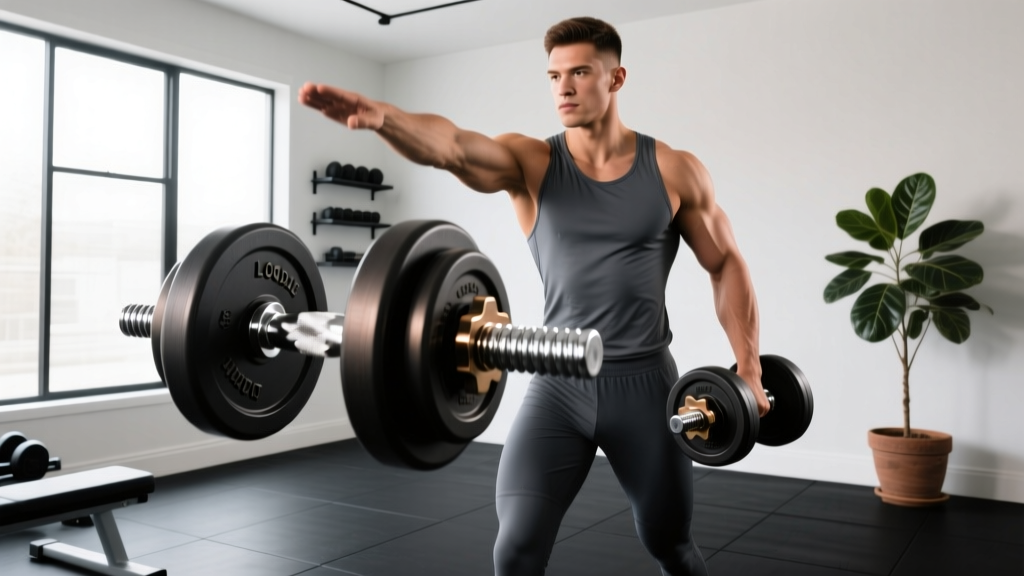
When executing the dumbbell waiter (commonly known as the overhead waiter's walk or carry), you are balancing 40 to 80+ pounds of steel directly above your skull and spine. According to biomechanics databases like ExRx.net, the overhead carry demands intense shoulder stabilization and core bracing. If a collar fails, a sleeve oxidizes and seizes, or plates shift during the walk, the consequences are catastrophic. This guide details the exact maintenance protocols required to keep your loadable dumbbell handles safe, functional, and rust-free for decades of heavy use.
The Anatomy of Failure: Why the Dumbbell Waiter Demands Perfect Gear
The dumbbell waiter exercise subjects your equipment to unique stress vectors. Unlike a floor press or a goblet squat, where the weight is close to your center of mass, the waiter's carry introduces dynamic micro-movements. Every step you take sends a kinetic shockwave down the dumbbell sleeve. If you are using standard spin-lock collars with worn threads, or clamp collars with fatigued springs, this vibration will slowly walk the collar off the sleeve.
⚠️ Critical Safety Warning
Never perform overhead movements like the dumbbell waiter with standard star-nut spin-lock collars if the threads show any sign of stripping. The dynamic vibration of walking will cause the nut to back off. Always upgrade to high-tension clamp collars or precision-machined lock collars for overhead carries.
Sleeve and Collar Maintenance Protocols
As of 2026, premium loadable handles like the Rogue Fitness Loadable Dumbbell Handles (typically retailing around $150 per pair) feature 1.9-inch grip diameters and 15.5-inch loadable sleeves. The tolerances on these sleeves are tight, designed to minimize plate rattle. To maintain this precision, follow this strict collar and sleeve regimen.
1. Thread and Groove Cleaning (For Spin-Lock and Threaded Collars)
Chalk dust and metal shavings accumulate in the threads of the sleeve and the inside of the collar. Over time, this creates a grinding paste that strips the steel.
- Frequency: Every 4 weeks (or immediately if you notice resistance when twisting the collar).
- Tool: Nylon-bristle thread brush and isopropyl alcohol (90% or higher).
- Action: Spray the sleeve threads with alcohol. Scrub vigorously with the nylon brush to dislodge chalk. Wipe completely dry with a microfiber cloth before applying a micro-layer of PTFE-based lubricant.
2. Spring Tension and Pad Inspection (For Clamp Collars)
If you use clamp-style collars (like Lock-Jaw or Rogue HG collars) for your interchangeable plates, the plastic or rubber pads compress over time, reducing the clamping force against the steel sleeve.
- Inspect the inner rubber pads for flat spots or tearing.
- Test the spring tension: the collar should require significant thumb pressure to open. If it snaps open too easily, the spring is fatigued and the collar must be replaced.
- Wipe the inner pads with a damp cloth to remove oxidized steel dust, which acts as a lubricant and causes the collar to slip during the waiter's walk.
Knurling Care: Preserving the Grip
When holding a heavy loadable dumbbell overhead, your grip endurance is the limiting factor. Sweat, dead skin, and gym chalk pack into the knurling valleys, leading to oxidation (rust) and a smooth, slippery shaft. According to equipment maintenance experts at BarBend, neglecting knurling care is the number one reason free weights degrade aesthetically and functionally.
The 3-Step Knurling Restoration
Do not use standard WD-40, as it attracts dust and degrades over time. Instead, use a dedicated barbell oil or a 3-IN-ONE Silicone Spray.
- Brush: Use a stiff nylon brush (never wire brass on stainless or chrome steel, as it can trap bristles and cause micro-scratches). Brush diagonally across the knurling to pop out embedded chalk.
- Oil: Apply 3-4 drops of barbell oil to the shaft.
- Buff: Use a clean microfiber cloth to work the oil into the knurling, then aggressively buff off all excess. The shaft should feel dry to the touch, not greasy.
Maintenance Matrix: Loadable Dumbbell Components
To keep your maintenance organized, use the following schedule tailored for lifters who frequently utilize loadable handles for dynamic movements like the dumbbell waiter.
| Component | Maintenance Action | Frequency | Required Tools |
|---|---|---|---|
| Shaft & Knurling | Brush out chalk, apply micro-layer of silicone oil | Weekly | Nylon brush, Barbell oil, Microfiber cloth |
| Sleeve Threads | Degrease with alcohol, remove metal shavings | Monthly | 90% Isopropyl alcohol, Thread brush |
| Collar Pads | Wipe away steel dust, check for compression fatigue | Bi-Weekly | Damp cloth, Replacement pads (if needed) |
| Interchangeable Plates | Check center hole for burrs that scratch the sleeve | Quarterly | Metal file or sandpaper (for cast iron plates) |
Troubleshooting Edge Cases and Failure Modes
Even with rigorous maintenance, loadable dumbbells subjected to heavy overhead work will encounter specific failure modes. Here is how to diagnose and fix them.
Edge Case 1: The 'Stuck' Plate on an Oxidized Sleeve
If you leave a 10lb cast-iron plate on the sleeve for months in a humid garage gym, galvanic corrosion can fuse the plate to the steel sleeve. Do not hit the sleeve with a hammer. Striking the sleeve can bend it by a fraction of a millimeter, which will cause a permanent wobble during the dumbbell waiter carry. Instead, apply a penetrating oil (like PB Blaster) to the seam, let it sit for 12 hours, and gently twist the plate off using a rubber mallet to tap the plate's edge, not the sleeve.
Edge Case 2: Bumper Plate Bore Degradation
Many lifters use fractional bumper plates on loadable handles to deaden the noise of shifting iron. However, the stainless steel insert inside cheap bumper plates can develop sharp burrs from repeated loading and unloading. These burrs act like a lathe, carving deep scratches into your dumbbell sleeve. Run your finger inside the bore of your bumper plates quarterly; if you feel a sharp ridge, use a circular metal file to smooth the insert before it destroys your handle's finish.
Edge Case 3: Asymmetrical Loading in the Waiter's Walk
When loading plates for the waiter's carry, always center the mass. If you load a 25lb plate on the inside and three 5lb plates on the outside, the center of gravity shifts away from your hand. This creates a torque multiplier on your wrist and increases the sheer force against the collar. Always load the heaviest interchangeable plates closest to the handle shaft to maintain optimal balance and reduce collar stress.
'The longevity of a loadable dumbbell isn't determined by the steel of the shaft, but by the microscopic care given to the threads, sleeves, and collars. A well-maintained handle is a safe handle, especially when gravity is waiting for a single mechanical failure.' — FitGearPulse Equipment Testing Lab, 2026 Report
Final Thoughts on Overhead Longevity
Investing in high-quality loadable dumbbell handles with interchangeable plates is one of the smartest equipment decisions you can make for a home gym. They offer infinite scalability and lack the planned obsolescence of modern adjustable dumbbells. However, the freedom of plate-loading requires the discipline of manual maintenance. By adhering to the cleaning schedules, respecting the threading tolerances, and understanding the unique kinetic forces of the dumbbell waiter exercise, you ensure your gear remains safe, precise, and ready for the heavy work ahead.
More gear to consider
All reviews
Budgeting Loadable Dumbbells for the Alternating Dumbbell Front Raise

Beyond the Squat and Press with Dumbbells: Kettlebell Buying Guide
Olympic vs Standard Plates: Shoulder Workouts with Dumbbells at Home

Beyond Dumbbell Swing Benefits: Rack Storage & Maintenance
2026 Storage Trends: What Weight Dumbbells Should I Use Male KG?