
Space-Saving Loadable Dumbbells: Choosing the Right Dumbbell Spring
Maximize your home gym footprint with loadable dumbbells. Learn how the right dumbbell spring collar impacts storage layout, safety, and rack clearance.

The Home Gym Spatial Crisis: Fixed vs. Loadable Dumbbells
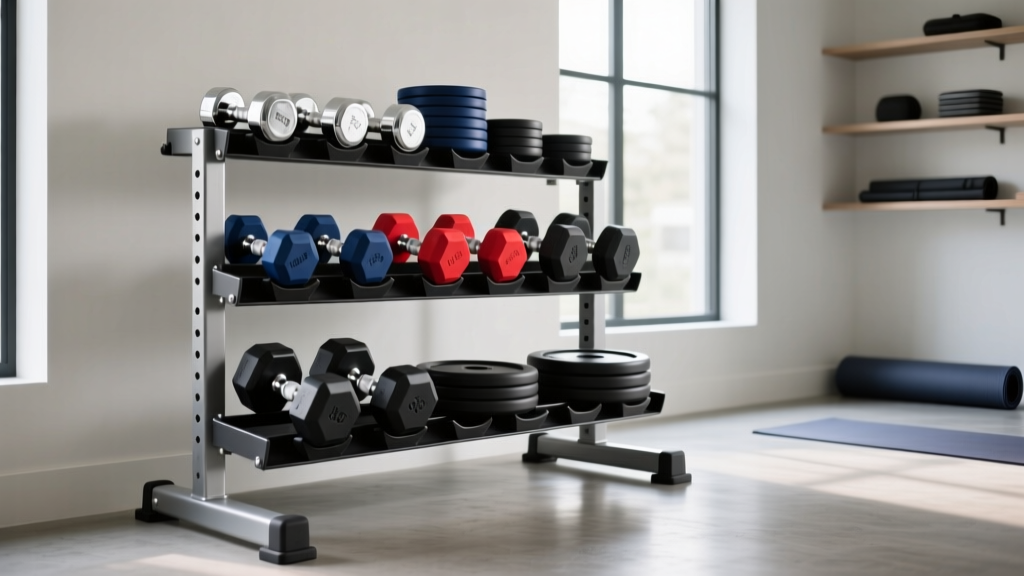
Real estate in a home gym is a premium commodity. For years, the standard approach to free weight training involved purchasing a full set of fixed hex dumbbells ranging from 10 to 50 pounds. While convenient, the spatial footprint is staggering. A standard three-tier A-frame rack holding a full 5-50 lb set consumes roughly 15 to 18 square feet of floor space, not including the clearance required to walk around it.
Enter the loadable dumbbell. By utilizing interchangeable plates and a central handle, lifters can replicate a 200-pound dumbbell rack in less than 4 square feet. However, when optimizing your layout, most lifters overlook the most critical hardware component dictating storage dimensions and safety: the dumbbell spring collar or locking mechanism. The physical profile of your dumbbell spring clip directly impacts tier spacing, shelf depth, and lateral clearance on your storage rack.
The Footprint Math: Calculating Your Layout
Before designing your storage layout, it is essential to understand the spatial savings. Below is a comparative breakdown of the floor and wall space required for traditional fixed setups versus modern loadable systems.
| Equipment Type | Weight Range | Storage Footprint | Wall Clearance Needed | Avg. Cost (2026) |
|---|---|---|---|---|
| Fixed Hex Dumbbells + Rack | 5 - 50 lbs (Pairs) | ~16 sq. ft. | 48" W x 30" D | $800 - $1,200 |
| Loadable Dumbbells + Plates | 10 - 100 lbs (Pairs) | ~3.5 sq. ft. | 24" W x 18" D | $350 - $600 |
Why the Dumbbell Spring Mechanism Dictates Shelf Design
When you buy a loadable handle, you must secure the plates. The mechanism you choose—whether it is an external dumbbell spring collar, a spin-lock nut, or a proprietary internal lock—adds lateral width to the assembled dumbbell. This overhang is the primary culprit behind scratched walls, dinged rack uprights, and dumbbells that refuse to sit flush on storage shelves.
Spring Collar Protrusion and Rack Clearance
A standard 1-inch or 2-inch Olympic dumbbell spring collar typically adds between 0.75 inches and 1.25 inches of lateral width per side. If you are loading a 14-inch sleeve with plates and securing it with a heavy-duty dumbbell spring clip, your total assembled width can easily exceed 18 inches.
Layout Pro-Tip: If your storage rack tiers are spaced exactly 16 inches apart, a fully loaded dumbbell secured with an external dumbbell spring collar will scrape the adjacent uprights. Always add a minimum of 3 inches of lateral buffer space to your rack design to account for the spring clip overhang and the user's hand clearance when grabbing the handle.Top Loadable Systems and Their Locking Profiles
According to equipment testing by BarBend, the market has bifurcated into two main categories: proprietary internal locks and traditional spring-secured sleeves. Here is how the top models impact your spatial layout.
1. Ironmaster Quick-Lock V2 (Internal Lock)
- Locking Mechanism: Patent-pending screw-in locking pin (No external dumbbell spring required).
- Spatial Impact: Minimal. The lock sits nearly flush with the outer plate.
- Price: ~$399 (Base Set).
- Best For: Ultra-compact wall-mounted shelves where every millimeter of lateral clearance matters.
2. Rogue Loadable Dumbbells (External Spring)
- Locking Mechanism: Standard barbell/dumbbell spring collars on a 6.8-inch sleeve.
- Spatial Impact: High. As noted in the specifications for the Rogue Loadable Dumbbells, the sleeve length requires standard spring clips, adding roughly 1.5 inches of total width when loaded.
- Price: ~$195 (Handles only).
- Best For: Lifters who already own Olympic plates and barbell spring collars, utilizing deep 18-inch tier racks.
3. Yes4All Olympic Loadable Handles (Spin-Lock / Spring)
- Locking Mechanism: Threaded spin-lock nuts or cheap 1-inch dumbbell spring clips.
- Spatial Impact: Moderate to High. Threaded nuts add 1 inch per side; spring clips add 0.75 inches.
- Price: ~$80 (Handles).
- Best For: Budget setups, though spin-locks drastically increase loading time compared to quick-release springs.
Designing Your Storage Layout Around Spring-Locked Dumbbells
If you are building a custom DIY rack or buying a commercial tier system for your loadable dumbbells, follow this step-by-step framework to ensure your dumbbell spring collars do not ruin your layout.
- Measure Maximum Assembled Width: Load the handle to its maximum practical weight (e.g., 80 lbs). Attach your preferred dumbbell spring collar. Measure the exact tip-to-tip width. (Typically 16" - 19").
- Determine Tier Spacing: Add 2.5 inches to your maximum assembled width. This is your minimum lateral distance between rack dividers to prevent the spring clip from catching on the wood or steel divider.
- Calculate Shelf Depth: The largest plate diameter for a 25lb or 45lb cast iron plate is roughly 5.8 inches. However, the handle grip adds central bulk. Your shelf depth must be a minimum of 14 inches to prevent the dumbbell from rolling forward when the heavy spring collar shifts the center of gravity.
- Implement a Lip Guard: Because dumbbell spring clips can snag on carpet or rubber matting when dragged, install a 1.5-inch wooden or steel lip on the front edge of your storage shelf to prevent accidental roll-offs.
Expert Troubleshooting: Spring Collar Failures & Maintenance
The most common failure mode in budget loadable setups is spring fatigue. A standard 1-inch dumbbell spring clip relies on a torsion spring. After roughly 500 to 800 compression cycles, the spring loses its elastic limit, resulting in a 1mm to 2mm gap between the collar and the outer plate.
⚠️ Safety Warning: Never use worn-out dumbbell spring clips for dynamic movements. If you can slide a standard 1mm guitar pick between the spring collar and the plate, the spring is dead. Upgrade to heavy-duty aluminum barbell clamps (like Rogue HG 2.0 collars) or switch to an internal locking system like the Ironmaster Quick-Lock for zero-maintenance safety."During a heavy floor press or dumbbell snatch, a 2mm gap allows the cast iron plate to rotate independently of the handle. This micro-movement causes catastrophic imbalance, leading to wrist sprains and dropped weights."
Frequently Asked Questions
Can I use barbell spring collars on loadable dumbbells?
Yes, but it is not recommended for compact spaces. Barbell spring collars (like the OSO Barbell clamps) are significantly wider than standard dumbbell spring clips, often adding over 2 inches of width per side. This will drastically increase your required shelf spacing and make the dumbbell feel unwieldy during close-grip movements like chest flies.
What is the best locking mechanism for saving space?
Proprietary internal locking mechanisms (such as screw-pins or dial systems) are the undisputed kings of space optimization. Because they do not require an external dumbbell spring collar, the lateral width of the dumbbell ends exactly where the outer plate ends, allowing you to store pairs flush against one another on a shelf.
How do I prevent spring collars from scratching my rack?
Wrap the inner teeth of your dumbbell spring clip in a single layer of high-density PTFE (Teflon) tape. This reduces the friction coefficient between the steel spring and the chrome or zinc-plated dumbbell sleeve, eliminating the screeching sound and preventing metal-on-metal scratching during loading and unloading.
More gear to consider
All reviews
Barbell Collar Guide: Safety & How to Recover After Dumbbell Workout

Power Rack vs Squat Rack vs Stand: Guide & Dumbbells for Chest Muscles

Rack Setup: Olympic Barbell Knurling & 21s with Dumbbells
Dumbbell Rack Maintenance: Storage for Wrist Dumbbell Curls & More
Rubber Hex vs Urethane Dumbbells: Dumbbell Pullover Care Guide
