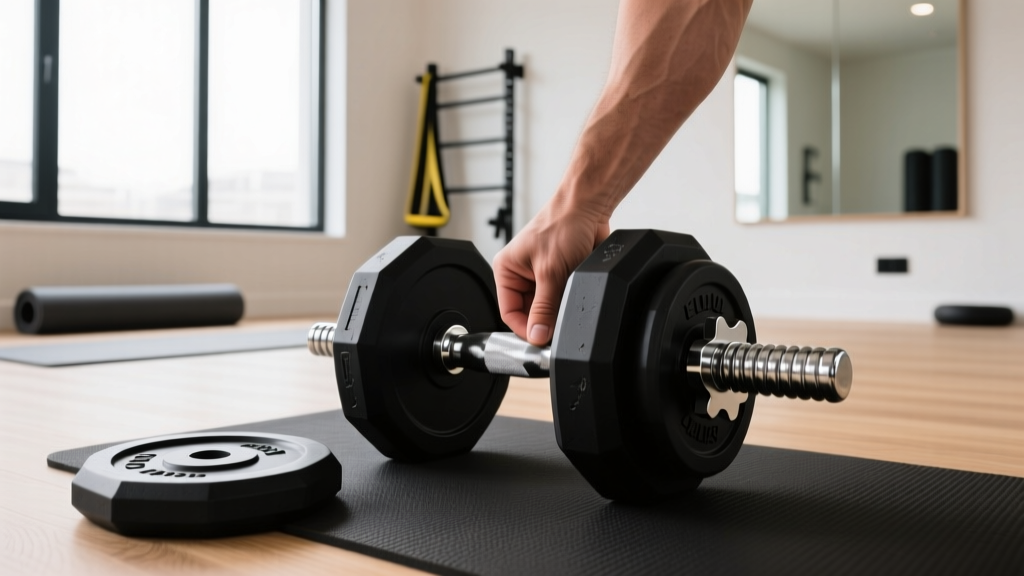
Loadable Dumbbell Maintenance for a Safe Dumbbell Turkish Get Up
Master loadable dumbbell maintenance to ensure maximum safety and longevity during your dumbbell Turkish get up. Expert tips on collars, threads, and plates.

The Hidden Dangers of Poorly Maintained Loadable Dumbbells
When building a versatile home gym in 2026, the loadable dumbbell with interchangeable plates remains a staple for space-conscious lifters. Models like the Ironmaster Quick-Lock V2, Rogue Loadable Dumbbell Handle, and traditional spin-lock handles offer the weight range of a full dumbbell rack in a fraction of the footprint. However, this modularity introduces mechanical failure points that fixed dumbbells simply do not have.
Nowhere are these failure points more dangerous than during the dumbbell Turkish get up. This complex, multi-planar movement transitions your body from supine to standing while stabilizing a load directly over your shoulder and head. If a collar loosens, a thread strips, or a plate shifts laterally during the sweep or the lunge phase, the resulting imbalance can lead to catastrophic shoulder injuries or dropped weight on your face. Proper maintenance care is not just about longevity; it is a critical safety protocol.
Biomechanical Stress: Why the Turkish Get Up Destroys Equipment
To understand how to maintain your loadable handles, you must first understand the unique forces the dumbbell Turkish get up exerts on them. According to biomechanical analyses by the American Council on Exercise (ACE), the TGU requires extreme shoulder stabilization and core anti-rotation.
- The Sweep and Roll: As you transition from your back to your elbow, the dumbbell experiences lateral torque. If your plates are not seated flush against the inner sleeve shoulder, this torque causes micro-vibrations that slowly back out spin-lock collars.
- The Tall Kneeling to Lunge: This phase introduces vertical oscillation. The sudden deceleration at the bottom of the lunge sends a shockwave up your arm and into the dumbbell sleeve, testing the sheer strength of your locking mechanism.
- The Overhead Lockout: Holding the weight at arm's length creates a long lever arm. Minor plate rattle is amplified, accelerating wear on the handle's knurling and sleeve finish.
Critical Maintenance Protocols by Handle Type
Not all loadable dumbbells are built the same. Your maintenance routine must be tailored to the specific locking mechanism of your equipment.
1. Traditional Spin-Lock Handles (Threaded Sleeves)
Spin-lock handles (common in budget-friendly sets from CAP Barbell or Yes4All) rely on threaded sleeves and star-lock nuts. The primary failure mode here is cross-threading and chalk impaction.
- Cleaning: Once a month, remove the collars completely. Use a brass wire brush (never steel, which will strip the zinc or chrome coating) to scrub the threads. Follow up with compressed air to blow out embedded gym chalk.
- Lubrication: Apply a light coat of PTFE-based dry lubricant (such as 3-IN-ONE Dry Lube). Avoid wet oils or WD-40, as these will attract dust and chalk, creating a grinding paste that destroys the threads over time.
- Inspection: Check the star nut for bent points. If the points are warped, it will not grip the sleeve shoulder evenly, allowing rotational slip during the TGU.
2. Quick-Lock and Lever Mechanisms (e.g., Ironmaster V2)
Premium loadable dumbbells like the Ironmaster Quick-Lock use a drop-pin or lever mechanism. While vastly superior for quick weight changes, the internal pins are highly susceptible to environmental debris.
- The Chalk Threat: Gym chalk (magnesium carbonate) is the enemy of drop-pin mechanisms. If chalk packs into the pin housing, the pin will not seat fully, creating a false lock. During the overhead phase of a Turkish get up, a false-locked plate can slide off the sleeve.
- Upkeep: Every two weeks, use a soft-bristled detailing brush and a vacuum hose to clean the lever housing. Wipe the locking pins with a microfiber cloth lightly dampened with isopropyl alcohol to remove sweat and oils.
Before every single TGU session, perform the Overhead Shake Test. Press the assembled dumbbell overhead, lock out your elbow, and vigorously shake the handle for 5 seconds. Look up at the plates. If you see any lateral movement, hear any rattle, or feel the collar shift, dismantle and re-seat the plates immediately. Never assume it is 'tight enough'.
3. Spring Collars and Clamp-Style Locks
If you are using a smooth-sleeve loadable handle (like the Rogue Loadable Dumbbell Handle) secured with spring collars (e.g., Rogue HG 2.0 Collars), you are relying on spring tension. Over time, metal fatigue reduces this tension. As of early 2026, a replacement set of high-quality spring collars costs around $35 to $45. Treat them as wearable consumables, not lifetime hardware. Replace your spring collars every 12 to 18 months if you use them frequently for dynamic movements.
Plate Selection and Sleeve Fitment
The longevity of your loadable dumbbell is also dictated by the plates you load onto it. Cast iron plates with large, poorly machined center holes will scrape the zinc coating off your dumbbell sleeves, leading to rapid oxidation and rust.
| Plate Material | Impact on Sleeve Longevity | TGU Suitability |
|---|---|---|
| Cast Iron (Machined) | Low impact if hole is precisely 1-inch/25mm. High wear if poorly cast. | Moderate. Can rattle if not paired with rubber shims. |
| Urethane / Rubber | Very low impact. Softer material protects sleeve finish. | Excellent. Absorbs micro-vibrations during the sweep. |
| Bumper Plates (Fractional) | Zero impact on metal sleeves, but thick profile limits max load. | Poor. Excessive width alters the center of gravity, making the TGU unwieldy. |
For the dumbbell Turkish get up, machined urethane grip plates are the gold standard. They feature precise center holes that slide smoothly onto the sleeve without scraping, and their rubberized coating dampens the vibrations that cause collars to loosen.
Environmental Factors: Rust, Sweat, and Storage
According to equipment care guidelines from Rogue Fitness, bare steel and even coated steel require active environmental management. Sweat is highly corrosive due to its salt content. When you perform a TGU, your gripping hand sweats directly onto the knurling and the inner sleeve shoulder.
- Post-Workout Wipe Down: Never put a loadable dumbbell away wet. Use a dry microfiber towel to wipe down the handle, knurling, and sleeves immediately after your session.
- Oxidation Management: If you notice surface rust forming on the sleeves (which increases friction and makes plate loading difficult), use a nylon brush and a light penetrating oil to lift the rust, followed by a dry wipe. Do not use sandpaper, which will permanently alter the sleeve diameter and cause plates to fit loosely.
- Storage: Store your loadable handles unloaded if possible. Leaving heavy plates clamped on the sleeves for months on end can cause microscopic warping in cheaper spin-lock nuts and compress the springs in clamp collars, permanently reducing their clamping force.
Troubleshooting Common Loadable Dumbbell Failures
Even with meticulous care, mechanical issues can arise. Here is how to troubleshoot the most common problems specific to loadable dumbbells:
Collar Won't Tighten Flush Against the Plate
The Cause: Debris (chalk dust, rust flakes, or a torn piece of rubber from a plate) is lodged on the inner sleeve shoulder.
The Fix: Remove all plates. Inspect the inner lip of the sleeve. Use a dental pick or a flathead screwdriver wrapped in a cloth to gently scrape the inner shoulder clean. A flush seat is mandatory for overhead stability.
Plates Rattle During the TGU Sweep
The Cause: The center hole of the plate is slightly larger than the sleeve diameter (common with older cast iron plates), creating a 1-2mm gap.
The Fix: You cannot shrink the plate hole. Instead, use a fractional plate shim (a thin rubber O-ring designed for barbell sleeves) placed between the plates to take up the slack and eliminate lateral play. Alternatively, upgrade to precision-machined urethane plates.
Spin-Lock Nut Binds Halfway Down the Thread
The Cause: Cross-threading or a buildup of hardened sweat and chalk in the thread grooves.
The Fix: Do not force the nut, as this will strip the zinc coating. Back it off. Soak the threaded sleeve in a shallow bath of white vinegar for 15 minutes to dissolve alkaline chalk and sweat deposits. Scrub with a brass brush, rinse, dry completely, and re-apply PTFE dry lube.
Conclusion: Respect the Overhead Load
The dumbbell Turkish get up is an unforgiving exercise that exposes every weakness in your body and your equipment. A loadable dumbbell with interchangeable plates is an incredible, cost-effective tool for home gyms in 2026, but it demands a higher standard of maintenance than fixed hex dumbbells. By implementing a strict cleaning schedule, understanding the specific failure modes of your locking mechanism, and utilizing the Overhead Shake Test, you ensure that your equipment remains as resilient and reliable as the strength you are building.
More gear to consider
All reviews
Olympic vs Standard Plates: Which is Best for the Dumbbell Tate Press?

Power Rack vs Squat Rack vs Stand: Mistakes for Biceps Exercises with Dumbbells

Rubber Hex vs Urethane for Alternating Supinated Dumbbell Curls

Incline Dumbbell Front Raise Mistakes & Adjustable Dumbbell Reviews

Incline Dumbbell Kickback: Urethane vs Rubber Hex 2026 Market Trends
