
Bumper vs Iron Plates: Space Layouts & Leg Day Workout With Dumbbells
Compare bumper vs iron plates for compact gym layouts. Plus, discover a space-saving leg day workout with dumbbells to maximize your home gym floor plan.

The Home Gym Footprint: Why Plate Choice Dictates Your Layout
When designing a high-performance home gym in a constrained environment—whether it is a two-car garage, a basement, or a spare bedroom—every square inch matters. Most lifters focus heavily on the footprint of their power rack or the dimensions of their adjustable bench. However, the most overlooked spatial variable is your weight plates. The ongoing debate of bumper plates versus cast iron plates is not just about aesthetics or dropping weights; it is fundamentally a space optimization and acoustic engineering challenge.
In 2026, with home gym real estate at a premium and urban living spaces shrinking, choosing the right plate profile dictates your rack clearance, your vertical storage footprint, and your ability to safely execute a heavy barbell session before transitioning into a targeted leg day workout with dumbbells. This guide breaks down the exact geometry, acoustic footprint, and layout strategies required to maximize your training space.
The Geometry of Iron: Bumper Plates vs. Cast Iron Plates
To understand spatial efficiency, we must look at the raw dimensional data of standard 45-pound plates. While both plate types share an IWF-standard diameter of roughly 17.7 inches, their thickness varies wildly. This thickness directly impacts how much sleeve space you have for micro-loading, how wide your vertical plate tree must be, and how close you can push your rack to a wall.
| Feature | Rogue Echo Bumper (45lb) | Rogue Deep Dish Iron (45lb) |
|---|---|---|
| Diameter | 17.72 inches | 17.75 inches |
| Thickness (Per Plate) | 3.25 inches | 1.30 inches |
| Sleeve Space (Per Pair) | 6.50 inches | 2.60 inches |
| Noise & Vibration | Low (Virgin Rubber Dampening) | High (Metal-on-Metal/Concrete) |
| Avg. Cost Per Pound (2026) | $2.15 - $2.45 | $1.50 - $1.80 |
As highlighted by equipment specifications from Rogue Fitness, a pair of 45lb bumpers consumes 6.5 inches of sleeve space, whereas a pair of machined iron plates consumes only 2.6 inches. If you are loading 315 lbs on a standard Olympic barbell with 16.3-inch sleeves, iron plates leave you with over 13 inches of sleeve space for heavy bands or extra collars. Bumper plates leave you with barely 3 inches. Furthermore, a standard vertical plate tree holding 500 lbs of bumpers requires a base footprint roughly 40% wider than one holding 500 lbs of iron plates to prevent tipping.
Acoustic Footprints and the 'Drop Zone' Radius
Space optimization is not purely visual; it is also acoustic. If your gym is located on an upper floor, above a finished basement, or in a shared townhouse, dropping cast iron plates will generate structural low-frequency vibrations that travel through floor joists. This forces you to implement a 'controlled lowering' protocol for deadlifts and heavy rack pulls.
💡 The Drop-Zone Spatial Tax: When using iron plates, you cannot drop the bar. This requires you to maintain clear lateral space around the barbell to safely guide the weight down without clipping your shins or the rack uprights. Bumper plates allow for dead drops directly from the hip, effectively shrinking your required 'safe clearance radius' by up to 18 inches on all sides of the lifting platform.However, bumpers introduce a different spatial hazard: the bounce. In a tight 8x8 foot rack footprint, a dropped bumper plate can ricochet off rubber flooring and strike the rack uprights or nearby walls. For ultra-compact spaces, 'Hi-Temp' or crumb-rubber bumpers (which are thicker but deaden bounce significantly better than virgin rubber) are the superior layout choice.
Designing the 'Dual-Zone' Leg Day Layout
To maximize efficiency, modern home gym layouts are moving away from single-station bottlenecks. The most effective spatial design for lower body training is the Dual-Zone Layout. This involves dedicating a primary 8x8 foot zone for barbell squats and deadlifts, and an adjacent 4x6 foot zone specifically for accessory work.
Why separate the zones? Barbell leg work requires heavy loading, long rest periods (3-5 minutes), and significant spatial clearance for loading/unloading plates. By moving accessory movements to a dedicated dumbbell zone, you keep the barbell rack free for supersetting or for other household members to use. This is where a highly targeted leg day workout with dumbbells becomes a critical component of your spatial strategy.
The Ultimate Space-Saving Leg Day Workout With Dumbbells
When your barbell rack is occupied, or you simply want to spare your central nervous system from heavy axial spinal loading, unilateral dumbbell training is biomechanically superior for targeting the quads, hamstrings, and glutes. According to biomechanical analysis via ExRx.net, unilateral movements correct left-to-right strength imbalances and require a fraction of the absolute load, meaning you can achieve deep muscular failure with 50lb dumbbells in a 4x4 foot corner.
Here is a high-yield, low-footprint leg day workout with dumbbells designed for a compact home gym:
- Dumbbell Bulgarian Split Squats (3 sets x 8-12 reps per leg)
Spatial Hack: Instead of using a full adjustable bench which eats up floor space, elevate your rear foot on a 12-inch plyo box or a stack of spare iron plates. Hold 50-75lb dumbbells. This isolates the quad and glute of the lead leg without requiring a 6-foot barbell clearance. - Deficit Dumbbell Reverse Lunges (3 sets x 10 reps per leg)
Spatial Hack: Stand on two 10lb iron plates (or low-profile bumpers) to create a 1.5-inch deficit. This increases the stretch at the bottom of the lunge, mimicking the hypertrophy stimulus of a leg press machine without the 15-square-foot machine footprint. - Dumbbell Romanian Deadlifts (4 sets x 10-15 reps)
Spatial Hack: Perform these in your 4x6 dumbbell zone facing a mirror or wall. Holding 70-90lb dumbbells, focus on the eccentric hamstring stretch. Because the weight is at your sides rather than in front of you (as with a barbell), you need zero forward toe-clearance space. - Goblet Squat to Calf Raise Pulses (3 sets x 20 reps)
Spatial Hack: Hold a single heavy kettlebell or dumbbell vertically. Sink into a deep squat and pulse twice before rising onto your toes. This burns out the adductors, quads, and calves in a stationary 2x2 foot footprint.
Vertical Storage Solutions for Tight Spaces
Once you have selected your plate type and established your zones, storage is the final spatial hurdle. If you opted for cast iron plates due to their slim profile, a standard A-frame vertical plate tree is highly efficient, occupying roughly 2.5 square feet of floor space while holding up to 600 lbs.
However, if you chose bumper plates for acoustic dampening, traditional plate trees become unstable due to the wide base required. For bumper plates in a space-optimized gym, wall-mounted plate cradles or rack-integrated storage pegs are mandatory. Mounting plate storage directly to the uprights of your power rack (using bolt-on storage horns) elevates the bumpers off the floor, allowing you to slide a bench or plyo box directly underneath the rack when not in use. This single layout trick can reclaim up to 8 square feet of usable floor space in a small garage gym.
Final Verdict on Plate Selection
Choose cast iron plates if your primary constraint is physical square footage, sleeve space for heavy band work, and budget. Choose bumper plates if your constraint is acoustic (shared walls/floors) and you frequently drop weights from the hip. By pairing your plate choice with a deliberate Dual-Zone layout and incorporating a strict leg day workout with dumbbells, you can build a world-class lower-body training facility in less than 100 square feet.
More gear to consider
All reviews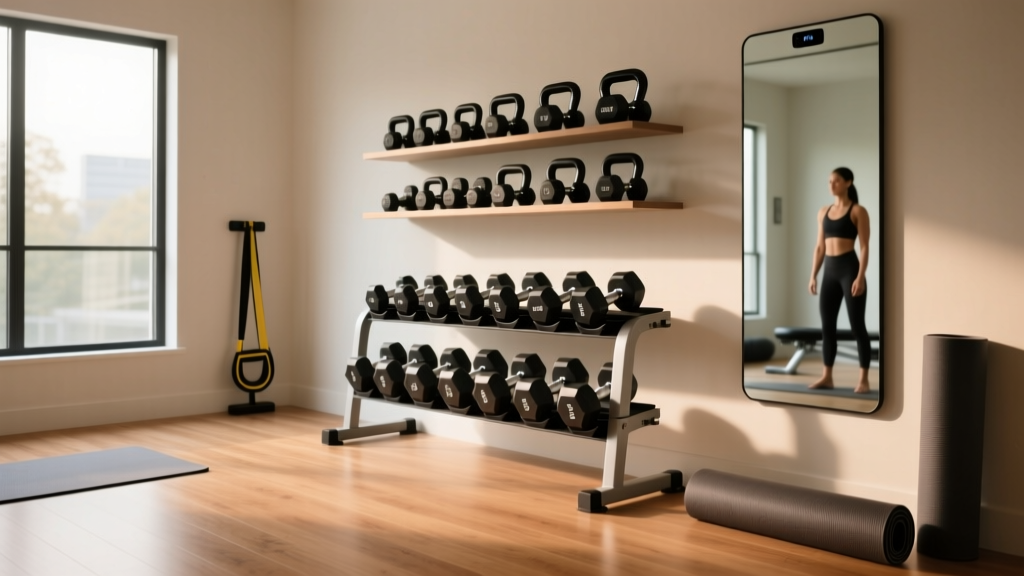
Setting Up Your Space for a Workout Program with Dumbbells

Barbell Collar Types & One Dumbbell Exercises Guide

Power Rack vs Squat Rack vs Stand: Alternating Dumbbell Shoulder Press

How to Choose Adjustable Dumbbells for a Triceps Workout at Home (2026)

2026 Trend: Loadable Dumbbells for a 30 Minute Dumbbell Workout
