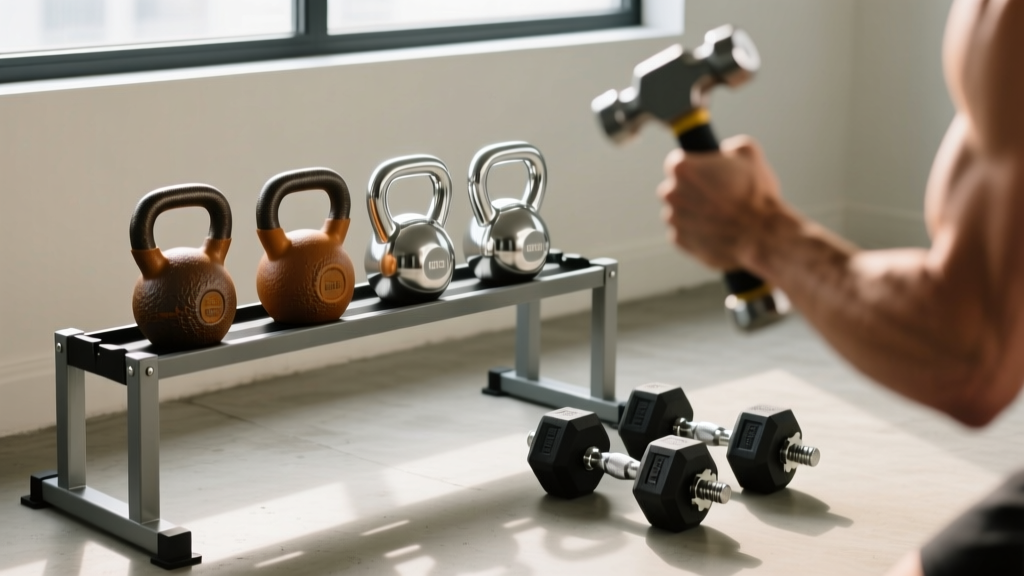
Cast Iron vs Competition Kettlebells & Hammer Curls with Dumbbells
Master small-space gym layouts with our guide on cast iron vs competition kettlebells, plus optimal racking for hammer curls with dumbbells.

The Spatial Dilemma: Designing a Compact Free-Weight Zone
Building a comprehensive home gym in a constrained footprint—whether it is a 60-square-foot garage corner or a spare bedroom—requires ruthless spatial efficiency. When outfitting your free weights and racks zone, two distinct challenges emerge: selecting the right kettlebell profile for your storage system, and designing a dumbbell station that accommodates specific biomechanical pathways. This guide breaks down the kettlebell buying guide (cast iron vs competition) through the lens of space optimization, while also detailing the exact layout clearances required for isolation movements like hammer curls with dumbbells.
Kettlebell Buying Guide: Cast Iron vs. Competition for Small Spaces
The decision between cast iron and competition kettlebells is often framed around training style (hardstyle vs. sport). However, from a layout and racking perspective, the choice fundamentally dictates your storage footprint. According to the Kettlebell Kings sizing guide, the physical dimensions of these two bell types vary drastically, which impacts how they interact with wall-mounted racks and floor stands.
The Uniformity of Competition Kettlebells
Competition kettlebells are manufactured to a strict, uniform dimension regardless of weight. Whether you are holding an 8kg or a 32kg bell, the height is exactly 280mm, the width is 210mm, and the handle diameter is 33mm. From a space-planning perspective, this uniformity is a dream. You can build or purchase a rack with identical 215mm slots, ensuring a flush, predictable footprint. The drawback? Lighter weights (like 8kg or 12kg) are physically bulky and hollow, taking up the exact same shelf space as a massive 32kg bell.
The Scalability of Cast Iron Kettlebells
Cast iron bells scale in size proportionally to their weight. A 16kg cast iron bell is significantly more compact than a 32kg bell. If you are building a small, staggered wall rack, cast iron allows you to minimize wasted airspace on the lower tiers. However, the varying horn widths and handle diameters (often ranging from 30mm to 40mm+) mean that off-the-shelf tiered racks often result in awkward overhangs or wasted lateral space.
| Weight | Competition Bell Dimensions (H x W) | Cast Iron Bell Dimensions (Approx. H x W) | Space Optimization Verdict |
|---|---|---|---|
| 16 kg (35 lbs) | 280mm x 210mm | 230mm x 180mm | Cast Iron wins on compact shelving |
| 24 kg (53 lbs) | 280mm x 210mm | 255mm x 200mm | Tie; Cast Iron is slightly narrower |
| 32 kg (70 lbs) | 280mm x 210mm | 280mm x 225mm | Competition wins on predictable rack fit |
Racking Footprints and Floor Load Considerations
When optimizing layout, vertical storage is mandatory. A standard 3-tier floor rack for competition bells requires a footprint of roughly 24 inches wide by 20 inches deep. Wall-mounted racks eliminate the floor footprint entirely but introduce structural concerns.
Dumbbell Station Layout: Optimizing for Hammer Curls
While kettlebells dominate ballistic movements, a complete free-weight zone requires a dedicated dumbbell station for hypertrophy. Designing this station requires understanding the biomechanics of specific exercises. For example, performing hammer curls with dumbbells requires a neutral grip (palms facing inward) and a vertical travel path that demands specific lateral and posterior clearances.
Biomechanical Clearance for the Neutral Grip
When executing hammer curls with dumbbells, the elbows must remain pinned to the ribs to isolate the brachialis and biceps brachii. If your dumbbell station is placed too close to a wall or a squat rack, the posterior drift of the elbow during the eccentric (lowering) phase will cause the dumbbell heads or the user's knuckles to strike the obstacle. The ACE Fitness exercise library emphasizes that joint tracking requires unobstructed sagittal plane movement.
- Wall Clearance: Maintain a minimum of 18 inches between the back of the user and any wall or rack upright to allow for natural spinal extension and elbow drift.
- Lateral Width: Allocate at least 36 inches of lateral width for the dumbbell zone to prevent the dumbbell heads from clipping adjacent equipment during the concentric phase.
Adjustable Dumbbells: Shape Matters in Tight Spaces
If space constraints force you to use adjustable dumbbells instead of a 5-tier hex rack, the physical shape of the adjustable bell drastically impacts exercises like hammer curls with dumbbells.
PowerBlock Elite: The rectangular, blocky design of PowerBlocks is exceptional for space-saving (replacing 28 pairs of dumbbells in a 12-inch cube). However, the sharp, boxy edges can dig into the forearms or strike the thighs during deep hammer curls if the user has a narrow stance.
Nuobell or Bowflex SelectTech: These maintain a more traditional contoured dumbbell silhouette. The Nuobell 80lb set, measuring roughly 15.5 inches in length at max weight, mimics the balance of a fixed hex dumbbell, making it vastly superior for strict isolation movements in a cramped layout.
The 60-Square-Foot Free Weight Blueprint
Here is a proven layout matrix for an 8x7.5 foot (60 sq ft) free-weight zone that accommodates both kettlebell ballistics and dumbbell isolation work without spatial conflict.
- The Back Wall (Kettlebell Zone): Install a wall-mounted, staggered 3-tier rack. Use cast iron bells (16kg, 24kg, 32kg) to minimize the protruding footprint. The rack should sit 18 inches off the floor to allow for easy dead-stop pickup without requiring a deep, spatially restrictive squat.
- The Lateral Wall (Dumbbell Zone): Place a compact, 2-tier angled dumbbell rack (holding 5-50lb hex bells) or an adjustable dumbbell cradle. Position this 36 inches away from the back wall corner to create an open 'L' shaped staging area.
- The Center Staging Mat: Lay down a 4x6 foot, 3/4-inch thick vulcanized rubber mat. This provides the exact 48x72 inch workspace needed to transition from kettlebell swings to standing hammer curls with dumbbells without having to shift equipment or risk tripping on rack feet.
2026 Sourcing and Budget Allocation
When purchasing gear for a space-optimized layout, prioritize dimensional accuracy over aesthetic. According to current market data from Rogue Fitness and specialized vendors, budget allocation should reflect your spatial priorities.
- Competition Kettlebells: Expect to pay $130 to $180 per bell for premium brands like Kettlebell Kings or Rogue. Buy these if you are utilizing a uniform, custom-built slotted rack.
- Cast Iron Kettlebells: Typically priced between $1.80 and $2.50 per pound. Ideal for staggered, space-saving wall mounts.
- Space-Saving Dumbbells: A high-quality adjustable set like the Nuobell 80s retails around $450-$500, replacing over $1,500 worth of fixed hex dumbbells and eliminating the need for a 4-foot floor rack.
By understanding the exact dimensional differences between cast iron and competition bells, and by respecting the biomechanical clearances required for movements like hammer curls with dumbbells, you can engineer a free-weight zone that feels expansive, safe, and highly functional—even when confined to a small footprint.
More gear to consider
All reviews
Best Adjustable Sets for Chest Exercises Using Dumbbells (2026)

Loadable Dumbbells for Donkey Kicks With Dumbbells: 2026 Top Picks

Rubber Hex vs Urethane Dumbbells for Reverse Dumbbell Curls
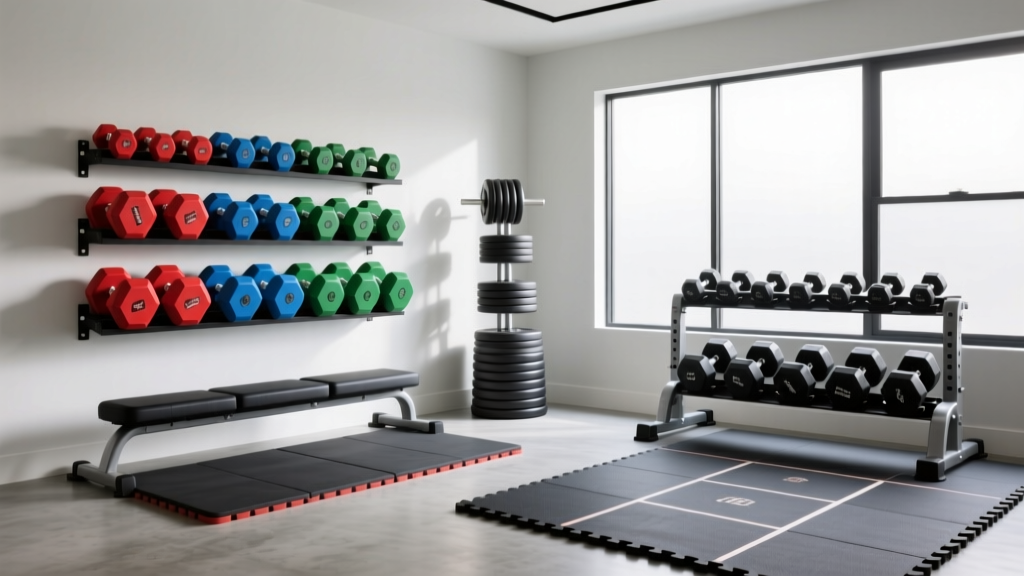
Best Dumbbell Workout Zones: Bumper vs Iron Plate Gym Layouts

Rack Setup: Barbell Knurling & Dumbbell Shoulder External Rotation
