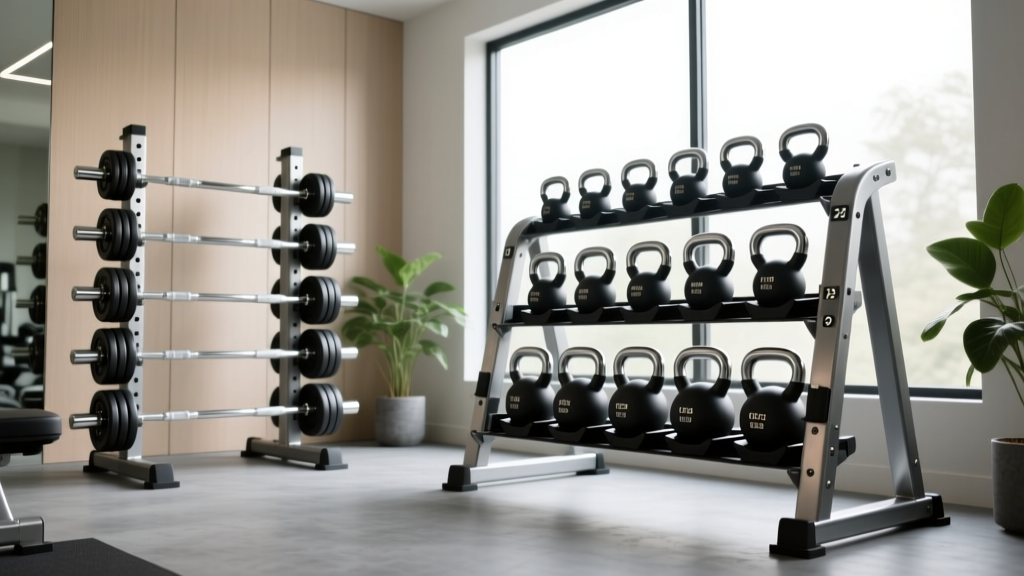
Kettlebell Versus Dumbbell Storage: Top Rack Picks 2026
Explore the kettlebell versus dumbbell storage dilemma. Our 2026 hands-on review of top dumbbell racks covers specs, safety, and hybrid gym layouts.

The Kettlebell Versus Dumbbell Storage Dilemma
When outfitting a commercial facility or a premium home gym, the kettlebell versus dumbbell debate usually centers on programming: hypertrophy and isolation versus ballistic power and rotational core work. However, as a gear reviewer who has spent the last decade testing free weight equipment, I look at this debate from a purely logistical and structural standpoint. How do you actually store them?
The physics of these two implements dictate entirely different storage requirements. Dumbbells feature a centralized center of gravity aligned with the handle. This makes them perfectly suited for sloped, tiered A-frame racks that allow for ergonomic, wrist-neutral lifting. Kettlebells, conversely, are bottom-heavy. Their center of gravity sits well below the handle. Placing a kettlebell on a sloped dumbbell rack is a recipe for disaster: the offset weight causes them to slide, scratch their urethane coatings, and potentially tumble off the edge, creating a severe crushing hazard.
In 2026, the trend in hybrid training has forced manufacturers to rethink the traditional weight tree. Below, I break down the exact structural differences required for storing these tools, followed by hands-on reviews of the top dumbbell and hybrid storage racks on the market today.
Expert Warning: The Sloped Shelf Hazard
Never store round-bodied kettlebells or competition-style steel kettlebells on a sloped dumbbell shelf. The downward angle combined with the spherical base creates a rolling hazard. Always reserve sloped tiers strictly for hex-head or urethane-coated dumbbells, and utilize flat, reinforced shelving for kettlebells.
Hands-On Reviews: Top Dumbbell & Hybrid Racks
After loading, unloading, and stress-testing the most popular storage solutions over the past six months, here are the top performers that address the nuances of free weight organization.
1. Rogue Fitness 3-Tier Dumbbell Rack (Best Overall for Dumbbells)
If your gym leans heavily toward traditional bodybuilding and you are firmly on the 'dumbbell' side of the kettlebell versus dumbbell split, the Rogue 3-Tier Dumbbell Rack remains the gold standard. Constructed from 11-gauge steel with 3x3-inch uprights, this rack is virtually indestructible.
- Dimensions: 34 x 22-inch footprint; 38 inches high.
- Capacity: Holds 10 pairs of dumbbells (5 to 50 lbs).
- Price: $295.00 (plus freight shipping).
- Failure Mode / Edge Case: The top tier shelf depth is exactly 8.5 inches. If you purchase oversized urethane dumbbells (common in 45lb and 50lb pairs from boutique brands) with head diameters exceeding 9 inches, they will overhang the lip. This isn't an immediate danger, but it creates an unbalanced visual and can scratch the urethane over time.
Source reference for steel gauge standards and manufacturing specs can be verified via Rogue Fitness.
2. Rep Fitness 3-Tier Dumbbell Rack (Best Budget Option)
For garage gym owners who need to maximize their equipment budget, the Rep Fitness 3-Tier rack offers 90% of the utility of premium brands at a fraction of the cost. It uses 14-gauge steel, which is slightly thinner than Rogue's 11-gauge, but more than sufficient for static storage loads up to 800 lbs.
- Dimensions: 32 x 21-inch footprint.
- Capacity: Holds 10 pairs (5 to 50 lbs).
- Price: $179.99.
- Hands-On Insight: The welds on the lower tier brackets show minor spatter compared to premium racks, a common cost-cutting measure in budget manufacturing. However, the structural integrity holds firm under dynamic loading (dropping heavy dumbbells onto the shelf). The sloped angle is slightly steeper than Rogue's, making it excellent for rubber hex dumbbells but less ideal for round neoprene dumbbells, which may slowly creep downward.
3. Titan Fitness Flat Shelf Utility Rack (Best Hybrid Storage)
If you refuse to choose in the kettlebell versus dumbbell debate and train with both, you need flat shelving. The Titan Fitness Flat Shelf Utility Rack (often adapted from their power rack attachment line or standalone utility shelves) provides a level surface that accommodates the flat bases of kettlebells while still holding hex dumbbells securely.
- Dimensions: Varies by model, typically 42 x 24 inches for standalone floor units.
- Capacity: 1,000+ lbs distributed.
- Price: $189.00 - $249.00 depending on tier count.
- Trade-off: Because the shelves are flat, picking up heavy dumbbells (over 70 lbs) requires more wrist extension compared to a sloped rack. It is a compromise: perfect for kettlebell safety, acceptable for dumbbell storage.
Comparative Analysis: Rack Specifications
To help you map out your gym floor plan, I have compiled the critical specifications of these three storage solutions. Note how the steel gauge and shelf design directly impact the intended use case.
| Brand / Model | Steel Gauge | Shelf Type | Max Load | Best For |
|---|---|---|---|---|
| Rogue 3-Tier DB Rack | 11-Gauge | Sloped (Tiered) | 1,200 lbs | Pure Dumbbell (Hex/Urethane) |
| Rep Fitness 3-Tier | 14-Gauge | Sloped (Steep) | 800 lbs | Budget Rubber Hex DBs |
| Titan Flat Shelf Utility | 11-Gauge | Flat (Level) | 1,000+ lbs | Hybrid (Kettlebells & Hex DBs) |
Space Planning: Footprint and Safety Clearances
Buying the right rack is only half the battle; placing it correctly is where safety and ergonomics intersect. According to facility design guidelines published by the National Strength and Conditioning Association (NSCA), weight storage areas must account for both the static footprint of the rack and the dynamic movement of the athlete.
The 36-Inch Rule
You must maintain a minimum of 36 inches of clear aisle space in front of any dumbbell or kettlebell rack. When an athlete bends over to pick up a 100 lb dumbbell pair, their posterior chain extends backward, and the dumbbells extend forward. If a rack is placed too close to a squat rack or a wall, the athlete will be forced to twist their spine laterally to clear the weights, significantly increasing the risk of lumbar herniation.
'Proper spacing in the free weight zone is not merely an aesthetic choice; it is a critical biomechanical necessity to prevent compensatory twisting during heavy load retrieval.' — NSCA Facility Design Guidelines.
Wall Anchoring for A-Frames
If you opt for a vertical A-frame dumbbell tree rather than a horizontal 3-tier rack, wall anchoring is mandatory once the total stored weight exceeds 300 lbs. The center of gravity on an A-frame shifts dramatically when the bottom tiers are empty and the top tiers are fully loaded. Use 3/8-inch lag bolts driven directly into wall studs, never drywall anchors.
Final Verdict: Building Your Free Weight Zone
The kettlebell versus dumbbell storage debate ultimately comes down to your primary training modality. If your programming is 80% traditional hypertrophy, invest in the Rogue Fitness 3-Tier Dumbbell Rack. The 11-gauge steel and perfectly calibrated sloped shelves will protect your wrists and your investment for decades. If you are a hybrid athlete utilizing kettlebells for swings, snatches, and tactical conditioning, abandon the sloped shelves entirely and invest in flat, reinforced utility shelving like the Titan Fitness Flat Shelf to prevent catastrophic rolling hazards.
Frequently Asked Questions
Can I store adjustable dumbbells on a standard 3-tier rack?
Generally, no. Adjustable dumbbells (like PowerBlock or Bowflex) have blocky, non-standard dimensions and delicate internal selector pins. Standard sloped racks are designed for fixed-weight hex or urethane dumbbells. Adjustable dumbbells should be stored on their proprietary flat cradles or dedicated flat utility shelves to prevent damaging the adjustment mechanisms.
How do I protect my rubber dumbbells from degrading on the rack?
Cheap rubber dumbbells off-gas and degrade when exposed to UV light and ozone. While the rack itself won't cause degradation, storing the rack in a garage with direct sunlight will cause the rubber to dry-rot and crack. Keep your racks in a climate-controlled, UV-shielded environment, and wipe down the dumbbells monthly with a mild, non-alcohol-based cleaner to preserve the rubber's elasticity.
What is the best way to store competition kettlebells?
Competition kettlebells have identical physical dimensions regardless of weight (unlike cast iron kettlebells which grow larger as they get heavier). Because of this uniform sizing, they are best stored on flat, heavy-duty steel shelving with dividers, allowing you to organize them strictly by color-coded weight without worrying about varying base diameters.
More gear to consider
All reviews
10 lbs Dumbbell Set Care: Rubber Hex vs Urethane Longevity
Cast Iron vs Competition Kettlebell Guide & Dumbbell Exercises with One Dumbbell

Bumper vs Iron Plate Maintenance & The Kong Squeezz Dumbbell Test

Dumbbell Front Rack Squats: Troubleshooting Neoprene Weights

Power Rack vs Squat Rack vs Squat Stand: RDL Dumbbell Setup Guide
