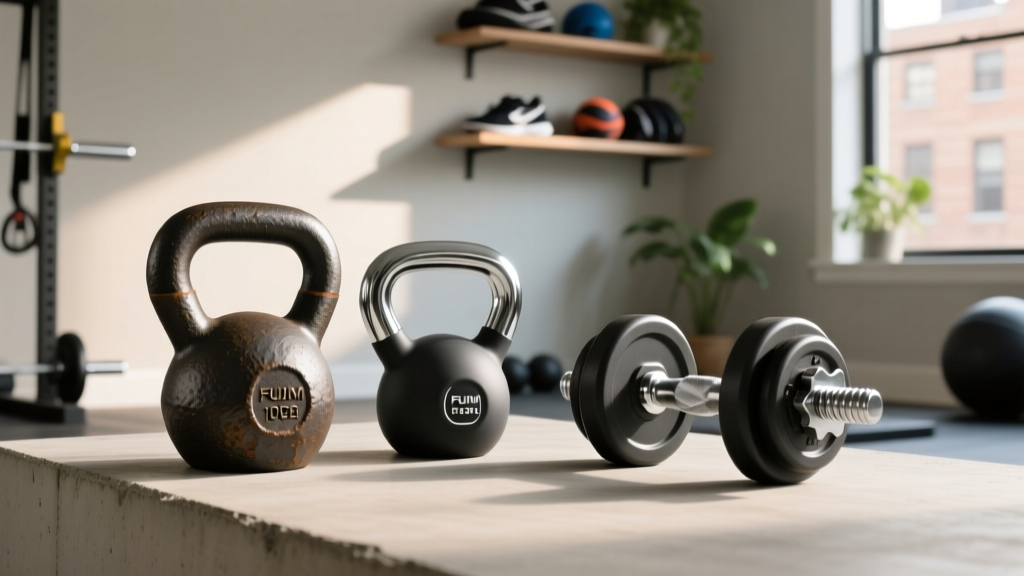
Cast Iron vs Competition Kettlebells & Side Delt Dumbbell Exercises
Compare cast iron vs competition kettlebell costs. Plus, discover why side delt dumbbell exercises offer superior budget value for shoulder isolation.

The 2026 Home Gym Economy: Rethinking Free Weight Allocations
Building a functional, hypertrophy-focused home gym in 2026 requires a ruthless approach to budget allocation. With steel prices and freight logistics stabilizing over the last year, the free weights market has seen a divergence in pricing strategies. Nowhere is this more apparent than in the kettlebell aisle, where the debate between traditional cast iron and premium steel competition kettlebells continues to divide buyers. However, a true value analysis extends beyond the initial purchase price of a single piece of iron; it requires examining the biomechanical return on investment (ROI) for specific muscle groups.
While kettlebells are unparalleled for ballistic movements and heavy grinds, they are notoriously inefficient—and unnecessarily expensive—for targeted shoulder isolation. In this comprehensive budget breakdown, we will dissect the true cost-per-pound of cast iron versus competition kettlebells, and reveal why pivoting your isolation budget toward side delt dumbbell exercises is the smartest financial and physiological move you can make this year.
The Metallurgical Divide: Cast Iron vs. Competition Steel
To understand the pricing gap, you must first understand the manufacturing processes. The physical properties of these tools dictate their price tags and their ideal use cases.
Cast Iron Kettlebells: The Sand-Cast Standard
Cast iron bells are produced by pouring molten iron into sand molds. Because the mold size must scale with the weight, an 8kg cast iron bell is physically much smaller than a 24kg bell. The handles are often thicker (ranging from 30mm to 35mm depending on the brand) and the surface is usually finished with a matte powder coat or e-coat. They are durable, cost-effective, and perfect for general strength and conditioning.
Competition Kettlebells: The CNC-Machined Elite
Competition bells are machined from solid steel. To meet international Girevoy sport standards, every competition bell—regardless of whether it weighs 8kg or 48kg—shares the exact same dimensions: 210mm height, 210mm width, and 280mm depth. The handles are strictly 35mm in diameter and 33mm in inner width. The hollow core is filled with steel shot or machined plugs to achieve the target weight. This uniformity ensures that your technique and rack position never change as you increase the load, but the CNC machining and tighter tolerances drive up the cost significantly.
Budget Breakdown: 2026 Price-Per-Pound Matrix
The most objective way to evaluate free weight value is the cost-per-pound metric. Below is a comparative analysis of three market leaders in 2026, highlighting the stark financial differences between cast iron and competition lines.
| Brand & Line | Type | 8kg (17.6 lbs) | 16kg (35.2 lbs) | 24kg (52.8 lbs) | Avg Cost / lb |
|---|---|---|---|---|---|
| Rogue Fitness (Standard) | Cast Iron | $35.00 | $65.00 | $95.00 | $1.75 |
| Bells of Steel (Standard) | Cast Iron | $29.99 | $54.99 | $79.99 | $1.55 |
| Kettlebell Kings (Competition) | Steel Comp | $69.00 | $115.00 | $165.00 | $3.25 |
| Onnit (Competition) | Steel Comp | $74.95 | $129.95 | $189.95 | $3.70 |
Data sourced from 2026 direct-to-consumer retail pricing, excluding seasonal freight promotions.
As the matrix illustrates, competition kettlebells command a 100% to 120% premium over standard cast iron. For heavy, two-handed movements like swings, goblet squats, and Turkish get-ups, investing in a 24kg or 32kg cast iron bell is the undisputed champion of value. However, the premium pricing of competition bells exposes a massive budget trap when lifters attempt to use them for light isolation work.
The Micro-Load Trap: Why Kettlebells Fail the Shoulder Budget Test
A common mistake among home gym owners is purchasing light (8kg or 12kg) competition kettlebells for shoulder isolation movements, under the assumption that uniform handle dimensions will improve their form. Biomechanically, this is a flawed approach that wastes capital.
According to the American Council on Exercise (ACE), optimal activation of the lateral deltoid requires a specific line of pull and the ability to manipulate wrist pronation and supination to target different heads of the muscle. Kettlebells, by design, force the hand into a fixed, relatively wide, and neutral grip. When attempting a strict lateral raise with a kettlebell, the thick horns of the bell dig into the forearm, and the center of mass sits awkwardly below the wrist. This causes grip and forearm flexor fatigue to occur long before the lateral deltoid reaches mechanical failure.
Furthermore, spending $69 on a single 8kg competition kettlebell just to perform light shoulder raises is a terrible allocation of funds. You are paying a premium for uniform dimensions that offer zero benefit to a single-joint isolation movement.
Maximizing Value: Side Delt Dumbbell Exercises for Hypertrophy
To achieve the coveted "capped" shoulder look without draining your wallet on micro-loaded kettlebells, you must pivot your isolation budget toward adjustable or fixed hex dumbbells. Dumbbells allow for independent limb movement, precise grip adjustments, and a center of mass that aligns perfectly with the hand.
Here is how to integrate highly effective side delt dumbbell exercises into your programming to maximize hypertrophy while maintaining a strict budget:
1. The Seated Strict Lateral Raise
By removing leg drive and momentum, the seated lateral raise forces the medial deltoid to handle the entirety of the load.
- Equipment Needed: A pair of 15lb to 25lb hex dumbbells (Total cost: ~$35 - $50).
- Execution: Sit on a bench with a back support. Hold the dumbbells with a slight bend in the elbows. Raise the weights out to the sides until your arms are parallel to the floor, leading with your elbows. Pause for one second at the apex to eliminate momentum, then lower slowly over 3 seconds.
- Value Proposition: A $40 investment in a pair of 20lb hex dumbbells provides a superior biomechanical stimulus for the side delts compared to a $69 competition kettlebell, saving you nearly 50% while yielding better muscle fiber recruitment.
2. Leaning Unilateral Dumbbell Lateral Raises
This exercise alters the resistance profile, increasing tension on the side delt at the bottom of the movement where it is typically weakest.
- Equipment Needed: A single moderate-weight dumbbell and a sturdy power rack or squat stand.
- Execution: Grip a squat rack post with your non-working hand and lean your body away at a 30-degree angle. Let the working arm hang straight down, then raise the dumbbell laterally until it reaches shoulder height. The leaning angle keeps constant tension on the lateral fibers throughout the entire range of motion.
- Value Proposition: You only need one or two pairs of moderately light dumbbells to execute this, completely eliminating the need to buy multiple sizes of expensive, light kettlebells to chase progressive overload.
Expert Insight: The StrongFirst methodology emphasizes that kettlebells are premier tools for teaching tension generation, ballistic power, and full-body integration. Attempting to use a tool designed for full-body tension to isolate a small, pennate muscle like the lateral deltoid is a misuse of the implement. Save your steel for the heavy grinds, and use dumbbells for the precise isolation work.
Decision Framework: Building Your 2026 Arsenal
To ensure every dollar spent in your home gym delivers maximum physiological return, follow this decision matrix when purchasing free weights:
When to Buy Cast Iron Kettlebells:
- For heavy, two-handed ballistic movements (Swings, Cleans, Snatches).
- For heavy grinds where absolute handle uniformity isn't a strict requirement (Goblet Squats, Heavy Farmer's Walks).
- When your budget dictates prioritizing total weight moved over aesthetic uniformity.
When to Buy Competition Kettlebells:
- You are actively training for Girevoy sport or kettlebell endurance competitions.
- You are performing complex, multi-rep flow routines (e.g., the Jerk or Long Cycle) where a uniform rack position prevents forearm bruising.
- You require exact 35mm handle dimensions to maintain callus management and grip consistency across all weight jumps.
When to Pivot to Dumbbells (The Isolation Rule):
- For any single-joint isolation movement targeting the deltoids, biceps, or triceps.
- When executing side delt dumbbell exercises to build shoulder width and cap development.
- When micro-loading is required; buying a 5lb or 10lb dumbbell is exponentially cheaper and more ergonomic than sourcing a 4kg or 6kg competition steel bell.
The Final Verdict on Free Weight Budgeting
The allure of a pristine, color-coded rack of competition kettlebells is undeniable for any home gym enthusiast. However, true value analysis requires divorcing emotion from biomechanics and economics. In 2026, the smartest lifters are adopting a hybrid approach: they anchor their heavy, explosive, and full-body conditioning work with cost-effective cast iron kettlebells, and they reserve their isolation budgets for the superior ergonomics of dumbbells.
By recognizing the limitations of kettlebell handles for strict lateral raises, and by embracing targeted side delt dumbbell exercises, you not only save hundreds of dollars on overpriced, light steel bells, but you also subject your shoulder musculature to a vastly superior hypertrophic stimulus. Build your gym with intent, respect the biomechanics of the target muscle, and let the data dictate your next purchase.
More gear to consider
All reviews
Barbell Collar Comparison & Dumbbell Silicone Coatings
Power Walking With Dumbbells to Lifting: Olympic vs Standard Plates

2026 Bumper vs Iron Plate Budget & One Arm Dumbbell Row GIF Guide
Dumbbell Hip Thrust Form: 2026 Adjustable Setup & Review
Barbell Knurling: Rogue vs Titan & Supinated Dumbbell Biceps Curl
