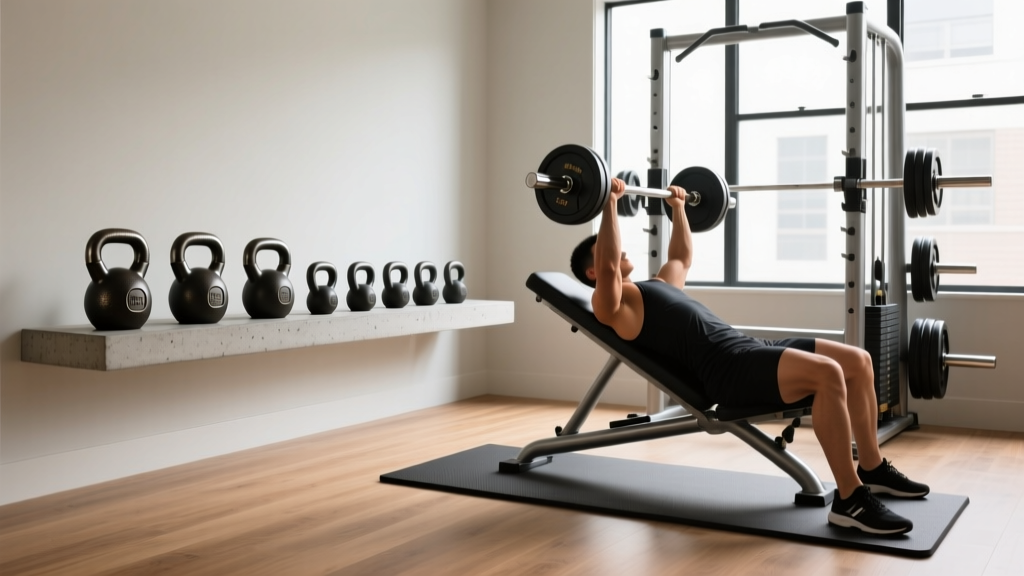
Cast Iron vs Competition Kettlebells & Incline Dumbbell Row Angle
Optimize home gym layouts by comparing cast iron vs competition kettlebell storage and calculating clearance for the ideal incline dumbbell row angle.

Designing a high-performance home gym in a constrained space requires more than just purchasing the right equipment; it demands a rigorous understanding of spatial geometry, storage footprints, and biomechanical clearance. As of 2026, the shift toward modular, high-density home training spaces has forced lifters to carefully evaluate how every piece of free weight interacts with the room's layout. Two seemingly unrelated factors dictate the success of a small-room gym layout: the dimensional uniformity of your kettlebells and the precise spatial envelope required for specific bench exercises.
This guide bridges the gap between equipment purchasing and spatial design. We will break down the physical differences between cast iron and competition kettlebells to determine which is superior for vertical space optimization. Then, we will map out how your equipment storage dictates bench placement, specifically focusing on the critical clearance required for the perfect incline dumbbell row angle.
Cast Iron vs. Competition Kettlebells: A Spatial Buying Guide
When optimizing a home gym layout, the physical dimensions of your weight storage matter just as much as the weight itself. Kettlebells generally fall into two categories: traditional cast iron and competition-grade steel. While both serve the same physiological purpose, their spatial footprints are drastically different.
The Dimensional Divide
Cast iron kettlebells are manufactured by pouring molten iron into molds. Because they are solid and density varies slightly by manufacturer, their physical size scales linearly with their weight. A 12kg cast iron bell might be compact enough to tuck under a desk, but a 32kg cast iron bell features a massive, wide base and a thick handle that demands significant shelf depth.
Competition kettlebells, on the other hand, are built to strict international standards. According to Rogue Fitness and international lifting federations, every competition kettlebell—from a featherweight 8kg to a massive 48kg—shares the exact same dimensions: 210mm wide, 280mm tall, with a 35mm handle diameter. To achieve this, lighter bells are hollow-cored, while heavier bells are packed with steel shot or solid steel inserts.
| Feature | Cast Iron Kettlebells | Competition Kettlebells |
|---|---|---|
| Dimensions | Variable (Scales with weight) | Uniform (210mm x 280mm) |
| Average Price per lb | $1.50 - $2.20 | $3.50 - $4.80 |
| Shelf Compatibility | Poor for heavy weights (overhang risk) | Perfect for uniform tiered racking |
| Handle Thickness | Variable (Often thicker on heavy bells) | Strict 35mm standard |
| Space Optimization | Requires deep, heavy-duty shelving | Allows for narrow, vertical footprint racks |
Space Optimization: Racking and Vertical Footprints
If your primary goal is space optimization, competition kettlebells are the undisputed winner for racking. Because their 210mm width never changes, you can invest in a narrow, vertical 3-tier or 4-tier kettlebell rack. A standard 22-inch wide vertical rack will safely house an entire set of competition bells from 8kg to 32kg without a single millimeter of overhang.
Cast iron bells present a severe spatial hazard on tiered racks. A 24kg or 32kg cast iron bell often exceeds 230mm in width. When placed on a standard 22-inch rack designed for uniform bells, the heavy cast iron bases will overhang the edges, creating a dangerous tipping hazard and forcing you to buy wider, deeper racks that eat into your valuable floor space.
Layout Warning: Never store heavy cast iron kettlebells on the top tier of a narrow vertical rack. The shifting center of gravity combined with the wider base of larger cast iron bells can cause the entire rack to tip forward during retrieval, especially on rubber-matted floors that compress under load.The Incline Dumbbell Row Angle: Calculating Spatial Clearance
A home gym is an interconnected ecosystem. The storage footprint of your kettlebell rack directly dictates where your adjustable bench can live. And where your bench lives determines whether you have the physical clearance to execute compound movements safely. This brings us to a critical, often overlooked spatial metric: the incline dumbbell row angle.
The incline dumbbell row is a staple for targeting the lats, rhomboids, and rear deltoids while minimizing lower back shear. According to biomechanical resources like ExRx, chest-supported rows allow for strict isolation. However, the spatial envelope your body occupies changes drastically depending on the exact incline dumbbell row angle you set on your adjustable bench.
Clearance Math: 30-Degree vs. 45-Degree Angles
Most commercial gym layouts leave 4 to 5 feet between benches. In a space-constrained home gym, you don't have that luxury. You must calculate the exact clearance based on your preferred incline dumbbell row angle.
- The 45-Degree Setup: At a 45-degree incline dumbbell row angle, your torso is elevated significantly. Your head and shoulders are pushed forward toward the front of the bench, but your elbows must pull backward and upward to achieve full lat contraction. If your bench is backed against a wall or placed immediately in front of your kettlebell rack, your elbows will strike the obstacle at the top of the movement. You need a minimum of 28 inches of rear clearance from the back of the bench pad to the nearest wall or rack.
- The 30-Degree Setup: Lowering the bench to a 30-degree incline dumbbell row angle pushes your torso further back, closer to the rear of the bench. This reduces the vertical height of your elbow travel but extends your horizontal footprint. You will need 34 inches of rear clearance to accommodate the backward sweep of the elbows, but you gain overhead vertical clearance if your gym is in a room with low ceilings (like a basement).
- Lateral Clearance: Regardless of the incline dumbbell row angle, your lateral clearance remains constant. A standard bench is 12 inches wide. Add a 24-inch arm extension and a 15-inch dumbbell on each side. You must maintain a 51-inch lateral clearance zone on both the left and right sides of the bench to prevent the dumbbells from striking your kettlebell rack during the eccentric lowering phase.
Real-World Layout Scenarios for Small Rooms
Understanding the interplay between kettlebell dimensions and bench clearance allows you to design highly efficient layouts. Here are two optimized blueprints for common home gym spaces.
Scenario A: The 10x10 Spare Bedroom (Low Ceiling, Tight Footprint)
In a small bedroom, every inch counts. Opt for a full set of competition kettlebells stored on a narrow, 3-tier vertical rack (22" wide x 24" deep) placed in the corner. Position your adjustable bench parallel to the rack, leaving exactly 52 inches of lateral space between the bench and the wall. Because bedroom ceilings are typically 8 feet (96 inches) high, avoid the 45-degree incline dumbbell row angle; the upward elbow sweep with heavy dumbbells risks ceiling strikes. Set the bench to a 30-degree angle to keep the movement horizontal and safely within the room's vertical envelope.
Scenario B: The Garage Corner (High Ceiling, Concrete Floor)
Garages offer high ceilings and durable floors, allowing for heavier, bulkier equipment. You can save money here by purchasing cast iron kettlebells ($1.70/lb average). Because cast iron bells have wide, stable bases, you can store them directly on the floor in a tight, staggered cluster against the wall, eliminating the need for a rack entirely and freeing up vertical space. With the floor clear, you can place your bench in the center of the zone and utilize a steep 45-degree incline dumbbell row angle, taking full advantage of the 10-foot garage ceiling for unrestricted upward elbow travel.
Final Thoughts on Spatial Training
Optimizing a home gym is an exercise in applied geometry. By choosing competition kettlebells for uniform, space-saving vertical storage, or leveraging the wide bases of cast iron bells for floor-level stacking, you reclaim valuable square footage. More importantly, by calculating the exact spatial clearance required for your preferred incline dumbbell row angle, you ensure that your layout supports uncompromised biomechanics. As the experts at StrongFirst often emphasize, true strength requires a mastery of your environment just as much as a mastery of your body.
More gear to consider
All reviews
Maximize Your Biceps Workout by Dumbbells: 2026 Adjustable Guide
Bowflex SelectTech 552 Dumbbells and Stand vs 2026 Rivals

Best Adjustable Dumbbells for Arm and Chest Workouts: 2026 Guide

EZ Bar vs Straight Bar Budget Guide: One Arm Dumbbell Row No Bench

Barbell Buying Guide: Knurling & Half Kneeling Dumbbell Overhead Press
