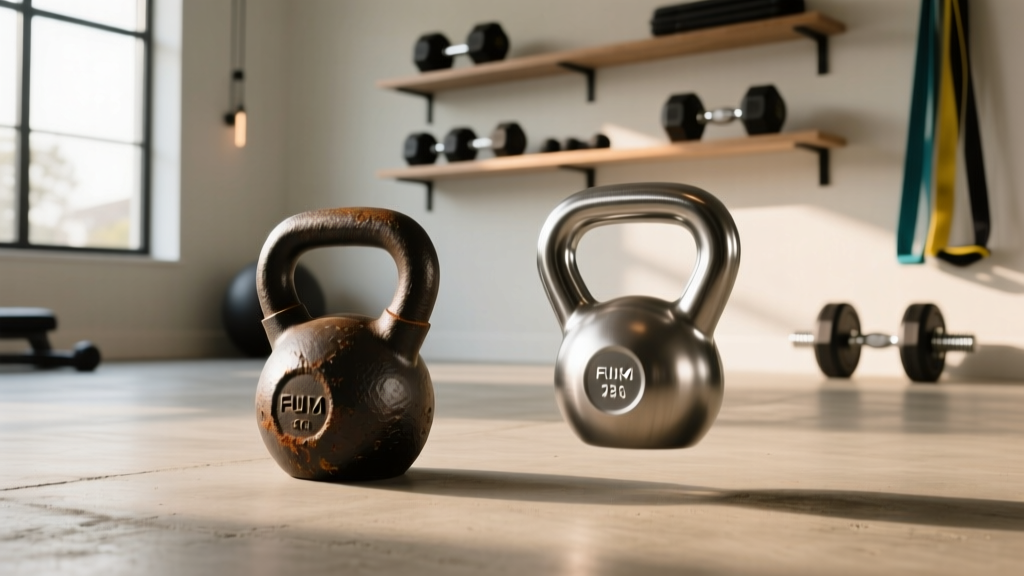
Cast Iron vs Competition Kettlebells: No Dumbbell Bicep Workout
Optimize your home gym layout with our cast iron vs competition kettlebell guide. Includes space-saving storage tips and a no dumbbell bicep workout.

In the 2026 home fitness landscape, square footage is the ultimate premium. As more lifters transition to hyper-efficient micro-gyms, garage corners, and accessory dwelling unit (ADU) workout spaces, the traditional 5-tier dumbbell rack has become a spatial liability. A standard pair of adjustable dumbbells or a light dumbbell set can consume up to 8 square feet of floor space, disrupting the flow of a compact room. Enter the kettlebell: a dense, multi-planar tool that can replace an entire rack of dumbbells while occupying a fraction of the footprint.
However, designing a space-optimized layout requires a critical purchasing decision: cast iron vs. competition kettlebells. This choice dictates not only your storage dimensions but also your biomechanical leverage for isolation movements. Below, we break down the spatial mathematics of both styles, provide a blueprint for compact racking, and deliver a highly effective no dumbbell bicep workout tailored specifically to the unique ergonomics of kettlebell handles.
Expert Insight: "When programming for hypertrophy in a constrained space, the handle geometry of your kettlebell dictates muscle activation. A 33mm competition handle forces greater forearm recruitment during curls compared to a 28mm cast iron handle, fundamentally altering the stimulus on the biceps brachii."
The Spatial Footprint: Cast Iron vs. Competition Kettlebells
To optimize your layout, you must first understand the dimensional variance between the two primary kettlebell archetypes. Competition kettlebells (often referred to as 'pro grade' or 'steel') are manufactured to a single, universal dimension regardless of weight. Cast iron bells, conversely, scale in physical size as the weight increases.
| Dimensional Metric | Competition Kettlebell (e.g., Rogue, Onnit) | Cast Iron Kettlebell (e.g., Rep Fitness, CAP) | Spatial & Layout Impact |
|---|---|---|---|
| Height | 280 mm (11.02 in) | Varies (approx. 210mm to 300mm) | Competition bells allow for uniform shelf heights; cast iron requires adjustable or staggered racking. |
| Width (Base) | 210 mm (8.26 in) | Varies (approx. 150mm to 240mm) | Heavy cast iron bells (32kg+) require wider floor clearance and deeper shelves to prevent tipping. |
| Handle Diameter | 33 mm (Uniform) | 28mm - 32mm (Scales with weight) | Thinner cast iron handles favor strict bicep isolation; thicker comp handles increase grip fatigue. |
| Horn Width (Inner) | Narrower, uniform spacing | Wider on heavier bells | Wider horns on heavy cast iron bells allow for two-handed swings but complicate tight-storage stacking. |
Designing the Compact Kettlebell Storage Layout
When wall-mounting or floor-storing your arsenal, the uniformity of competition bells allows for highly predictable, high-density storage. According to the Kettlebell Kings Buying Guide, understanding base dimensions is critical to preventing shelf overload and handle interlocking.
Layout Blueprint: The 4x2 Foot Wall Zone
- For Competition Bells: A single 36-inch wide, 12-inch deep heavy-duty steel shelf mounted to 16-inch on-center wall studs can safely hold up to six 24kg competition bells in a single row. The uniform 210mm base ensures zero spatial guessing.
- For Cast Iron Bells: You must design a staggered or triangular floor layout. A 40kg cast iron bell has a base width exceeding 9 inches. Storing a set of 16kg, 24kg, and 32kg cast iron bells on a wall rack requires a minimum depth of 16 inches and a width of 42 inches to prevent the handles from overlapping and scratching the powder coat.
Executing the "No Dumbbell Bicep Workout" in a 4x4 Foot Zone
Many lifters abandon home arm days because they lack the space for a full dumbbell rack. By utilizing a single pair of kettlebells (or adjustable kettlebells), you can execute a comprehensive no dumbbell bicep workout that maximizes tension and minimizes spatial requirements. You only need a 4x4 foot clearance zone to perform these movements safely.
1. The Kettlebell Horn Curl (Strict Isolation)
By gripping the kettlebell by the "horns" (the sides of the handle) rather than the top arch, you alter the center of mass. This forces the biceps brachii to work through a strict, shortened range of motion without the momentum often abused in dumbbell curls.
- Select a cast iron kettlebell (the wider horns on 16kg+ bells provide a more ergonomic grip for this movement).
- Hold the bell upside down by the horns at chest level, elbows tucked tightly against your ribs.
- Lower the bell toward your waist, maintaining rigid elbow placement.
- Curl upward, squeezing the biceps at the peak contraction for a full 1.5 seconds.
- Prescription: 4 sets of 10-12 reps. Rest 60 seconds.
2. Bottoms-Up Towel Curl (Brachioradialis & Grip Focus)
Loop a heavy-duty gym towel through the kettlebell handle. Gripping the towel eliminates the rigid steel interface, demanding intense stabilization from the forearm and brachioradialis, which pushes the biceps up for a thicker arm appearance.
- Setup: Loop a towel through a competition kettlebell handle (the 33mm handle accommodates thick towels better than thin cast iron handles).
- Execution: Grip the ends of the towel, keep the elbow pinned to your side, and curl upward. The instability of the towel forces constant micro-adjustments, spiking time-under-tension.
- Prescription: 3 sets to technical failure.
3. The Bottoms-Up Kettlebell Curl (Neural Drive)
Holding the kettlebell upside down by the handle (bell facing the ceiling) requires massive grip strength. As noted by strength experts at Rogue Fitness, the uniform handle of a competition bell makes bottoms-up holds slightly more predictable, but the thicker 33mm grip will tax your forearms before your biceps fail. If your goal is pure bicep hypertrophy without forearm bottlenecking, use a lighter cast iron bell with a 28mm-30mm handle for this specific movement.
Purchasing Framework: Which Bell Fits Your Layout?
Choosing between cast iron and competition isn't just about aesthetics; it's a spatial and financial calculation.
| Decision Factor | Choose Competition Kettlebells If... | Choose Cast Iron Kettlebells If... |
|---|---|---|
| Spatial Constraints | You are wall-mounting racks and need uniform, predictable dimensions for tight shelving. | You are storing them on the floor in a corner and don't mind a staggered, organic footprint. |
| Budget | You have a higher budget ($80 - $130+ per bell) and view them as a lifetime, uniform investment. | You are budget-conscious ($2.00 - $3.50 per lb) and only need 2-3 specific weights for isolation work. |
| Bicep Isolation | You want thicker handles to inadvertently train grip strength during arm isolation workouts. | You want thinner handles (on lighter bells) to ensure the biceps fail before the forearms do. |
Real-World Edge Cases and Failure Modes
When designing a high-density kettlebell corner, lifters frequently encounter specific failure modes that compromise both their equipment and their workouts:
Warning: Powder Coat Shearing on Metal RacksIf you purchase powder-coated cast iron kettlebells and store them on a bare steel wall rack, the repetitive sliding will shear the coating off the base within months, leading to rust and floor damage. Solution: Line your storage shelves with 5mm horse stall mats or high-density EVA foam. Competition bells, which often feature bare steel or e-coat finishes, are slightly more forgiving but still require UHMW plastic liners on shelves to prevent screeching and metal-on-metal degradation.
Furthermore, when planning vertical wall racks, ensure you account for the "handle clearance" metric. A 32kg cast iron bell stands nearly 12 inches tall, and the handle arches another 5 inches above the base. If your shelf spacing is only 14 inches apart, you will not be able to lift the bell off the rack without hitting the shelf above. Always maintain a minimum 18-inch vertical clearance between tiered shelving units.
Final Thoughts on Space-Optimized Arm Training
Ditching the dumbbell rack does not mean sacrificing arm development. By understanding the precise dimensional differences between cast iron and competition kettlebells, you can engineer a storage layout that respects your spatial limitations while providing the exact handle ergonomics required for a brutal no dumbbell bicep workout. Whether you opt for the uniform predictability of steel competition bells or the scalable, budget-friendly nature of cast iron, the key to a successful micro-gym is intentional design. Measure your walls, check your handle diameters, and maximize every square inch of your training zone.
More gear to consider
All reviews
Beyond Exercises with Dumbbells: Bumper vs Iron Plate Maintenance
Space Layout for a Dumbbell Circuit Routine: Rubber Hex vs Urethane

Olympic vs Standard Plates: Building the Biggest Dumbbell Setup
2026 Adjustable Dumbbell Review: Standing Single Arm Dumbbell Row

EZ Bar vs Straight Bar & Chest Workouts With One Dumbbell Layouts
