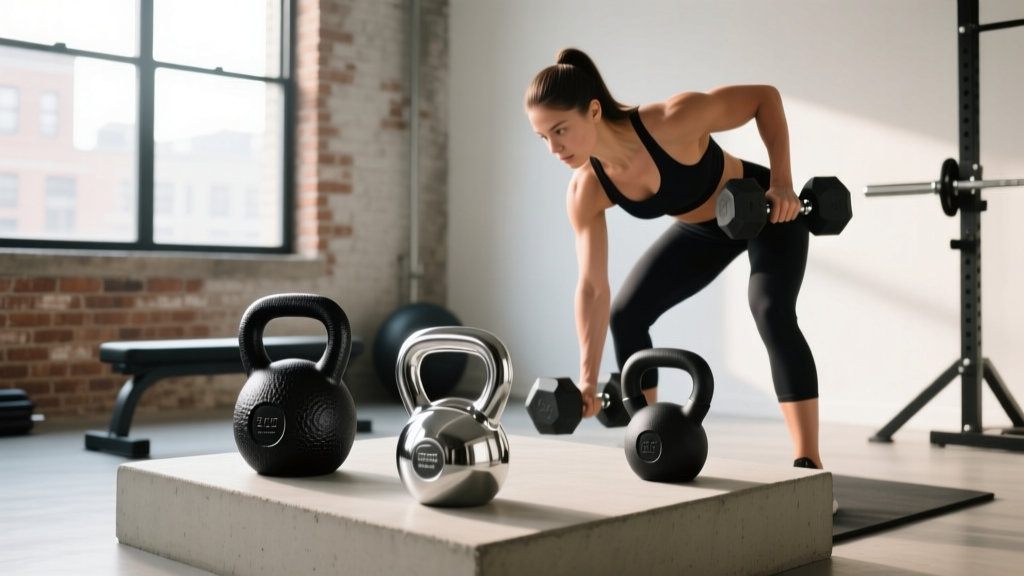
Kettlebell Guide: Cast Iron vs Competition & One-Arm Dumbbell Rows
Compare cast iron vs competition kettlebells for compact home gyms. Learn space-saving layouts and alternatives to one-arm dumbbell rows.

The Spatial Dilemma: Benches vs. Free-Standing Pulls
As home gym footprints continue to shrink in 2026, space optimization has transitioned from a luxury to a strict necessity. When designing a compact training layout, unilateral back work often presents a significant spatial challenge. The traditional setup for one-arm dumbbell rows requires a standard 45-inch flat bench, plus a minimum of 24 inches of lateral clearance on the pulling side to prevent knuckle-strikes against the floor or adjacent walls. This creates a functional footprint of roughly 28 square feet—a massive premium in a 10x10 apartment gym or a crowded two-car garage.
To reclaim this floorspace, many lifters are pivoting to free-standing kettlebell variations. However, choosing the right tool for a compact layout requires a deep understanding of equipment geometry. Specifically, the debate between cast iron and competition kettlebells dictates not only your grip mechanics but also your storage footprint, floor protection, and the viability of your pulling stations.
Cast Iron vs. Competition Kettlebells: A Space & Grip Analysis
Before redesigning your pulling station, you must understand the physical anatomy of the two primary kettlebell categories. The dimensional differences drastically affect how they stack, store, and feel during heavy unilateral rows.
Competition Kettlebells: The Uniform Standard
Forged from hollow steel, competition kettlebells adhere to strict international dimensions regardless of weight. According to standard specifications outlined by the International Union of Kettlebell Lifting, a competition bell is always 210mm tall, 280mm wide, and 85mm deep. The handle diameter is locked at exactly 33mm.
- Spatial Advantage: Because a 16kg and a 32kg bell share the exact same exterior dimensions, they stack perfectly on uniform shelving units, maximizing vertical storage efficiency.
- Grip Mechanics: The 33mm handle is relatively thin, which is excellent for high-repetition ballistic movements but can cause grip fatigue during heavy, slow-grind pulling movements if you have larger hands.
- Base Stability: The 210mm x 85mm base is wide and flat, making it incredibly stable when placed on thin rubber mats in tight corners.
Cast Iron Kettlebells: The Variable Classic
Cast iron bells are solid, and their physical size scales linearly with their weight. A 16kg cast iron bell is significantly smaller than a 32kg bell. Brands like Rogue Fitness and Rep Fitness utilize powdercoat finishes that preserve the raw texture of the iron.
- Spatial Challenge: Because dimensions vary by weight, storing a full set of cast iron bells requires adjustable shelving or a staggered floor rack, which wastes valuable vertical airspace.
- Grip Mechanics: Cast iron handles are typically thicker (ranging from 35mm to 40mm on heavier bells). This thicker grip mimics the handle of a standard hex dumbbell, making the transition to heavy rows more comfortable for the average lifter.
- Base Stability: Smaller cast iron bells (8kg-12kg) have notoriously tiny bases. If you are performing a renegade row or using the bell as a brace in a tight layout, the bell is prone to tipping on uneven garage floors.
Dimensional & Spatial Footprint Comparison
The table below illustrates how weight scaling impacts the physical footprint of your equipment, directly influencing your gym layout and storage strategy.
| Feature | Competition (16kg / 24kg) | Cast Iron Powdercoat (16kg / 24kg) | Spatial & Layout Impact |
|---|---|---|---|
| Height | 210mm (Both) | ~195mm / ~240mm | Cast iron requires adjustable rack heights; competition fits uniform shelves. |
| Width | 280mm (Both) | ~170mm / ~215mm | Wider competition base prevents tipping during floor-braced rows. |
| Handle Diameter | 33mm (Both) | ~35mm / ~38mm | Thicker cast iron handles better replicate standard dumbbell grip mechanics. |
| Approx. 2026 Cost | $95 / $125 | $55 / $75 | Cast iron is more budget-friendly for outfitting multi-bell corner racks. |
Biomechanics in Tight Quarters: Kettlebell Rows vs. One-Arm Dumbbell Rows
When space prohibits the use of a flat bench, lifters must adapt their pulling biomechanics. The standard dumbbell row relies on a three-point stance (hand and knee on a bench) to stabilize the lumbar spine while the latissimus dorsi and rhomboids execute the pull. Removing the bench changes the center of gravity and the required floor clearance.
The 'Tripod Hinge' Layout for Compact Gyms
To replicate the isolation of one-arm dumbbell rows without a bench, you must utilize the Tripod Hinge stance. This reduces your required clearance zone from 28 square feet down to a mere 9 square feet (a 3x3 foot zone).
- The Stance: Stand in a split stance, roughly 24 inches from a wall. Hinge at the hips until your torso is nearly parallel to the floor.
- The Brace: Place your non-working hand firmly on your front knee (or against a wall-mounted storage rack if positioned at hip height).
- The Pull: Because you lack the lateral stability of a bench, the kettlebell's center of mass becomes critical. A competition bell's mass sits directly beneath the handle, promoting a vertical pulling path. Cast iron bells, especially wider enamel-coated ones, can pull slightly forward, requiring more rear-deltoid stabilization.
"In a 10x10 training space, the bench is often the first piece of equipment to go. Mastering the hinged kettlebell row allows you to maintain heavy unilateral back volume without sacrificing the center of the room for Olympic lifting or cardio." — 2026 Home Gym Layout Symposium
2026 Storage Solutions for Mixed Iron
Optimizing your layout isn't just about the exercise footprint; it's about how the equipment lives when not in use. Storing kettlebells requires heavy-duty racking capable of supporting concentrated point-loads.
- Wall-Mounted Shelves: For competition bells, standard 24-inch deep heavy-duty garage shelving works perfectly. Because the bells are uniform, you can align them flush against the wall, protruding only 210mm into the room.
- Vertical Floor Racks: If you cannot drill into concrete or drywall, a 3-tier vertical kettlebell stand (such as the Rogue Universal Storage system) is ideal. However, place this rack in a 'dead zone' corner. Cast iron bells should be stored on the bottom tier due to their smaller base and higher center of gravity on upper tiers.
- Matting Requirements: Competition bells feature a steel base that will crack standard 8mm EVA foam tiles if dropped. You must designate a 'drop zone' lined with 3/4-inch vulcanized rubber horse stall mats under your rowing station. Cast iron bells, while still heavy, have a slightly more forgiving impact profile on standard gym flooring.
Frequently Asked Questions
Can I use a kettlebell for renegade rows in a small space?
Yes, but only with cast iron kettlebells weighing 20kg or more, or any competition bell. Renegade rows require you to bear weight on the handles. The 33mm handle of a competition bell is ideal for this, and the wide 210mm base prevents the bell from rolling while you are in a plank position. Avoid small cast iron bells, as their narrow bases will tip, risking wrist injuries.
Which is better for heavy one-arm rows: cast iron or competition?
For pure heavy pulling strength (e.g., sets of 5-8 reps), cast iron is generally preferred. The thicker handle (35mm+) challenges the grip in a way that translates better to heavy barbell and dumbbell work. However, if your space requires you to perform high-rep endurance rows (15+ reps) in a hinged stance, the 33mm competition handle will save your forearms from premature failure.
How much wall clearance do I need for a kettlebell rowing station?
You need a minimum of 36 inches from the wall to the center of your stance. This allows for the natural backward drift that occurs during a heavy hip hinge, plus the physical length of the kettlebell hanging from your hand at the bottom of the movement without striking the drywall.
More gear to consider
All reviews
Barbell Collars, Clamps & Locks for Standing Dumbbell Exercises
Olympic vs Standard Plates: Setup & Dumbbell Wall Rack Guide

Rogue vs Titan Barbells: Upgrading Your Chest Dumbbell Home Workout
Bumper vs Iron Plates: The Golden Dumbbell Tarkov of Gym Layouts
Power Rack vs Squat Rack vs Stand: Dumbbell Ulnar Deviation
