Kettlebell Guide: Cast vs Competition & Barbell or Dumbbell Rows
Master your home gym layout with our cast iron vs competition kettlebell guide, comparing spatial footprints, storage, and barbell or dumbbell rows.

The Spatial Dilemma: Cast Iron vs. Competition Kettlebells
Designing a high-performance home gym in a constrained environment requires treating your floor plan like a geometric puzzle. When selecting your free weight arsenal, the kettlebell buying guide debate almost always centers on a critical fork in the road: cast iron vs. competition kettlebells. While most lifters focus solely on grip feel or aesthetics, from a space optimization and layout design perspective, the physical dimensions and uniformity of the bell dictate your entire storage and movement strategy.
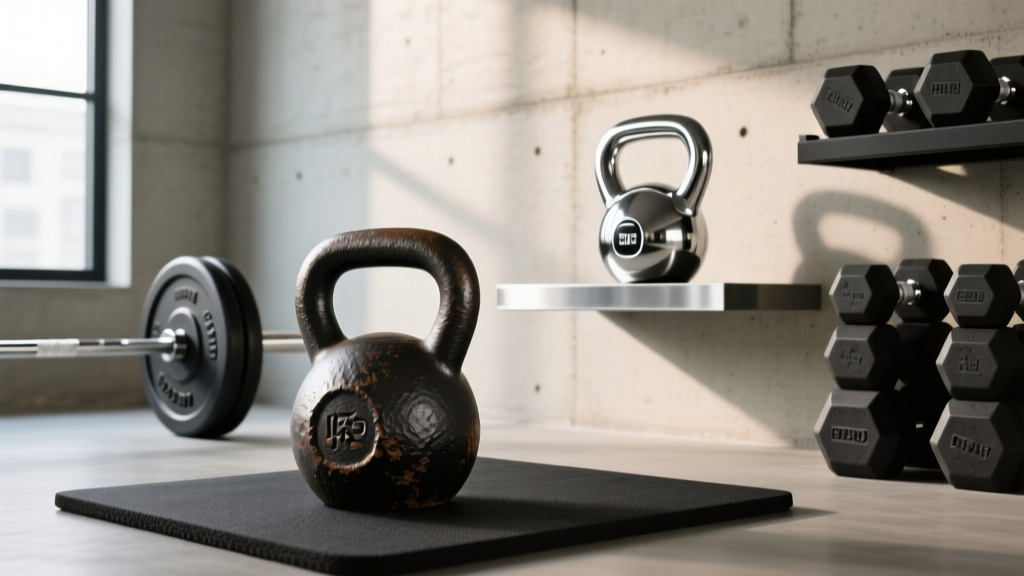
Cast iron kettlebells, such as the Rogue Fitness E-Coat line, are poured into molds that scale proportionally with weight. A 12kg bell is noticeably smaller than a 32kg bell. Competition kettlebells, like those from Kettlebell Kings, maintain identical external dimensions regardless of the internal steel or lead shot used to achieve the target mass. This uniformity is a massive advantage for spatial planning, allowing for predictable racking and streamlined movement zones.
Dimensional & Pricing Matrix (16kg / 35lb Baseline)
| Specification | Cast Iron (e.g., Rogue E-Coat) | Competition (e.g., KB Kings) | Spatial Impact |
|---|---|---|---|
| Height | 330 mm | 280 mm (Standardized) | Competition bells sit lower, allowing tighter vertical clearance on multi-tier racks. |
| Base Diameter | 212 mm | 210 mm (Standardized) | Negligible difference for a single bell, but uniform bases allow flush alignment on shelves. |
| Handle Thickness | ~35 mm (Scales with weight) | 33 mm (Uniform across all weights) | Uniform handles allow identical grip spacing when storing bells side-by-side. |
| Avg. Price (2026) | $60 - $75 | $95 - $115 | Cast iron is more budget-friendly for filling out a full weight spectrum. |
The Pulling Paradigm: Footprint of Horizontal Rows
When mapping out a high-density pulling zone, you must evaluate the spatial footprint of your primary horizontal pulling movements. A dedicated kettlebell corner requires significantly less clearance than a traditional setup designed for barbell or dumbbell rows, fundamentally altering how you allocate your square footage.
Spatial Clearance Requirements for Pulling Movements
- Barbell Bent-Over Rows: Requires a 7-foot (84-inch) barbell plus plate sleeves. Factoring in the lifter's posterior hinge angle and backward step, you need a minimum clearance zone of 10 feet long by 4 feet wide.
- Dumbbell Rows (Bench Supported): Requires a standard 48-inch flat bench plus lateral movement space. Minimum clearance zone: 6 feet long by 3 feet wide.
- Single-Arm Kettlebell Rows: Requires only the lifter's stance width and a forward hinge. Minimum clearance zone: 3 feet by 3 feet.
If you are optimizing a sub-100-square-foot garage gym or apartment workout space, prioritizing heavy kettlebells for single-arm rows allows you to maintain high-intensity back training without dedicating nearly 40 square feet of permanent 'dead space' to a barbell rowing lane. According to the ExRx Biomechanics Database, the latissimus dorsi and rhomboid activation in a heavy single-arm kettlebell row closely mirrors that of dumbbell variations, but with a vastly reduced equipment footprint.
Layout Design: Storing and Staging Your Iron
The choice between cast iron and competition bells directly influences the type of storage infrastructure you must purchase. Space optimization isn't just about the floor; it's about vertical air rights and aisle flow.
Cast Iron Storage Dynamics
Because cast iron bells grow progressively wider and taller, standard 3-tier racks often fail to accommodate a full set. A 32kg cast iron bell might be too wide for a shelf designed to hold a 16kg bell.
- Recommended Solution: Utilize a single-tier floor rack or a heavy-duty, adjustable-depth shelving unit (like the Rep Fitness 3-Tier KB Rack with extended depth).
- Layout Tip: Store cast iron bells in a 'stair-step' configuration on the floor against a reinforced wall to save the cost and footprint of a dedicated rack.
Competition Kettlebell Storage Dynamics
Competition bells are a spatial planner's dream. Because a 12kg bell shares the exact 280mm height and 210mm base of a 32kg bell, they fit flawlessly onto uniform, high-density multi-tier racks.
- Recommended Solution: Wall-mounted 3-tier racks. Because the dimensions are static, you can mount the rack precisely 12 inches from the floor and 10 inches from the wall, minimizing the protrusion into your workout aisle.
- Layout Tip: Group competition bells by color-coded bands (the international standard for competition bells) rather than just weight, allowing for rapid visual identification during high-heart-rate circuits without stepping into the rack's footprint.
Material, Finish, and Environmental Constraints
Space optimization also encompasses the 'environmental footprint'—how your equipment interacts with your floors, walls, and acoustic space.
'In a multi-use space like a garage or spare bedroom, the acoustic and physical impact of dropped weights dictates where you can safely place your equipment zone. Competition kettlebells, often featuring a hollow core and thinner steel shells on lighter weights, can produce a sharper, more resonant clang than solid cast iron when dropped on rubber matting.'
— Home Gym Engineering & Acoustics Report, 2025
Cast Iron (E-Coat & Powder Coat): Solid iron absorbs high-frequency sound better than hollow competition bells. If your layout places your kettlebell swing and snatch zone directly above a finished basement or adjacent to shared walls, e-coated cast iron paired with 3/4-inch horse stall mats is the superior choice for noise dampening. Furthermore, e-coat finishes resist rust in humid, uninsulated garages without adding the thick, chip-prone layers of traditional powder coat.
Competition Bells (Bare Steel & Painted): The handles on competition bells are typically bare, polished steel to prevent chalk buildup and slipping during high-rep kettlebell sport snatches. However, bare steel requires regular maintenance (wiping down and light oiling). If your gym layout lacks a dedicated 'maintenance drawer' or humidifier control, the handle may develop surface rust, which can stain adjacent flooring or walls if stored improperly.
Step-by-Step Framework: Designing Your Pulling Zone
To finalize your layout and equipment purchase, follow this spatial decision framework:
- Map the Maximum Clearance: Measure your longest available unbroken floor space. If you have less than 8 feet of continuous length, cross traditional barbell or dumbbell rows off your primary layout plan and pivot to heavy single-arm kettlebell rows and resistance band cable rows.
- Select the Bell Type by Rack Availability: If your floor plan only allows for a wall-mounted rack (max 14-inch depth), you must buy competition kettlebells to ensure the larger weights fit the shelves. If you have a 4x6 foot corner for floor storage, cast iron is viable and more cost-effective.
- Calculate the Budget-to-Space Ratio: A full set of cast iron bells (8kg to 32kg) will cost roughly $450 and require a 6-foot floor arc. A matched set of competition bells will cost upwards of $900 but can be condensed into a 3-foot wide, 3-tier vertical rack, freeing up 12 square feet of prime floor space for a plyo box or rowing ergometer.
Expert Verdict
When optimizing a home gym for both performance and spatial efficiency, the cast iron vs. competition kettlebell decision is ultimately a question of geometry versus budget. For lifters prioritizing a minimalist footprint, standardized vertical storage, and compact alternatives to barbell or dumbbell rows, competition kettlebells are the undisputed champions of layout design. However, for those with ample floor space seeking raw, heavy pulling power without the premium price tag, a well-organized cast iron collection remains a timeless, space-conscious staple.
More gear to consider
All reviews
Neoprene Dumbbells for One Arm Dumbbell Extension: Top 2026 Picks

Home Gym Setup for Squats with Dumbbell Press & Neoprene Weights

Gym Setup: Olympic vs Standard Plates & Dumbbell Shoulder Exercises

Beginner Back Muscle Workouts With Dumbbells: 2026 Gear Review

Calf Raises with Dumbbells: Adjustable Set Reviews & Setup Guide
