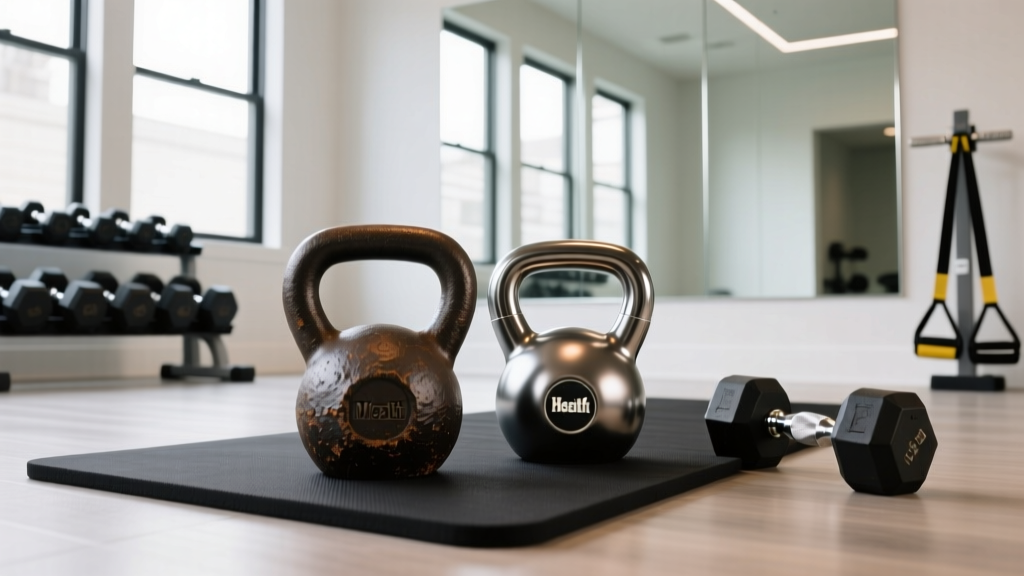
Kettlebell Budget: Cast Iron vs Competition & Dumbbell Leg Raise
Compare cast iron vs competition kettlebells with our 2026 budget breakdown. Discover cost-per-kg value and safer alternatives to the dumbbell leg raise.

The 2026 Kettlebell Market: Navigating the Cast Iron vs. Competition Divide
Building a functional home gym or upgrading a commercial facility in 2026 requires a ruthless approach to budget allocation. When it comes to free weights, the kettlebell market presents a unique financial dilemma: do you invest in traditional cast iron bells, or do you pay the premium for uniform competition kettlebells? The price gap between these two categories can exceed 150%, but the value proposition depends entirely on your training methodology, grip mechanics, and exercise selection.
In this comprehensive budget breakdown, we will dissect the manufacturing differences, cost-per-kilogram metrics, and ergonomic realities of both styles. Furthermore, we will explore how equipment geometry dictates exercise safety—specifically why upgrading your gear can eliminate the need for high-risk movements like the traditional dumbbell leg raise in favor of biomechanically superior kettlebell alternatives.
Cast Iron Kettlebells: The Budget-Conscious Workhorse
Cast iron kettlebells are manufactured by pouring molten iron into a single mold. This single-cast process results in a durable, solid piece of equipment with no welded seams. However, because the mold scales with the weight, a 12kg cast iron bell will have a significantly smaller physical footprint and handle diameter than a 32kg bell.
2026 Pricing & Value Analysis
As of early 2026, cast iron remains the most cost-effective entry point for kettlebell training. Brands like Rogue Fitness and Rep Fitness dominate this space, offering prices that generally range from $2.00 to $3.50 per pound, depending on the finish and shipping logistics.
- Standard Cast Iron (Rep Fitness): ~$35 for a 16kg (35lb) bell. Features an e-coat finish that resists rust but feels slightly slick in the hand.
- Powder-Coated Cast Iron (Rogue): ~$45 to $55 for a 16kg bell. The powder coat provides an aggressive, chalk-friendly texture ideal for high-rep grinds like Turkish get-ups.
Competition Kettlebells: The Premium Investment
Competition kettlebells are engineered for Girevoy Sport and high-volume ballistic training. Regardless of whether the bell weighs 8kg or 48kg, the dimensions remain strictly uniform: 280mm in height, 210mm in width, and a 33mm handle diameter. To achieve this, manufacturers use a steel shell that is welded together and filled with a dense aggregate (like concrete mixed with steel shot) or solid steel cores to reach the target weight.
2026 Pricing & Value Analysis
You are paying for precision engineering and uniformity. According to the Kettlebell Kings Competition Series and similar premium lines, expect to pay between $5.50 and $8.00 per pound.
- Entry-Level Competition (e.g., Bells of Steel): ~$75 for a 16kg bell.
- Premium Competition (e.g., Kettlebell Kings, Rogue): ~$95 to $115 for a 16kg bell. These feature reinforced steel handles that will never flex or snap under extreme centrifugal force.
Cost-Per-Use Matrix: Where Does the Value Lie?
To truly understand the budget breakdown, we must look at the cost-per-kilogram and the intended lifespan of the equipment. Below is a comparative matrix based on average 2026 market pricing for a standard 24kg (53lb) kettlebell.
| Specification | Standard Cast Iron (E-Coat) | Powder-Coated Cast Iron | Competition (Steel Shell) |
|---|---|---|---|
| Avg. Price (24kg) | $55.00 | $72.00 | $135.00 |
| Handle Diameter | ~34mm (Varies) | ~34mm (Varies) | 33mm (Strict) |
| Base Footprint | Varies by weight | Varies by weight | 210mm x 210mm |
| Best For | Grinds, Goblet Squats | Hardstyle, Get-Ups | Snatches, Jerks, Sport |
| Estimated Lifespan | Generational | Generational | Generational |
Ergonomics in Action: Ditching the Dumbbell Leg Raise
Budgeting for equipment isn't just about the price tag; it's about the biomechanical value and safety the tool provides. A prime example of equipment geometry dictating exercise safety is the evolution of weighted core training—specifically, the transition away from the dumbbell leg raise.
The traditional dumbbell leg raise involves lying supine on a bench or floor and clamping a dumbbell between the medial arches of the feet to add resistance to hip flexion and lower abdominal engagement. This movement is notorious in sports science for its high failure risk. As the hip flexors fatigue, the adductor squeeze required to maintain friction on the smooth, often rubber-coated or knurled dumbbell heads inevitably fails. The result? A heavy piece of iron dropping onto the groin, shins, or floor.
The Kettlebell Leg Raise Alternative
As highlighted in comparative analyses by BarBend regarding kettlebell vs. dumbbell training, the kettlebell's unique center of mass and handle geometry solve the friction problem entirely. By utilizing a competition kettlebell (or a cast iron bell with a wide enough horn window), athletes can perform a vastly superior and safer alternative:
- The Horn Hook: Instead of clamping the weight between the soles of the feet, the user hooks the top of the foot or the ankle securely through the kettlebell's handle or over the horns.
- Mechanical Lock: This creates a mechanical lock rather than relying purely on friction and adductor squeeze. Even when the core and hip flexors reach absolute muscular failure, the weight remains tethered to the foot until the user actively points their toe to release it.
- Center of Mass Alignment: The kettlebell's off-center mass pulls the foot into natural dorsiflexion, which aligns better with the kinetic chain of the lower leg during hip flexion compared to the awkward balancing act of a dumbbell.
Expert Insight: "When programming weighted lower-core work, the tool must fail safely. The dumbbell leg raise relies on a friction coefficient that degrades with sweat and fatigue. A kettlebell's handle window provides a positive mechanical stop, transforming a high-risk isolation movement into a safe, scalable core builder."
2026 Buying Framework: How to Allocate Your Budget
To maximize your return on investment, use this decision framework to determine which kettlebell style deserves your budget.
💰 The Budget Allocation Matrix
Scenario A: The Home Gym Generalist (Budget: Under $150)
Verdict: Buy Cast Iron. If your training consists of goblet squats, farmer's carries, and basic swings, the dimensional variance of cast iron won't hinder you. Invest the saved money into a quality adjustable bench or resistance bands.
Scenario B: The Aspiring Girevoy Sport Athlete (Budget: $300+)
Verdict: Buy Competition. If you are training for the snatch test, long-cycle clean and jerks, or high-volume flow work, the 33mm uniform handle is non-negotiable. The muscle memory developed on a 16kg competition bell will translate perfectly to a 24kg competition bell, preventing the grip-timing errors caused by cast iron's scaling handles.
Scenario C: The Core & Mobility Specialist
Verdict: Mixed Approach. Purchase a single 16kg or 20kg Competition bell for technical work and safe weighted leg raises, and fill out the rest of your weight range with cheaper cast iron bells for heavy two-handed swings and deadlifts.
Final Verdict: Value Beyond the Price Tag
The cast iron vs. competition kettlebell debate ultimately boils down to the specificity of your training goals. Cast iron offers undeniable financial value for general strength and conditioning, allowing you to build a diverse weight arsenal without breaking the bank. However, competition kettlebells offer an ergonomic consistency that protects your wrists during ballistics and enables safer, more effective exercise variations—proving that sometimes, the best way to upgrade your fitness isn't just buying more weight, but buying the right geometry to replace flawed movements like the dumbbell leg raise.
Assess your primary training modalities, calculate your cost-per-use, and invest in the steel that best supports your long-term biomechanical health.
More gear to consider
All reviews
Dumbbell Iron Cross Rack Maintenance and Longevity Guide

Arm Training with Dumbbells: Olympic vs Standard Plate Mistakes

Top Adjustable Dumbbells for a Quad Workout With Dumbbells: Setup
How to Grip Dumbbells vs Barbells: Olympic Barbell Knurling Guide
Rubber Hex vs Urethane: Surviving Your Dumbbell CrossFit Workout