
How to Use Dumbbells: Beginner Guide & 2026 Adjustable Review
Learn how to use dumbbells safely with our beginner step-by-step guide, featuring a 2026 review of the best adjustable sets for home gyms.

Building a home gym in 2026 requires maximizing floor space without sacrificing load progression. For beginners, the most common hurdle isn't just knowing which exercises to perform, but understanding how to use dumbbells safely and selecting the right equipment to support long-term gains. Traditional fixed-weight dumbbells require an entire wall of storage and a massive financial investment. Adjustable dumbbells solve this by condensing 15 pairs of weights into a single, compact footprint.
According to the Mayo Clinic, consistent strength training is vital for bone density, joint health, and metabolic function. However, improper equipment handling or poor form can lead to injury. This comprehensive guide bridges the gap between gear selection and practical application, giving you a step-by-step blueprint to start your fitness journey safely.
Why Adjustable Dumbbells Are the Ultimate Beginner Investment
When learning how to use dumbbells, you will quickly realize that your strength will outgrow your starting weights within four to six weeks. Buying fixed hex dumbbells in 5-pound increments from 10 lbs to 50 lbs requires purchasing 17 individual pairs. At an average cost of $2.50 per pound, that exceeds $1,200 and takes up roughly 12 linear feet of rack space. Adjustable sets cost between $350 and $450, saving you over 70% in capital and 90% in floor space.
Expert Insight: Beginners often underestimate the speed of neurological adaptations. Your nervous system will learn to fire muscle fibers more efficiently within the first 3 weeks, meaning you will need heavier weights much sooner than your muscles actually grow. Adjustable dumbbells accommodate this rapid early progression seamlessly.2026 Adjustable Dumbbell Comparison Matrix
Not all adjustable mechanisms are created equal. Below is a data-driven comparison of the three market leaders in 2026, evaluated on durability, ergonomics, and failure modes.
| Model | Weight Range | Length | Mechanism | 2026 Price |
|---|---|---|---|---|
| Bowflex SelectTech 552 | 5 - 52.5 lbs | 16.9 inches | Rotary Dial | $349 |
| Nuobell 80lb | 5 - 80 lbs | 15.8 inches | Handle Twist | $449 |
| PowerBlock Elite USA | 5 - 50 lbs | 12.0 inches | Selector Pin | $379 |
Bowflex SelectTech 552 (The Dial Classic)
The Bowflex 552 remains a staple for beginners due to its intuitive dual-dial system. You simply turn the dials on each end to select your weight. However, its 16.9-inch length remains constant regardless of the weight selected, which can feel cumbersome during exercises like renegade rows or tight-goblet squats.
- Pros: Extremely easy to use; wide availability of replacement parts; smooth weight transitions.
- Cons: Fixed length; plastic housing is fragile.
- Failure Mode Edge Case: The internal plastic retaining clips will snap if the dumbbell is dropped from even 12 inches. Never drop Bowflex dumbbells.
Nuobell 80lb (The Ergonomic Standard)
Nuobell utilizes a handle-twist mechanism that mimics the exact dimensions and knurling of a commercial fixed dumbbell. As you twist the handle, the unused weight plates stay in the cradle. This makes it the superior choice for pressing movements and dynamic lifts.
- Pros: True commercial feel; compact at lower weights; goes up to 80 lbs.
- Cons: Premium price point; requires precise docking.
- Failure Mode Edge Case: The base must be placed on a perfectly flat, hard surface. If placed on thick, plush carpet, the base flexes, preventing the handle from locking back into the cradle securely.
PowerBlock Elite USA (The Indestructible Tank)
PowerBlock's cage design uses a simple steel selector pin. It is virtually indestructible and features a urethane coating that dampens noise and protects floors.
- Pros: Unmatched durability; highly compact 12-inch footprint; expandable with add-on kits.
- Cons: Blocky shape restricts wrist movement; lacks traditional knurling.
- Failure Mode Edge Case: The 12-inch cage width restricts wrist clearance during deep goblet squats or dumbbell floor presses, forcing beginners to alter their natural biomechanics slightly.
Step-by-Step: How to Use Dumbbells Safely (Beginner Protocol)
Selecting the right gear is only half the battle. The Harvard Health Publishing guidelines emphasize that proper form and controlled tempos are far more critical than the sheer amount of weight lifted. Follow this step-by-step protocol to master the fundamentals.
⚠️ Safety First: The Lift-Off RuleNever bend at the waist to pick up heavy dumbbells from the floor or a low rack. Always perform a hip hinge (pushing your glutes back) or a partial squat, keeping your spine strictly neutral. Grip the dumbbells firmly, brace your core, and drive through your heels to stand.
Step 1: The Adjustment & Setup
- Clear the Zone: Ensure you have a 6x6 foot clearance. Use a 3/8-inch thick vulcanized rubber mat to protect your flooring and provide traction.
- Dial It In: Adjust your dumbbells while they are fully seated in their cradles. Never attempt to twist a Nuobell or dial a Bowflex while holding them in the air, as this will misalign the internal weight plates.
- The Grip: Wrap your thumbs fully around the handle (closed grip). Do not use a 'thumbless' or 'suicide' grip, especially on pressing movements.
Step 2: The 4-Move Full-Body Starter Routine
Perform this routine twice a week, leaving at least 48 hours of rest between sessions. Focus on a 2-1-2-0 tempo (2 seconds lowering, 1 second pause, 2 seconds lifting, 0 seconds resting at the top).
| Exercise | Sets | Reps | Primary Focus |
|---|---|---|---|
| 1. Dumbbell Goblet Squat | 3 | 10-12 | Quads, Glutes, Core |
| 2. Dumbbell RDL (Romanian Deadlift) | 3 | 8-10 | Hamstrings, Lower Back |
| 3. Dumbbell Floor Press | 3 | 8-12 | Chest, Triceps |
| 4. Single-Arm Dumbbell Row | 3 | 10-12 / side | Lats, Rhomboids, Biceps |
Progression Framework: When to Increase the Weight
Beginners often ask how to know when it is time to turn the dial to a heavier setting. We recommend the Double Progression Method. Select a weight you can lift for the bottom of the rep range (e.g., 8 reps). Keep using that weight until you can comfortably complete the top of the rep range (e.g., 12 reps) for all 3 sets with perfect form. Once you hit 3 sets of 12, increase the weight by 5 pounds and drop back down to 8 reps. This systematic approach guarantees progressive overload while minimizing joint strain, a core principle supported by the American Council on Exercise (ACE).
Frequently Asked Questions (FAQ)
Can I drop adjustable dumbbells after a heavy set?
No. Unlike solid cast-iron or urethane-coated commercial hex dumbbells, adjustable dumbbells contain complex internal mechanisms, pins, and plastic housings. Dropping them—even from knee height—can shatter the casing or misalign the weight plates, rendering the $400 investment useless. Always lower them to the floor or rack with control.
Do I need a bench to learn how to use dumbbells?
While an adjustable FID (Flat/Incline/Decline) bench is a great long-term investment, it is not strictly necessary for beginners. The routine provided above utilizes the floor press and goblet squat, which require zero bench equipment while still providing immense muscular stimulus.
Why do my wrists hurt during dumbbell presses?
Wrist pain usually stems from two issues: a weak grip causing the dumbbell to tilt backward (extension), or using blocky adjustable sets (like PowerBlocks) that restrict natural wrist alignment. Ensure your knuckles are pointing toward the ceiling and the dumbbell handle rests directly over your forearm bones, not in the meat of your palm.
Final Thoughts
Mastering how to use dumbbells is a journey of consistency, patience, and smart equipment choices. By investing in a high-quality adjustable set like the Nuobell or Bowflex in 2026, you eliminate the friction of gym commutes and the clutter of fixed weights. Stick to the foundational movements, respect the lift-off mechanics, and let the double progression method guide your strength gains safely.
More gear to consider
All reviews
Best Neoprene Dumbbells for the Dumbbell Squat to Press: 2026 Guide
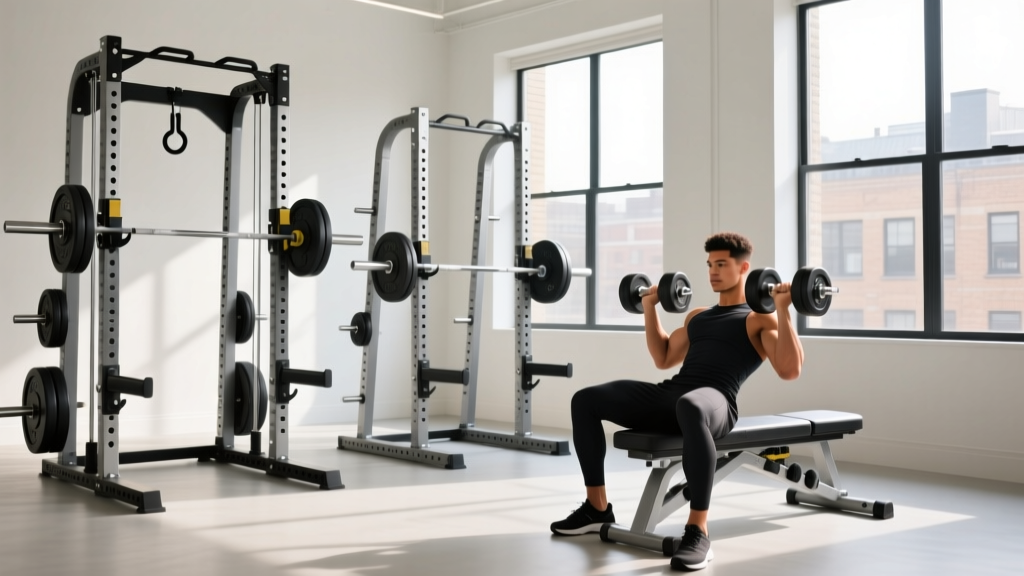
Power Rack vs Squat Rack vs Stand: Incline Dumbbell Tricep Extension

Cast Iron vs Competition Kettlebells: Leg Workout Gym with Dumbbells

Squat Stand vs Power Rack Setup with Lifeline Hex Rubber Dumbbell

Lower Chest Dumbbell Errors: Troubleshooting Neoprene Home Weights
