
Space Layouts: Hex vs Urethane for Single Leg Dumbbell Curl to Press
Optimize your compact home gym layout. We compare rubber hex vs urethane dumbbells for multi-planar moves like the single leg dumbbell curl to press.

The Spatial Reality of Multi-Planar Movements
When designing a compact home gym, most lifters focus on the footprint of their power rack or cardio machines. However, the true test of a space-optimized layout is how well it accommodates dynamic, multi-planar free weight movements. A prime example is the single leg dumbbell curl to press. This unilateral exercise demands a massive "spatial envelope"—requiring lateral balance sway, a full bicep curl arc, and an overhead press extension.
If you are training in a 10x10 bedroom gym or a narrow garage bay, the physical dimensions and edge geometry of your dumbbells dictate whether you can perform this movement safely without clipping a wall, mirror, or storage rack. This brings us to a critical equipment debate for space-constrained lifters: rubber hex dumbbell vs urethane dumbbell. While both protect your flooring, their volumetric density and geometric profiles drastically alter your gym's functional layout.
The Biomechanical Spatial Envelope
Before comparing materials, we must quantify the space required for the single leg dumbbell curl to press. According to biomechanical spatial guidelines for unilateral overhead movements, an average 5'10" lifter requires a functional clearance zone of approximately 36 inches laterally and 86 inches vertically to account for arm extension and balance correction.
📐 The Clearance Calculation
User Height: 70"
Arm + Dumbbell Overhead Reach: +28"
Total Vertical Envelope: 98" (Requires standard 8ft+ ceilings)
Lateral Sway Buffer: 18" per side of center gravity
Total Lateral Envelope: 36" minimum clear width.
When your lateral buffer is tight, the width of the dumbbell head becomes a liability. If you are standing 20 inches from a wall, a bulky dumbbell head will strike the drywall during the eccentric lowering phase of the curl or the lockout of the press.
Material Density and the Footprint Factor
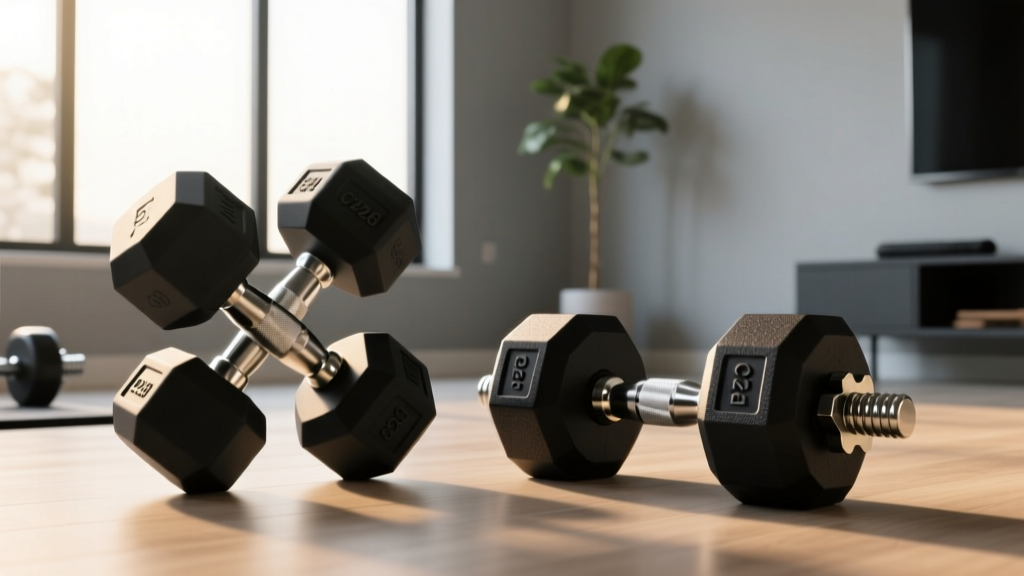
The primary differentiator between rubber and urethane in a space-optimization context is material density. Urethane is significantly denser than vulcanized rubber. This means a 40 lb urethane dumbbell requires less physical volume (and therefore less spatial footprint) than a 40 lb rubber hex dumbbell.
For lifters executing the single leg dumbbell curl to press in tight quarters, reducing the dumbbell head width by even half an inch per side can be the difference between a fluid repetition and a wall-strike.
| Dumbbell Type (40 lb Pair) | Head Width / Diameter | Head Length (Protrusion) | Spatial Snag Risk | Avg. Price per Pound (2026) |
|---|---|---|---|---|
| Standard Rubber Hex | ~6.5" (Flat edge to edge) | ~6.5" | High (Corners catch on racks) | $1.40 - $1.80 / lb |
| Premium Urethane (Round) | ~5.6" (Diameter) | ~5.6" | Low (Smooth glide path) | $3.20 - $4.50 / lb |
| Compact Urethane Hex | ~5.8" (Edge to edge) | ~5.8" | Medium (Blunted corners) | $2.80 - $3.50 / lb |
As the data illustrates, switching to a round urethane profile shaves nearly an inch off the total width of the weight stack. When performing a curl to press, the hand rotates and the wrist supinates; a round urethane head navigates this rotational arc far more cleanly in a narrow corridor than a wide, flat-sided rubber hex.
Edge Geometry: Navigating Tight Racks and Walls
Space optimization isn't just about the active workout area; it's about the flow between your weight storage and your lifting zone. The rubber hex dumbbell vs urethane dumbbell debate heavily features edge geometry.
The Hex Snag Hazard
Rubber hex dumbbells feature sharp, 120-degree corners. In a compact gym layout where your dumbbell rack is positioned less than four feet from your lifting platform, picking up and maneuvering heavy hex dumbbells into the starting position for a single leg curl to press is cumbersome. The protruding corners frequently snag on uprights, bench pads, or adjacent equipment. Furthermore, if you lose your balance during the single-leg eccentric phase and drop the weight, the rigid rubber corners are prone to chunking and tearing when they strike concrete or hard rubber mats at an angle.
The Urethane Advantage
Urethane—whether poured into a round mold or a tightly beveled hex mold—offers a superior "glide path." The material has a higher Shore A durometer rating (typically 85-90A) compared to standard rubber, meaning it is harder, more shock-absorbent, and less likely to deform or tear upon impact. In a space-optimized layout where the floor is shared between deadlifts and dynamic unilateral work, urethane protects both the equipment and the surrounding environment from collateral damage during balance failures.
"In facility design, we don't just measure the footprint of the equipment at rest; we measure the 'dynamic clearance' required to move the equipment from storage to the point of exertion. Urethane's compact density drastically reduces this dynamic clearance requirement."
Layout Scenarios: Mapping Your Floor Plan
How should you design your gym layout based on your dumbbell choice? Here is a step-by-step framework for accommodating the single leg dumbbell curl to press.
- The 8x8 Bedroom Gym (Urethane Mandatory): If your lateral wall clearance is under 24 inches from your center line, you must use round urethane dumbbells. The reduced diameter prevents drywall strikes during the overhead press lockout. Position your storage tier directly behind you to avoid lateral snags.
- The Narrow Garage Bay (Compact Urethane Hex): If you have 30 inches of lateral space but struggle with dumbbells rolling away between sets, opt for compact urethane hex. The blunted edges prevent rolling, while the higher density keeps the head width manageable for the curl-to-press arc.
- The Open Basement Gym (Rubber Hex Acceptable): If you have 48+ inches of lateral clearance and are on a strict budget, standard rubber hex is perfectly viable. Ensure your storage rack is placed at least 5 feet away from your active lifting zone to prevent corner-snagging during pickup.
The Financial ROI of Space Optimization
There is no ignoring the cost disparity. Outfitting a full set of rubber hex dumbbells (5-50 lbs) will cost roughly $900 to $1,100. The equivalent urethane set will push $2,200 to $2,800.
However, in the context of space optimization, you must calculate the "Cost Per Square Foot Saved." By utilizing denser urethane heads, you can comfortably reduce your lateral lifting zone by 10-15%, potentially allowing you to fit a functional trainer or a rowing machine into a room that would otherwise feel claustrophobic. For urban dwellers or those finishing basement spaces where square footage is at a premium, the spatial ROI of urethane frequently justifies the upfront premium.
Final Verdict for Compact Gym Architects
If your training regimen heavily features expansive, balance-dependent movements like the single leg dumbbell curl to press, your equipment must complement your spatial constraints. Rubber hex dumbbells remain the undisputed champion of budget-friendly garage gyms with ample square footage. However, for the dedicated space-optimizer, urethane dumbbells offer a masterclass in volumetric efficiency. Their superior density, reduced head width, and snag-free geometry allow you to push the boundaries of compact gym design without sacrificing the integrity of your multi-planar movements.
More gear to consider
All reviews
Power Rack vs Squat Stand: American Barbell Dumbbell Layout Mistakes

Loadable Plates vs Dial: Bowflex Dumbbell Exercises Cost Analysis
Power Rack vs Squat Stand: Is Dumbbell Bench Press on Floor Better?

EZ vs Straight Bar: Best Bicep Workout Without Dumbbells 2026
Rubber Hex vs Urethane: 2026 Gear for a Biceps Routine With Dumbbells
