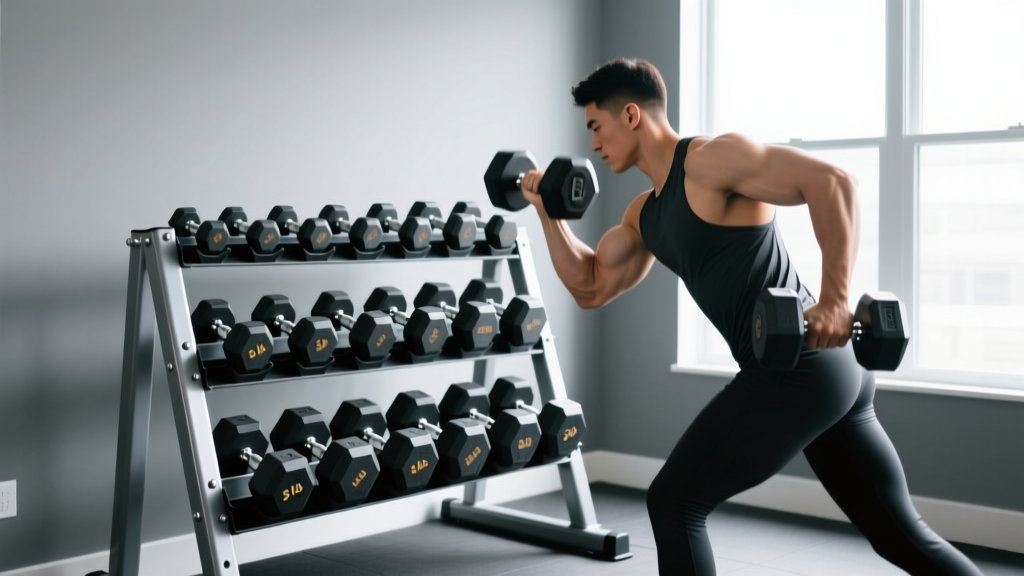
2026 Dumbbell Storage Trends: Racking Heavy Calf Raise Dumbbells
Explore 2026 dumbbell rack trends driven by heavy calf raise dumbbell training. Compare heavy-duty storage solutions, weight capacities, and safety.

The Biomechanics Boom: Why the Calf Raise Dumbbell is Getting Heavier
The landscape of hypertrophy training has shifted dramatically as we move through 2026. Driven by a deeper, evidence-based understanding of stretch-mediated muscle growth, lifters and coaches are increasingly prioritizing extreme loaded stretches. Nowhere is this more evident than in lower leg training, where the heavy standing calf raise dumbbell has become an absolute staple for breaking through plateaued growth.
According to research highlighted by the National Strength and Conditioning Association (NSCA) and extensive breakdowns on Stronger By Science, training a muscle at long muscle lengths (the stretched position) yields significantly greater hypertrophic adaptations than training at shortened lengths. For the gastrocnemius and soleus, this means performing deep, paused calf raises with massive loads. Consequently, advanced lifters are now routinely performing single-leg calf raises holding a 120-pound to 150-pound dumbbell in one hand while balancing on a deficit block.
However, hoisting, balancing, and ultimately storing these ultra-heavy dumbbells introduces severe logistical and structural challenges. Standard commercial A-frame racks and budget home gym storage solutions are failing under the unique torque and point-load stresses generated by the modern heavy calf raise dumbbell.
Structural Failure Modes in Standard Dumbbell Racks
When analyzing the 2026 equipment market, we are seeing a distinct bifurcation. Budget-tier racks (typically priced under $300) are designed for hex dumbbells maxing out at 50 to 70 pounds. When users attempt to rack or retrieve a 140-pound urethane dumbbell from the top tier of these units, several specific failure modes emerge:
- Upright Weld Shearing: The lateral force required to "walk" a 140-pound dumbbell out of a tight saddle creates a massive moment arm. On 14-gauge or 12-gauge steel frames with single-pass MIG welds, this repeated lateral stress causes micro-fractures at the base gussets, eventually leading to catastrophic upright snapping.
- Polyurethane Saddle Deformation: Standard injection-molded plastic or low-durometer rubber saddles compress and crack under the concentrated 150-pound point-load of a thick-handled urethane dumbbell, eventually causing the weight to slip through the rack.
- Top-Heavy Tipping Hazards: Retrieving a heavy calf raise dumbbell from the top tier (often 48+ inches high) requires the lifter to extend their lumbar spine and shift their center of gravity. If the rack lacks a widened footprint or rear stabilizer bar, the asymmetric pull can tip the entire unit forward.
2026 Market Analysis: Heavy-Duty Rack Comparison
To accommodate the trend of ultra-heavy isolation movements, premium fitness manufacturers have redesigned their storage solutions, prioritizing 11-gauge steel, reinforced cross-members, and ergonomic tier spacing. Below is a market analysis of the top heavy-duty dumbbell racks capable of safely housing your heavy calf raise dumbbells.
| Brand & Model | Steel Gauge | Max Tier Capacity | Top Tier Height | 2026 Price |
|---|---|---|---|---|
| Rogue 3-Tier Dumbbell Rack | 11-Gauge | 150 lbs (per pair) | 39.5 inches | $895.00 |
| Rep Fitness 3-Tier Rack | 12-Gauge | 120 lbs (per pair) | 41.0 inches | $549.00 |
| Eleiko Olympic DB Storage | 7-Gauge | 200+ lbs (per pair) | 36.0 inches | $1,850.00 |
| Titan Fitness Heavy Duty A-Frame | 11-Gauge | 100 lbs (per pair) | 45.0 inches | $399.00 |
The Gold Standard: Rogue 3-Tier Dumbbell Rack
For lifters routinely handling 120lb+ dumbbells for calf raises, the Rogue 3-Tier Dumbbell Rack remains the undisputed market leader in 2026. Constructed from 11-gauge steel with heavily gusseted uprights, it eliminates the lateral sway that plagues cheaper models. Crucially, its top tier sits at 39.5 inches—significantly lower than the industry standard of 45 inches. This specific height reduction allows a lifter to retrieve a 140-pound dumbbell with a neutral spine and a slight hip hinge, rather than requiring a dangerous overhead reach.
Ergonomic Retrieval for Heavy Isolation Movements
Storing the weight safely is only half the battle; retrieving a 140-pound calf raise dumbbell and getting it into the working position without expending excessive energy or risking a hernia is a skill that requires proper equipment and technique.
Step-by-Step Heavy Dumbbell Retrieval
- The Stance: Approach the middle or bottom tier of the rack (never the top tier for weights over 100 lbs). Stand with feet shoulder-width apart, toes pointing slightly outward.
- The Hinge: Push your hips back and grip the dumbbell handle. Ensure your grip is perfectly centered to prevent the heavy urethane heads from torquing in your hand.
- The Clean: Drive through your heels, extending the hips and knees simultaneously. As the dumbbell passes the waist, aggressively shrug and pull the weight upward, rotating your wrist to catch the dumbbell head on your shoulder (the front rack position).
- The Transfer: Walk to your calf raise block. Place your non-working hand on a wall or rig for balance. Carefully guide the dumbbell from your shoulder down to your working-side hip, locking out the latissimus dorsi to stabilize the load before initiating the calf raise descent.
"The limiting factor in heavy single-leg calf raises isn't always the calf muscle itself; it's the grip strength and the systemic fatigue generated by cleaning a 140-pound dumbbell into position. Proper rack height and tier spacing are just as critical to the exercise's success as the biomechanics of the ankle joint."
— 2026 Biomechanics & Hypertrophy Coaching Symposium Notes
Integration with Power Racks: The Attachments Trend
Another major trend in 2026 is the migration away from standalone dumbbell racks toward integrated power rack storage. For home gym owners with limited square footage, attaching heavy-duty dumbbell storage to a power rack provides superior stability. Because the storage pins are bolted directly to the 3x3-inch 11-gauge uprights of the power rack, the massive footprint and weight of the rack itself act as a counterbalance, completely eliminating the tipping hazard associated with standalone A-frames.
Brands like Rep Fitness and Bells of Steel now offer reinforced "Dumbbell Storage Attachments" that slide directly into the uprights. When purchasing these, ensure the attachment pins are rated for at least 500 lbs of static load, and verify that the storage saddles feature a 5-degree downward tilt. This tilt prevents round-handled dumbbells from rolling off the pegs when bumped during heavy barbell squatting sessions.
Decision Framework: Upgrading Your Storage for 2026
If your current training regimen incorporates heavy stretch-mediated movements like the loaded calf raise dumbbell protocol, use this framework to audit your current storage setup:
- Audit your heaviest pair: If your heaviest dumbbells exceed 90 lbs, immediately remove them from the top tier of any A-frame rack.
- Check the welds: Inspect the base gussets of your current rack. If you see hairline cracks in the powder coating near the welds, the metal underneath is fatiguing. Retire the rack.
- Measure your retrieval height: The optimal retrieval height for heavy dumbbells is between 36 and 40 inches from the floor. If your top tier is higher than 42 inches, you are sacrificing lumbar safety for storage density.
- Invest in Urethane Cradles: If your rack uses bare steel or hard plastic saddles, upgrade to bolt-on urethane cradles. These absorb the acoustic shock of racking heavy weights and prevent the steel handles from slipping out of the saddle during lateral pulls.
Conclusion
The evolution of hypertrophy science has fundamentally changed how we train, and by extension, how we must equip our gyms. The modern calf raise dumbbell is no longer a lightweight accessory; it is a primary, heavy-load implement designed to exploit stretch-mediated growth. Ensuring your dumbbell rack and storage solutions are metallurgically sound, ergonomically optimized, and structurally rated for 2026's heavy isolation trends is not just a matter of organization—it is a critical component of injury prevention and long-term training longevity.
More gear to consider
All reviews
Power Rack vs Squat Rack: Arm and Back Workout with Dumbbells

EZ vs Straight Bar: Budget Latissimus Dorsi Dumbbell Workout Guide

2026 Trends: Wooden Dumbbells & Cast Iron vs Competition Kettlebells
Best Adjustable Dumbbells for Dumbbell Delt Raises: 2026 Guide
Power Rack vs Squat Rack vs Stand: Reverse Lunge Single Dumbbell