Smart Storage Layouts to Maximize Dumbbell Workouts for Glutes
Optimize your home gym layout for dumbbell workouts for glutes. Discover space-saving dumbbell racks, clearance metrics, and floor plans for 2026.

The Intersection of Storage and Glute Biomechanics
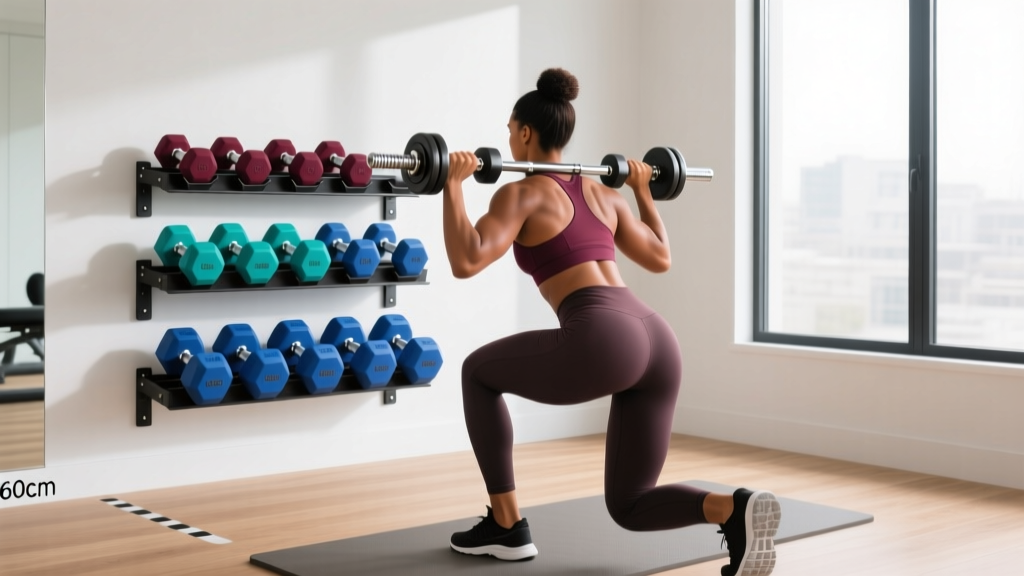
Designing an efficient home gym in 2026 requires more than just buying the right equipment; it demands a strategic approach to spatial zoning. When athletes focus heavily on lower-body development, specifically dumbbell workouts for glutes, the spatial requirements shift dramatically compared to upper-body or isolation training. Glute-dominant movements like Romanian deadlifts (RDLs), Bulgarian split squats, and walking lunges require expansive linear and posterior clearance.
If your dumbbell racks are poorly placed or oversized, they create physical bottlenecks and tripping hazards, effectively shrinking your usable workout area. By selecting the right dumbbell rack and storage solutions and positioning them using biomechanical clearance metrics, you can reclaim up to 30% more functional floor space in a standard spare bedroom or garage gym.
Mapping the Spatial Demands of Glute Training
Before selecting a storage unit, we must define the 'Clear-Zone'—the uninterrupted floor space required to perform dumbbell workouts for glutes safely and effectively. According to facility design guidelines outlined by the National Strength and Conditioning Association (NSCA), resistance training areas must account for the full range of motion plus a safety buffer for equipment handling.
Posterior Clearance for Hinge Movements
Exercises like dumbbell RDLs and good mornings require the hips to travel backward. For an average-height lifter (5'8" to 6'0"), the hips will push back approximately 18 to 24 inches from the starting stance. To prevent backing into a dumbbell rack or wall, you must maintain a minimum 30-inch posterior clearance zone behind the lifter.
Lateral and Linear Footprints
- Bulgarian Split Squats: Requires a staggered stance spanning roughly 36 inches in length and 24 inches in width per leg. You need a dedicated 4x4 foot static footprint.
- Walking Lunges: Demands a linear 'runway'. A set of 10-12 walking lunges requires a clear lane of at least 120 inches (10 feet) to maintain continuous tension on the gluteus maximus without stopping to pivot.
- Dumbbell Hip Thrusts: Performed on the floor with shoulders elevated on a bench. This requires a 6x4 foot central zone to accommodate the bench, the lifter's extended legs, and the heavy dumbbells resting on the hips.
Evaluating Dumbbell Racks by Footprint and Capacity
To protect the Clear-Zone, your storage solution must minimize its physical footprint while maximizing vertical or high-density storage. Below is a comparison of the three primary rack configurations available on the 2026 market, analyzed specifically for compact home gyms.
| Rack Configuration | Model Example | Footprint (W x D) | Capacity | Avg. Price (2026) | Best Layout Placement |
|---|---|---|---|---|---|
| 3-Tier Horizontal | Rogue 3-Tier Dumbbell Rack | 52" x 22" | 10 Pairs (5-50 lbs) | $325 | Flat against a rear wall |
| Vertical Tower | Titan Fitness Vertical Rack | 24" x 24" | 12 Pairs (5-50 lbs) | $160 | Tucked into a corner |
| Wall-Mounted Pegs | Fringe Fitness Wall Mount | 48" x 4" (Depth) | 6 Pairs (up to 35 lbs) | $140 | Dead space above benches |
Deep Dive: The Vertical Tower Advantage
For athletes prioritizing dumbbell workouts for glutes in rooms under 200 square feet, the Titan Fitness Vertical Dumbbell Rack is often the superior choice. By utilizing a 24" x 24" footprint, it consumes only 4 square feet of floor space. Placed in a corner, it leaves the center of the room entirely open for walking lunges and lateral movements. However, vertical racks have a higher center of gravity; they must be bolted to wall studs or loaded from the bottom up to prevent tipping hazards.
Deep Dive: The Horizontal 3-Tier Standard
The Rogue 3-Tier Dumbbell Rack remains the gold standard for garage gyms with ample wall space. Its 22-inch depth is shallow enough to push flush against a baseboard, but its 52-inch width demands a dedicated wall segment. The ergonomic 15-degree angle of the tiers reduces lower back strain when picking up heavy 50lb+ dumbbells for sumo squats or heavy RDLs.
The 'U-Shape' Layout Blueprint for Glute Training
To optimize flow, arrange your gym using a U-Shape perimeter layout, keeping the center entirely void of permanent fixtures.
Layout Blueprint: The Glute Clear-Zone
Wall 1 (The Anchor): Place your 3-Tier Dumbbell Rack here. Ensure the 30-inch posterior clearance zone faces the center of the room.
Wall 2 (The Bench Zone): Position your adjustable bench parallel to the wall. This is your station for hip thrusts and seated movements.
Wall 3 (The Mirror/Mobility Wall): Leave this wall completely bare or mount mirrors. This provides the visual feedback needed for single-leg RDLs and acts as a boundary for lateral lunges.
The Center (The Runway): A minimum 10x8 foot open rubber-matted area dedicated exclusively to dynamic movements like walking lunges and goblet squat variations.
Floor Protection and Equipment Longevity
Dumbbell workouts for glutes frequently involve heavy loads resting on the hips (hip thrusts) or being lowered to the floor (deficit RDLs). Standard 1/2-inch foam tiles will compress and degrade under the point-load of a 60-pound dumbbell dropped from hip height.
According to the American College of Sports Medicine (ACSM), proper flooring is critical for both shock absorption and equipment preservation in home facilities. Invest in 3/4-inch vulcanized rubber horse stall mats (typically 4x6 feet, costing around $60-$80 per mat in 2026). These provide the necessary density to absorb the impact of heavy dumbbells being set down during fatiguing glute burnout sets, while also providing a non-slip surface essential for the wide stances used in sumo deadlifts.
Edge Cases: Navigating Compact Room Failures
Even with the best layout plans, compact rooms present unique edge cases that can derail a workout or cause injury.
- The 'Pivot' Hazard: During heavy dumbbell swing squats or rotational lunges, lifters often pivot on their heel. If a dumbbell rack is placed less than 48 inches from the workout zone, a stray heel strike can rock a tiered rack, potentially causing upper-tier dumbbells to roll off. Solution: Install a 2-inch wooden lip or buy racks with integrated retaining lips on the shelves.
- Overhead Clearance for Presses: While glute training is lower-body focused, many lifters superset with overhead presses. Ensure your vertical rack is not placed directly under low-hanging garage door tracks or ceiling fans. You need a minimum of 84 inches of vertical clearance above your lifting zone.
- Lighting Shadows: Placing a tall vertical rack in the corner of a poorly lit room can cast shadows over the floor mat, making it difficult to see the knurling alignment on your dumbbells or judge floor depth during deficit RDLs. Position overhead LED shop lights to illuminate the center Clear-Zone, not the storage perimeter.
Finalizing Your 2026 Gym Layout
Optimizing your home gym for dumbbell workouts for glutes is an exercise in spatial discipline. By abandoning bulky, poorly placed storage in favor of high-density vertical towers or flush-mounted horizontal racks, you reclaim the square footage necessary for unhindered, full-range-of-motion training. Measure your room, map out the 30-inch posterior buffers, secure your rubber matting, and transform your cramped spare room into a highly functional, glute-building powerhouse.
More gear to consider
All reviews
Rubber Hex vs Urethane Dumbbells: Layout and Dumbbell Recall Risks

Dumbbells Drawing Plans: Rubber Hex vs Urethane Rack Layouts

Hex vs Urethane Dumbbells: Space & Dumbbell Side Bend Exercise

50kg Adjustable Dumbbell Set: 2026 Heavy-Duty Comparison
Gym Layouts: Kettlebell Sizing & How to Adjust Bowflex Dumbbells