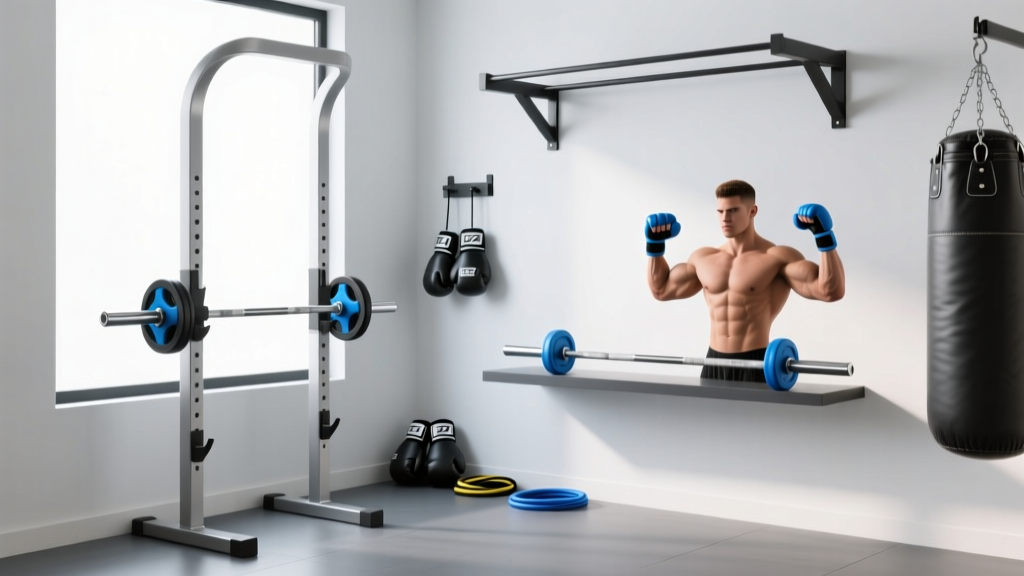
EZ Curl Bar vs Straight Bar: Space Layouts for a Boxing Dumbbell Workout
Compare EZ curl bar vs straight bar dimensions, storage layouts, and biomechanics to optimize your home gym for a boxing dumbbell workout.

The Spatial Dilemma: Equipping a Combat Athlete's Home Gym
Designing a high-performance home gym for combat sports requires a meticulous balance between heavy strength equipment and open floor space. When your programming includes a high-volume boxing dumbbell workout—involving shadowboxing with 1 to 5 lb hex dumbbells, rotational core work, and dynamic footwork drills—every square foot of clearance matters. You cannot afford to have 86-inch Olympic bars jutting into your striking zone.
This brings us to a critical equipment and layout decision for hybrid athletes: the EZ curl bar vs straight bar debate. While powerlifters default to the straight bar, boxers and MMA fighters must weigh biomechanical joint preservation against spatial efficiency. In 2026, with home gym real estate at a premium and specialized combat conditioning becoming more data-driven, choosing the right barbell profile and storage layout is essential for optimizing your training environment.
Dimensional Breakdown: Footprints and Storage Clearances
Before mapping out your gym layout, we must look at the hard data. The physical footprint of your barbells dictates where your dumbbell racks and striking zones can safely exist. Below is a comparison of standard Olympic models widely used in compact garage gyms.
| Equipment Model | Total Length | Weight | Wall Clearance Needed | 2026 Avg Price |
|---|---|---|---|---|
| Standard Olympic Straight Bar (e.g., CAP Barbell) | 86 inches (7.2 ft) | 45 lbs | 90+ inches horizontal | $140 - $180 |
| Rogue Fitness Curl Bar | 47.24 inches | 30 lbs | 50 inches horizontal | $245 |
| Titan Fitness EZ Curl Bar | 47 inches | 25 lbs | 50 inches horizontal | $115 |
Biomechanics & Utility: Why Wrist Angle Matters for Boxers
The choice between an EZ curl bar and a straight bar isn't purely about spatial optimization; it is deeply tied to injury prevention for combat athletes. Boxers subject their wrists, carpals, and radioulnar joints to immense repetitive stress through heavy bag work and pad drills.
According to biomechanical data cataloged by ExRx.net, the straight bar forces the forearms into full supination (palms facing completely up). For athletes with limited wrist mobility or existing inflammation from punching, this locked position can exacerbate medial epicondylitis and wrist strain. The EZ curl bar features angled grips that place the wrists in a semi-supinated, more natural anatomical position. This reduces torque on the radioulnar joint while still effectively targeting the biceps brachii and brachialis.
"For a boxer, wrist integrity is non-negotiable. If a strength implement compromises the joint angle required to throw a safe, powerful cross, it has no place in the athlete's program. The EZ bar offers a vital compromise between loading the flexors and preserving the punching mechanism."
The Straight Bar: Max Load and Floor Space
- Pros: Unmatched versatility for squats, deadlifts, and overhead presses. Allows for maximum load progression.
- Cons: High spatial footprint. Forces extreme wrist supination during curls and skull crushers, which can aggravate punching-induced wrist fatigue.
- Best For: Athletes with a dedicated 2-car garage gym (400+ sq ft) who prioritize compound powerlifting movements over isolation arm work.
The EZ Curl Bar: Compact Storage and Joint Preservation
- Pros: Easily stored vertically or horizontally in tight spaces. Ergonomic grips protect vulnerable wrists. Excellent for tricep extensions and upright rows (crucial for clinch strength).
- Cons: Cannot be used for standard squats or deadlifts. Sleeve length limits the number of bumper plates you can load (usually maxing out around 250-300 lbs depending on plate width).
- Best For: Compact apartment gyms, spare bedrooms, and combat athletes prioritizing joint health and open floor space for agility drills.
Layout Design: Integrating Barbell Storage with Dumbbell Zones
To successfully execute a boxing dumbbell workout, you need a minimum 6x6 foot clear zone for shadowboxing, lateral shuffles, and pivoting. Here are two space-optimized layouts depending on your barbell choice.
Layout A: The Vertical Wall Mount (The EZ Bar Advantage)
If you opt for the EZ curl bar, utilize a vertical wall-mounted bar holder. These mounts typically protrude only 6 to 8 inches from the wall and take up less than 12 inches of horizontal width. The Setup: Mount the vertical hanger in the corner of your gym. Place a compact 3-tier hex dumbbell rack (housing your 2lb, 3lb, and 5lb neoprene dumbbells for shadowboxing, plus heavier pairs for presses) directly adjacent to it. This creates a unified "strength corner," leaving the center of the room entirely unobstructed for footwork and boxing drills.
Layout B: The Horizontal Rack Integration (The Straight Bar Necessity)
If your program demands a straight bar for heavy squats and deadlifts, you must integrate the bar storage into your power rack to save wall space. The Setup: Use a squat rack with a 24-inch depth footprint (like the Titan T-2 or Rogue SML-1). Store the straight bar on the J-cups or dedicated rear vertical bar holders attached directly to the rack's uprights. Keep your dumbbell rack on the opposite wall to create a distinct "heavy zone" and "speed/agility zone," ensuring you never trip over an 86-inch barbell while transitioning between a heavy set and a 3-minute boxing dumbbell shadowboxing round.
Failure Modes in Compact Gyms: What to Avoid
When optimizing for space, athletes often make critical errors that damage equipment or their home. Avoid these common failure modes:
- Drywall Destruction: Storing an EZ curl bar or straight bar horizontally on cheap, unanchored wall hooks. The 30-45 lb weight of the bar, combined with the leverage of the sleeves, will rip standard drywall anchors out. Always mount bar holders directly into wooden studs or use heavy-duty toggle bolts rated for 100+ lbs.
- Sleeve Diameter Mismatches: Buying a budget "Standard" (1-inch diameter) EZ curl bar to save space and money, but owning Olympic (2-inch) dumbbell handles or plates. Ensure your EZ bar has 50mm Olympic sleeves to maintain compatibility with your existing bumper plates and boxing-weight dumbbell plate loaders.
- Knurling Corrosion: Storing bars in unclimate-controlled garages where humidity fluctuates. The aggressive knurling on straight bars and the deep grooves of EZ bars trap moisture and chalk. Wipe down your bars with a nylon brush and apply a light coat of 3-in-One oil monthly to prevent rust, which can degrade the sleeve bearings over time.
Final Verdict: Which Bar Belongs in Your Compact Gym?
The decision ultimately hinges on your available square footage and your specific athletic demands. If your primary goal is to maintain a pristine, open floor plan for a dynamic boxing dumbbell workout, agility ladder drills, and heavy bag work, the EZ curl bar is the superior choice. Its 47-inch profile allows for effortless vertical storage, and its angled grips will actively protect the wrists you rely on for punching.
However, if your combat sport conditioning relies heavily on maximal strength outputs—such as heavy back squats for grappling power or conventional deadlifts for posterior chain explosiveness—the straight bar remains mandatory. In this case, you must sacrifice wall space and utilize rack-integrated storage to keep your 86-inch barbell out of your striking zone. For further reading on exercise selection and joint mechanics for athletes, the National Strength and Conditioning Association (NSCA) offers extensive literature on modifying lifts for sport-specific injury prevention.
By respecting the dimensional realities of your equipment and prioritizing the spatial needs of your boxing conditioning, you can build a 2026-ready home gym that builds knockout power without compromising your living space.
More gear to consider
All reviews
Top Dumbbell Racks & The Best Dumbbell Lateral Raise Alternative

Best Dumbbell Full Body Workouts: Top Neoprene Sets Compared

Setup Guide: Chest Muscles Workout with Dumbbells & Neoprene Gear

Troubleshooting Arm Exercises with Dumbbells: Neoprene Grip Errors
Power Rack vs Squat Rack vs Stand: Setup & Reverse Grip Curls Dumbbell
