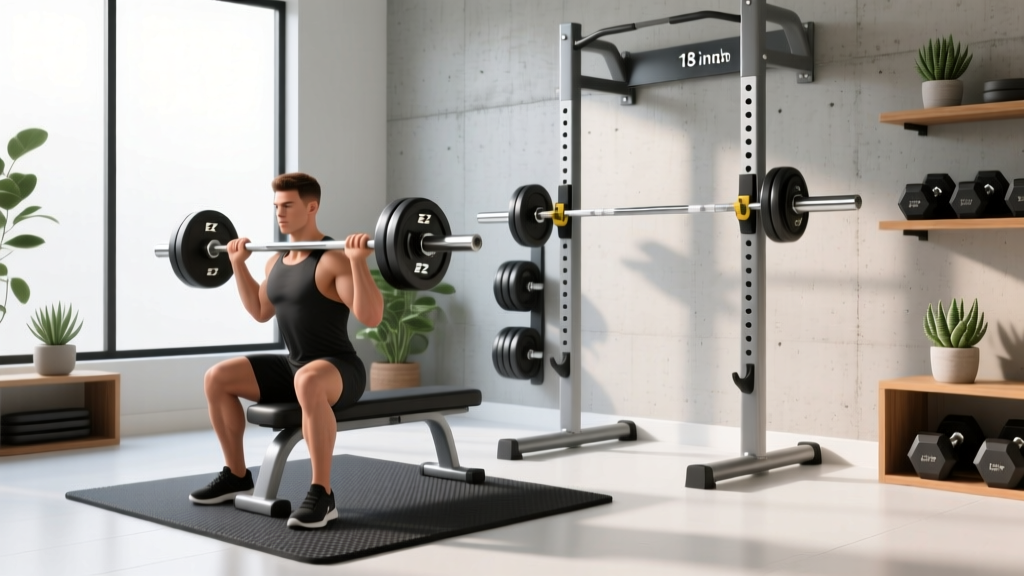
EZ Curl Bar vs Straight Bar: Dumbbell Shoulder Gym Layouts
Compare EZ curl bar vs straight bar for compact gym layouts. Discover space-saving storage, clearance metrics, and dumbbell shoulder superset flow.

The Spatial Footprint: 86 Inches vs. 47 Inches
Designing a high-functioning home or boutique gym in 2026 requires ruthless spatial efficiency. When programming arm and shoulder days, the transition between isolation and compound movements dictates your floor plan. The debate between an EZ curl bar and a standard Olympic straight barbell is traditionally confined to wrist ergonomics and bicep activation. However, from a layout design perspective, the choice drastically alters your gym's traffic flow, safe drop zones, and storage requirements—especially when integrating a dedicated dumbbell shoulder press station.
A standard Olympic straight barbell (such as the CAP Barbell OB-86B or the Rogue Ohio Bar) measures exactly 86.37 inches (7 feet 2 inches) in total length. To use this safely, you need a minimum operational clearance of 9 feet wide by 4 feet deep. In a compact 200-square-foot garage gym, an 86-inch barbell dominating the center floor creates a massive physical barrier.
Conversely, a dedicated Olympic EZ curl bar (like the Rogue Curl Bar or Titan Fitness EZ Bar) typically measures between 47 and 52 inches. This nearly 40-inch reduction in length fundamentally changes how you navigate your gym space, allowing for tighter equipment clustering and safer transitions between lifts.
The 3-Foot Clearance Rule: In spatial gym design, always account for the 'swing radius' of the barbell plus the user's arm length. An 86-inch straight bar requires a 10-foot lateral safety zone when loaded with 45lb plates. A 47-inch EZ curl bar reduces this lateral safety zone to just 6 feet, freeing up critical square footage for adjacent stations.
Biomechanics and the Dumbbell Shoulder Transition
Why does the curl bar debate matter for shoulder training? Because arm and shoulder routines are frequently paired in antagonist or superset formats. A classic hypertrophy superset involves heavy bicep curls immediately followed by a dumbbell shoulder press.
If you are using a straight barbell for your curls, the 86-inch bar must be lowered to the floor between sets. This creates a severe tripping hazard when you attempt to walk over or around it to reach your dumbbell rack for your shoulder presses. The semi-supinated, angled grip of the EZ curl bar not only reduces valgus stress on the wrists and elbows—a biomechanical advantage well-documented by the ExRx Kinesiology Directory—but its compact size allows you to rest it on a small bench or specialized wall hook without blocking the walkway to your dumbbell shoulder zone.
| Feature | Olympic Straight Bar | Olympic EZ Curl Bar |
|---|---|---|
| Total Length | 86.37 inches | 47 - 52 inches |
| Standard Weight | 44 - 45 lbs | 15 - 35 lbs |
| Floor Resting Footprint | ~12.5 sq ft (with plates) | ~5.5 sq ft (with plates) |
| Superset Flow to Dumbbells | Obstructive (Trip Hazard) | Seamless (Compact) |
| Primary Grip Angle | Fully Supinated | Semi-Supinated / Pronated |
Storage Matrices: Wall vs. Floor
Space optimization extends beyond the lifting platform; it heavily involves how equipment is stored when not in use. The National Strength and Conditioning Association (NSCA) guidelines on facility layout emphasize that clear pathways are critical for both safety and operational efficiency in multi-user or high-density gym environments.
Vertical vs. Horizontal Footprints
Storing an 86-inch straight bar horizontally on a wall-mounted rack requires a dedicated 8-foot stretch of unbroken wall space. In a garage gym where walls are often occupied by mirrors, whiteboards, or band pegs, this is a premium commodity. Furthermore, horizontal racks protrude about 10 inches from the wall, creating a head-height hazard if placed near high-traffic walkways.
Vertical barbell holders, on the other hand, occupy a mere 24x24 inch footprint on the floor. While both straight bars and EZ curl bars can be stored vertically, the EZ curl bar's unique cambered shape and shorter sleeve length make it significantly easier to slide into tight vertical holsters or specialized wall-mounted cradles that only require 4 feet of vertical clearance, allowing you to mount them low to the ground and keep the upper wall free for shelving or monitors.
2026 Equipment Pricing & Space ROI
When evaluating the return on investment (ROI) for your gym layout, you must weigh the cost of the equipment against the spatial value it provides. Here is a breakdown of current market pricing for high-quality, Olympic-sleeve options:
- Rogue Fitness Curl Bar: $245.00 (47 inches, 35 lbs, premium ceramic or hard chrome finish). Offers the tightest spatial footprint on the market.
- Titan Fitness Olympic EZ Curl Bar: $139.99 (52 inches, 30 lbs). A budget-friendly option that still saves nearly 3 feet of floor space compared to a straight bar.
- CAP Barbell OB-86B (Straight Bar): $155.00 (86 inches, 45 lbs). The standard workhorse, but demands maximum floor and wall real estate.
- Eleiko Olympic Weightlifting Bar: $950.00+ (86 inches, 44 lbs). Precision engineering for heavy compounds, but entirely impractical to leave on the floor during high-volume arm/shoulder accessory work.
From a spatial ROI perspective, spending $140–$250 on a dedicated EZ curl bar effectively 'buys back' 3 to 4 feet of lateral floor space, which can then be reallocated to a dedicated adjustable bench for your dumbbell shoulder presses.
Designing the Arm & Shoulder Micro-Zone
To maximize efficiency in a compact gym, we recommend designing a specific 'Micro-Zone' dedicated to arm and shoulder hypertrophy. This layout minimizes walking distance and eliminates equipment bottlenecks.
The 3-Step Micro-Zone Blueprint
- Anchor the Dumbbell Rack: Place your A-frame or wall-mounted dumbbell rack against the primary wall. Ensure the 50lb-80lb dumbbells (ideal for shoulder presses) are at waist height to prevent lower back strain during pickup.
- Position the Adjustable Bench: Place an adjustable FID (Flat/Incline/Decline) bench exactly 3 feet in front of the dumbbell rack. Set the backrest to 75-85 degrees for optimal dumbbell shoulder press mechanics, ensuring your elbows don't strike the wall behind you.
- The EZ Bar Resting Station: Instead of leaving your curl bar on the floor, mount a small, 2-hook horizontal wall cradle at knee-height (18 inches off the floor) on the adjacent side-wall. After your EZ bar curl set, simply hook the 47-inch bar on the wall. The center floor remains 100% clear for walking back to the dumbbell rack for your shoulder press superset.
Final Verdict for Compact Gym Zones
If your primary goal is heavy powerlifting or Olympic weightlifting, the 86-inch straight bar is non-negotiable. However, for dedicated bodybuilding zones, accessory work, and high-density home gyms, the EZ curl bar is vastly superior from a spatial design perspective.
By swapping the straight bar for a 47-inch EZ curl bar during arm days, you eliminate floor-level trip hazards, reduce your required lateral safety zone by nearly 40%, and create a seamless, unobstructed pathway to your dumbbell shoulder press station. In the modern 2026 home gym, where every square foot costs money and impacts workflow, the EZ curl bar isn't just an ergonomic tool—it is a critical piece of space-optimization equipment.
More gear to consider
All reviews
Rubber Hex vs Urethane: Storage & Dumbbell Bench Press Calculator

Maintaining Loadable Dumbbells for Bent Over Reverse Dumbbell Flys

Bumper vs Iron Plates & Single Dumbbell Exercises for Shoulders

Barbell Collar Mistakes: Securing Loads Past 140 Pound Dumbbells

Upper Body Workout Dumbbells Only vs Competition Kettlebells
