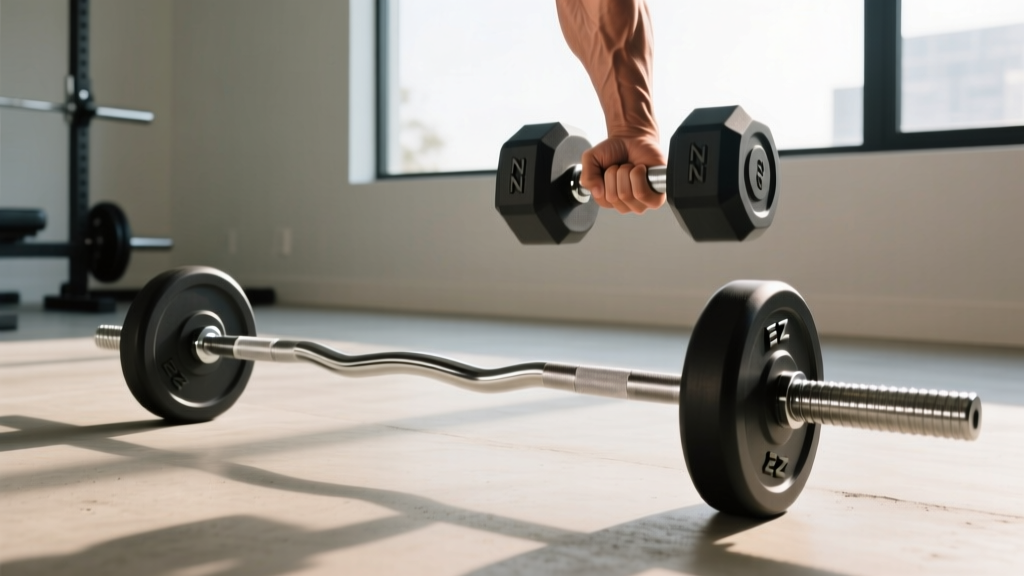
EZ Bar vs Straight Bar: Is the Close Grip Dumbbell Curl Better?
We test the EZ curl bar vs straight bar for bicep growth and reveal why the close grip dumbbell curl might be the ultimate joint-friendly mass builder.

The Eternal Arm-Building Debate: Fixed Bars vs. Free Movement
Walk into any serious training facility in 2026, and you will inevitably witness the ongoing debate over the best tools for bicep hypertrophy. For decades, the straight barbell and the EZ curl bar have dominated arm days. The straight bar promises maximum supination and peak bicep contraction, while the EZ bar offers an ergonomic reprieve for aching wrists. But as biomechanical science and sports physiotherapy have evolved, a third contender has emerged from the free weight rack: the close grip dumbbell curl.
In this hands-on review, we are putting the Rogue Curl Bar and a standard 5-foot Olympic straight bar to the test. More importantly, we are breaking down the exact biomechanics of why the close grip dumbbell curl might actually render both bars obsolete for lifters prioritizing joint longevity and brachialis thickness.
Biomechanical Breakdown: Supination Torque and Wrist Health
To understand why equipment selection matters, we must look at the primary functions of the biceps brachii. According to the kinesiology databases at ExRx.net, the biceps brachii is responsible for two main actions: elbow flexion and forearm supination. The underlying brachialis, however, is a pure elbow flexor that works regardless of forearm rotation.
When you use a straight bar, your hands are locked in a fully supinated, fixed position. For lifters with a high 'carrying angle' (cubitus valgus) at the elbow, this fixed position creates immense valgus stress on the wrist and medial epicondyle. Over time, this repetitive torque can lead to tendinopathy. The Mayo Clinic notes that repetitive strain and fixed-joint loading are primary catalysts for forearm and wrist tendinitis, a common complaint among veteran bodybuilders.
Warning: If you experience medial elbow pain or sharp wrist discomfort during straight-bar curls, pushing through the pain will not build muscle; it will only accelerate connective tissue degradation. You must alter your grip or your tool.Hands-On Equipment Review: EZ Bar vs. Straight Bar
We tested two industry-standard bars to evaluate knurling, shaft diameter, and joint comfort during high-volume hypertrophy blocks.
1. The Straight Bar (CAP Barbell 5-Foot Solid Bar)
At roughly $65, the CAP 5-foot solid bar is a staple in home gyms. It features a 25mm shaft diameter and aggressive knurling. The Verdict: While it allows for absolute maximum load and complete supination, the fixed hand position forces the wrists into ulnar deviation at the top of the movement. It is excellent for power output but suboptimal for long-term joint health.
2. The EZ Curl Bar (Rogue Curl Bar)
Retailing at $195, the Rogue Curl Bar features a 195,000 PSI steel shaft and a 28.5mm diameter. The angled grips (roughly 45 to 60 degrees) allow for a semi-supinated grip. The Verdict: This drastically reduces wrist strain and shifts a slight percentage of the load to the brachioradialis. However, because the angles are fixed, it still does not accommodate the natural, individual rotational path of every lifter's humerus and radius.
Comparison Matrix
| Feature | 5ft Straight Bar | Rogue EZ Curl Bar | Close Grip Dumbbell |
|---|---|---|---|
| Approx. Cost (2026) | $65 | $195 | $125 (per pair) |
| Wrist Strain | High | Low/Moderate | Near Zero |
| Biceps Peak Activation | Maximum | High | High (with supination) |
| Brachialis Bias | Low | Moderate | Maximum |
| Unilateral Imbalance Fix | No | No | Yes |
The Plot Twist: Why the Close Grip Dumbbell Curl Wins
If both fixed bars have inherent biomechanical compromises, what is the solution? Enter the close grip dumbbell curl. This movement is typically performed in one of two ways: holding a single heavy hex dumbbell vertically with both hands cupping the top bell, or pressing two dumbbells tightly together in a narrow, neutral grip.
By bringing the hands close together and utilizing independent dumbbells, you completely remove the fixed rotational torque of a barbell. Your wrists and elbows are free to track through their natural, individualized range of motion. Furthermore, the narrow, neutral hand position heavily biases the brachialis—the muscle that sits underneath the biceps brachii. When the brachialis grows, it literally pushes the biceps peak upward, creating a thicker, more impressive arm profile that a standard straight bar curl simply cannot maximize.
Pros and Cons of the Close Grip Dumbbell Variant
- Pro: Eliminates valgus wrist stress and medial elbow torque.
- Pro: Allows for natural forearm rotation (you can supinate as you ascend).
- Pro: Massive brachialis and brachioradialis overload for arm thickness.
- Con: Grip strength can become the limiting factor before bicep failure.
- Con: Loading is limited by the heaviest dumbbell available in your gym.
Step-by-Step Execution: Maximizing Hypertrophy
To get the most out of the close grip dumbbell curl, precision is required. Do not just swing the weight. Follow this exact protocol:
- The Setup: Select a heavy urethane or rubber hex dumbbell (e.g., 50-70 lbs). Stand tall, core braced, and cup the top of the dumbbell bell with both hands interlocked, or hold two dumbbells pinned tightly together in a neutral grip.
- The Eccentric (Lowering): Lower the weight over a strict 3-second count. Keep your elbows pinned to your ribcage. Do not let them drift forward.
- The Stretch: Pause for 1 second at the bottom. Feel the deep stretch in the brachialis and the distal bicep tendon.
- The Concentric (Lifting): Curl the weight up over 1 second. If using the two-dumbbell pinned variation, actively supinate your wrists outward at the very top of the movement to engage the biceps brachii peak.
- The Squeeze: Hold the top contraction for 1 second before repeating.
Programming Framework: How to Cycle Your Tools
You do not need to throw away your EZ bar or straight bar. Instead, use a periodized approach to your arm training throughout your 2026 macrocycle:
Mesocycle 1: Heavy Mechanical Tension (Weeks 1-4)
Use the Straight Bar for 3 sets of 6-8 reps. The goal here is pure load and mechanical tension. Keep the weight heavy, but stop one rep shy of form breakdown to protect the wrists.
Mesocycle 2: Metabolic Stress & Joint Relief (Weeks 5-8)
Transition to the Close Grip Dumbbell Curl for 4 sets of 12-15 reps using a 3-1-2-0 tempo. The higher rep range and slow eccentric will drive massive metabolic stress (the 'pump') into the brachialis without aggravating the connective tissues of the forearm.
Mesocycle 3: Unilateral Correction (Weeks 9-12)
Switch to standard alternating dumbbell curls to address any left-to-right strength imbalances that may have developed during the heavy barbell phases.
Expert Verdict & Final Recommendations
The straight bar remains an undeniable tool for raw strength and peak bicep supination, while the EZ curl bar serves as a necessary middle-ground for lifters with moderate wrist stiffness. However, when evaluating long-term joint health, natural biomechanical tracking, and the development of overall arm thickness, the close grip dumbbell curl stands out as the superior hypertrophy stimulus.
By freeing your wrists from a fixed steel axis and heavily targeting the brachialis, you unlock a new tier of arm growth. If you have been stuck on a plateau with the EZ bar, or if your medial elbow is screaming after straight bar sessions, it is time to step away from the barbell rack, grab a heavy hex dumbbell, and put the close grip variation to work.
More gear to consider
All reviews
Loadable Dumbbell Care for Your 15 Pound Dumbbell Workout
Incline Dumbbell Press at Home & Barbell Collar Comparison

Rack Setup: Power vs Squat Racks for Simple Dumbbell Workouts

Bumper vs Iron Plates: Care & Dumbbell Overhead Triceps Extension Muscles Worked
Barbell Collar Types: Beyond Dumbbell Exercises for Posture
