EZ Bar vs Straight Bar: Maintenance for Free Dumbbell Workouts
Compare EZ curl and straight bar maintenance. Learn rust prevention, sleeve care, and longevity tips to complement your free dumbbell workouts at home.

While free dumbbell workouts remain the cornerstone of hypertrophy, joint-friendly training, and home gym versatility, advancing your physique often requires integrating specialty Olympic bars. Transitioning from a purely dumbbell-based routine to incorporating an EZ curl bar or a standard straight Olympic bar introduces distinct biomechanical advantages—and significantly different maintenance variables. Unlike rubber or urethane-coated dumbbells, which are virtually maintenance-free, bare or lightly coated steel barbells are highly susceptible to environmental degradation.
In 2026, the home gym equipment market is saturated with advanced nano-ceramic coatings, yet traditional black oxide, zinc, and chrome finishes still dominate the mid-tier market. Understanding the metallurgical differences between a straight bar and an EZ curl bar is critical for preventing rust, preserving knurling integrity, and ensuring your equipment lasts a lifetime. This guide breaks down the exact maintenance protocols required to keep your specialty bars in pristine condition, ensuring they remain the perfect complement to your free dumbbell workouts.
The Metallurgical Divide: Straight Bar vs. EZ Curl Bar
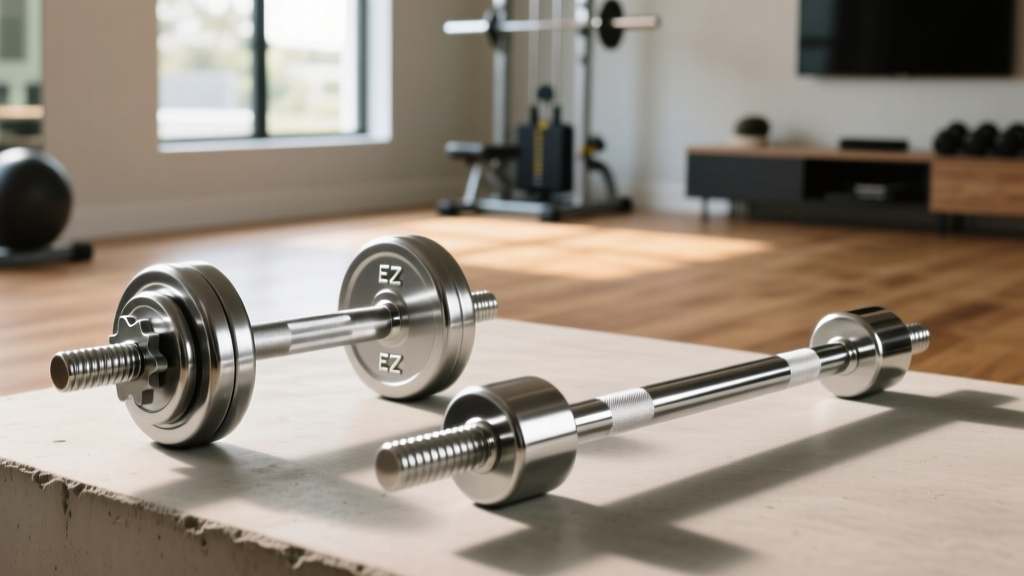
The physical geometry of a barbell dictates not only how it feels in your hands but also how it weathers environmental stress. A standard straight bar (like the iconic Rogue Ohio Bar) features a continuous, uniform shaft. In contrast, an EZ curl bar features multiple angled bends—typically at 120° and 145°—designed to reduce wrist and elbow supination strain during curls and triceps extensions.
These bends create unique stress points and microscopic crevices where moisture, dead skin, and gym chalk accumulate. Furthermore, the manufacturing process of bending an EZ bar can sometimes compromise the integrity of lower-quality chrome plating at the apex of the curves, leading to a specific failure mode known as 'chrome flaking.' According to the Rogue Fitness Barbell Care Guidelines, the primary enemy of any barbell is moisture trapped in the knurling valleys, but EZ bars require extra vigilance around the bent sleeves.
Coating Comparison and Maintenance Frequency
| Coating Type | Common Bar Models | Oxidation Resistance | Maintenance Frequency (60%+ Humidity) | Typical 2026 Price Range |
|---|---|---|---|---|
| Bare Steel | Custom Powerlifting Bars | Very Low | Before and after every use | $250 - $400 |
| Black Oxide | Rogue Ohio Bar (Standard) | Low-Medium | Weekly oiling, post-workout wipe | $200 - $295 |
| Zinc / Hard Chrome | Titan Fitness EZ Curl Bar | High | Monthly oiling, chalk removal | $130 - $180 |
| Cerakote (Ceramic) | Rogue Cerakote Ohio Bar | Very High | As needed (clean with mild soap) | $300 - $395 |
Knurling Care: The Most Common Point of Failure
Whether you are performing heavy deadlifts with a straight bar or close-grip skull crushers with an EZ bar, the knurling is your point of contact. The aggressive diamond pattern of Olympic knurling is essentially a grid of microscopic mountain peaks and valleys. During intense free dumbbell workouts or barbell sessions, sweat, sebum (skin oils), and magnesium carbonate (chalk) pack tightly into these valleys. If left untreated, this organic matter holds moisture directly against the steel, initiating galvanic corrosion.
💡 Pro-Tip: The Brush RuleNever use a stainless steel wire brush on zinc, chrome, or Cerakote coatings. You will strip the protective layer and ruin the knurling peaks. For coated bars and EZ bars, always use a stiff nylon bristle brush. Bare steel and black oxide bars can tolerate a brass wire brush, which is softer than steel but hard enough to dislodge chalk.
Step-by-Step Knurling Restoration Protocol
- Dry Scrub: Immediately after your workout, use a nylon or brass brush to vigorously scrub the knurling in a circular motion. This dislodges dried sweat and chalk.
- Deep Clean (Monthly): If chalk is impacted, apply a small amount of mineral spirits or isopropyl alcohol to a microfiber cloth and wipe the shaft. Avoid soaking the bar, as solvents can seep into the sleeves and degrade the internal grease.
- Oil Application: Apply 3-in-One oil or a dedicated barbell mineral oil to the shaft. Use a clean rag to rub the oil deeply into the knurling valleys.
- Wipe Down: Let the oil sit for 10 minutes, then wipe off all excess. A bar should feel tacky, not greasy. Greasy bars are a slip hazard for heavy free dumbbell workouts and barbell complexes.
Sleeve, Bushing, and Bearing Longevity
A frequently overlooked aspect of barbell maintenance is the rotating sleeve assembly. Straight Olympic bars designed for Olympic weightlifting typically utilize needle bearings, while power bars and most EZ curl bars rely on bronze or composite bushings. The maintenance approach for these two systems differs drastically.
Bushing vs. Bearing Maintenance
EZ curl bars almost exclusively use bronze bushings because the rotational speed of a curl or triceps extension does not require the high-RPM spin of a needle bearing. Bushings are self-lubricating to a degree but can seize if exposed to excessive moisture or if the factory grease dries out.
⚠️ WARNING: The WD-40 MythNever use standard WD-40 on barbell sleeves or shafts. WD-40 is primarily a solvent and water displacer, not a long-term lubricant. It will strip the existing factory grease from your bushings and bearings, leading to metal-on-metal grinding and permanent sleeve seizure. Use a lightweight synthetic machine oil or PTFE-based lubricant instead.
To maintain the sleeves of your straight bar or EZ bar, place the bar vertically on its end. Apply 2-3 drops of lightweight synthetic oil precisely at the seam where the rotating sleeve meets the steel collar. Rotate the sleeve manually for 30 seconds to allow capillary action to draw the oil into the bushing or bearing assembly. Wipe away any exterior drips to prevent dust accumulation.
Bridging the Gap: Specialty Bars and Free Dumbbell Workouts
Why invest time in maintaining specialty bars when free dumbbell workouts offer such immense versatility? The answer lies in progressive overload and biomechanical specificity. While adjustable dumbbells (like the Nuobell or PowerBlock Pro series) are excellent for unilateral work and general hypertrophy, they max out at 50-90 lbs for most home users. An EZ curl bar allows for heavier, bilateral bicep and triceps loading, while a straight bar is non-negotiable for heavy squats, deadlifts, and barbell rows.
According to the Cerakote Official Care Instructions, modern ceramic coatings can withstand immense abrasion, but they are not immune to the impact of metal-on-metal contact. When integrating barbell work alongside your free dumbbell workouts, storage becomes a critical maintenance factor.
Storage and Environmental Controls
- Never Store on the Floor: Concrete garage floors wick moisture and emit alkaline dust. Storing an EZ bar or straight bar on the floor guarantees rust on the bottom sleeve and shaft.
- Use a Dedicated Rack or Gun Rack: Store bars vertically in a wall-mounted gun rack or horizontally on a power rack's band pegs. Ensure the rack's metal pegs are lined with UHMW plastic or rubber to prevent scratching the bar's coating.
- Humidity Control: If your home gym is in a garage or basement where relative humidity (RH) regularly exceeds 60%, invest in a commercial dehumidifier. High humidity accelerates black oxide degradation from weeks to mere days.
When to Retire Your Barbell: Edge Cases and Safety
Barbells are generally considered 'buy it for life' equipment, but there are specific failure modes that necessitate retirement, particularly in older or poorly maintained EZ bars.
'A barbell should be retired if the shaft exhibits permanent deformation (bending) under loads that previously caused no issue, or if the knurling has rusted to the point of flaking, which can cause severe lacerations during heavy lifts.' — Home Gym Engineering Standards, 2025
For EZ curl bars, inspect the inner curves closely. If you notice the chrome peeling away in sharp, metallic shards, the bar is a laceration hazard and must be replaced. For straight bars, check the sleeve snap rings. If the sleeve exhibits excessive lateral play (more than 2-3 millimeters of side-to-side wobble), the internal retaining clips or thrust washers have failed, compromising the bar's structural integrity during heavy squats.
Final Thoughts on Gym Longevity
Mastering free dumbbell workouts builds a fantastic foundation, but a well-rounded home gym requires the heavy-duty capabilities of Olympic straight bars and the joint-saving ergonomics of EZ curl bars. By understanding the specific coating requirements, respecting the knurling with proper brushing techniques, and avoiding destructive solvents in the sleeve assemblies, you ensure your iron investments outlast your fitness journey. Treat your bars with the same respect you give your heaviest lifts, and they will never fail you.
More gear to consider
All reviews
ProForm Dumbbell Set vs Loadable Plates: Space Layout Guide

Cast Iron vs Competition Kettlebells & 100lb Dumbbell Set Value
Bumper Plate vs Iron Plate: Best for the Double Dumbbell Swing?
2026 Dumbbell Rack Trends: Optimizing Proper Incline Dumbbell Press

Olympic Barbell Buying Guide: Weight, Knurling & Dumbbell Waiter Curls