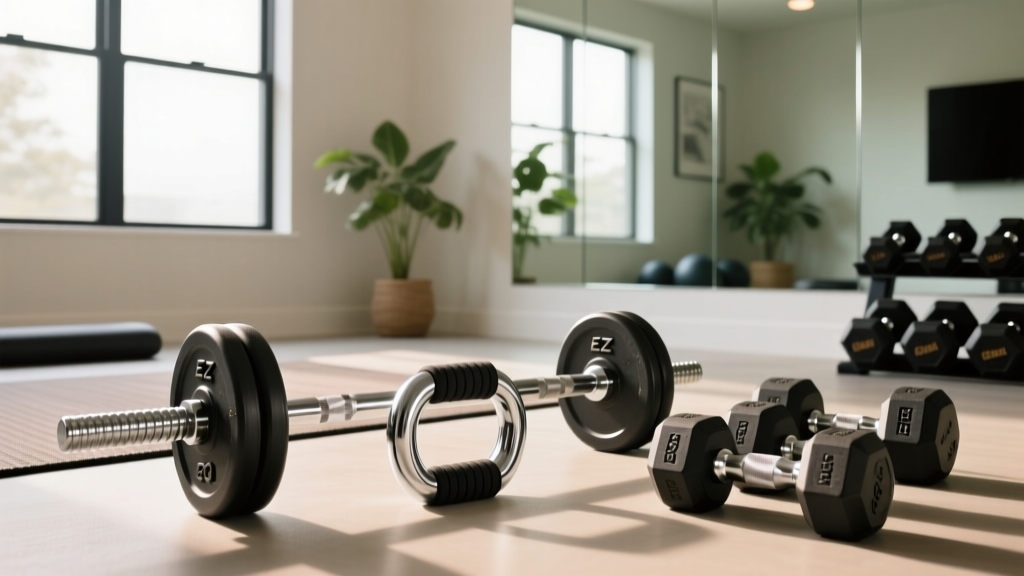
EZ Curl vs Straight Bar Care & Abs Workout at Home with Dumbbells
Master EZ curl vs straight bar maintenance to prevent rust and sleeve wear, plus a complete abs workout at home with dumbbells for core strength.

The Intersection of Equipment Longevity and Core Programming
Building a comprehensive home gym in 2026 requires more than just purchasing premium free weights; it demands a rigorous approach to equipment maintenance and intelligent programming. Free weights are subjected to immense mechanical stress, environmental humidity, and the corrosive nature of human sweat. While most lifters know how to wipe down a bench, the nuanced metallurgical differences between specialty bars and standard Olympic bars require distinct care protocols.
Furthermore, preserving your primary lifting bars means occasionally shifting your programming to alternative implements. When your heavy bars are undergoing deep sleeve maintenance, or when you want to preserve your barbell knurling from excessive chalk and sweat during high-rep metabolic conditioning, shifting to a targeted abs workout at home with dumbbells is a strategic move for both your physique and your equipment's lifespan. This guide bridges the gap between meticulous free weight maintenance and intelligent, equipment-sparing core training.
Structural Stress: EZ Curl Bar vs Straight Bar Comparison
To properly maintain your bars, you must first understand the mechanical forces they endure. A standard 20kg straight Olympic bar and a 10-15kg EZ curl bar experience vastly different stress vectors, which directly impacts their long-term wear patterns and maintenance needs.
| Feature | Straight Olympic Bar (20kg) | EZ Curl Bar (10-15kg) | Maintenance Implication |
|---|---|---|---|
| Primary Stress | Symmetrical bending & high-torque shear | Localized stress at angled bends | EZ bars require close inspection of the welds/bends for micro-fractures. |
| Shaft Diameter | 28mm - 29mm | 25mm - 28mm | Thinner EZ bar shafts are more prone to permanent bending if dropped loaded. |
| Knurling Traps | Continuous center and outer knurl | Segmented knurl with smooth angled gaps | EZ bar angles trap dead skin and chalk; requires angled nylon brushing. |
| Sleeve Assembly | Heavy-duty needle bearings or bronze bushings | Standard bronze bushings (typically) | Straight bars need high-viscosity synthetic oil; EZ bars need lighter 3-IN-ONE. |
According to equipment longevity analyses by Garage Gym Reviews, the angled bends of an EZ curl bar create natural "stress concentrators." While a straight bar like the Rogue Ohio Bar is engineered to flex and return to true under 500+ lb loads, an EZ curl bar is not designed for heavy axial loading. Dropping an EZ curl bar, even from a low height, can cause micro-fractures in the chrome or Cerakote finish right at the apex of the bends, inviting rapid oxidation.
The 2026 Maintenance Protocol for Free Weights
Maintaining your bars is a three-step process: extraction, lubrication, and environmental control. Here is the exact protocol you should follow every 4 to 6 weeks.
Step 1: Knurling Extraction
Sweat, dead skin, and magnesium carbonate (chalk) compact into the knurling valleys, creating a paste that holds moisture against the steel. For bare steel or hard chrome straight bars, use a stiff nylon brush followed by a light pass with a brass wire brush. Never use steel wire brushes, as they will strip the chrome and initiate rust. For modern Cerakote finishes, stick strictly to nylon bristles to avoid dulling the ceramic coating.
Step 2: Sleeve Lubrication
The sleeve assembly relies on either bronze bushings or needle bearings to spin smoothly. Over time, factory grease degrades and attracts metallic dust from the barbell collars.
⚠️ CRITICAL WARNING: Never use standard WD-40 on your barbell sleeves. WD-40 is a solvent and water displacer, not a long-term lubricant. It will strip the existing grease from your bushings and attract microscopic dust, turning your sleeve assembly into a grinding paste. Use a high-viscosity synthetic oil or a dedicated barbell sleeve lubricant.To lubricate, apply 3-4 drops of synthetic oil to the seam where the shaft meets the sleeve. Spin the sleeve vigorously for 30 seconds to work the oil into the bushings, then wipe away any excess to prevent dust adhesion.
Step 3: Environmental Control
Humidity is the enemy of free weights. If your home gym is in a garage or basement, maintain a relative humidity level below 50%. Store your bars horizontally on a proper rack rather than leaning them against a concrete wall, which wicks moisture directly into the steel shaft.
Active Recovery: Abs Workout at Home with Dumbbells
While your primary Olympic bars undergo monthly deep-cleaning, or when you simply want to spare your barbell knurling from the corrosive effects of high-sweat metabolic circuits, dumbbells offer an incredible alternative for core development. The National Strength and Conditioning Association (NSCA) emphasizes that anti-rotation and unilateral loading are critical for functional core stability—movements that are perfectly suited for dumbbells.
Here is a highly effective, equipment-sparing abs workout at home with dumbbells that targets the entire core matrix without requiring a barbell.
1. Urethane Hex Dumbbell Suitcase Holds (Anti-Lateral Flexion)
- Target: Obliques, Quadratus Lumborum (QL), Grip Strength
- Equipment: Heavy Urethane Hex Dumbbell (35-55 lbs)
- Execution: Stand tall holding a single heavy dumbbell at your side. Resist the urge to lean away from the weight. Walk slowly for 40 yards, maintaining perfect spinal alignment.
- Protocol: 3 sets per side, 60-second rest.
- Longevity Tip: Urethane hex dumbbells are ideal here because their flat edges prevent rolling when you set them down mid-set, protecting your garage floor and the dumbbell's casing from impact damage.
2. Weighted Dumbbell V-Ups (Rectus Abdominis)
- Target: Upper and Lower Rectus Abdominis
- Equipment: Light Neoprene or Rubber Dumbbell (10-20 lbs)
- Execution: Lie flat on your back, holding a single dumbbell with both hands extended overhead. Simultaneously lift your torso and legs, passing the dumbbell from your hands to your feet at the apex of the movement. Lower slowly with a 3-second eccentric tempo.
- Protocol: 4 sets of 12-15 reps.
3. Single-Arm Dumbbell Pullover (Core & Lats Stabilization)
- Target: Deep Core Stabilizers, Serratus Anterior, Lats
- Equipment: Moderate Dumbbell (25-40 lbs) and a bench or stability ball
- Execution: Lying perpendicular across a bench (upper back supported), hold a single dumbbell with one hand. Lower the weight backward over your head while actively bracing your core to prevent your hips from dropping or your spine from hyperextending.
- Protocol: 3 sets of 10 reps per side, focusing on a 2-second pause at maximum extension.
- Biomechanics Note: As highlighted by American Council on Exercise (ACE) research on core stabilization, unilateral overhead extensions force the contralateral obliques to fire intensely to maintain pelvic neutrality.
Storing Your Dumbbells and Bars for Maximum Lifespan
The longevity of your free weights is inextricably linked to your storage solutions. For your straight bars and EZ curl bars, a horizontal wall-mounted rack with UHMW plastic liners is mandatory to prevent scratching the bar shafts. Never store bars vertically in a corner; the uneven pressure on the base collar can warp the internal snap rings over time.
For dumbbells, invest in a tiered A-frame or horizontal rack with rubberized cradles. Dropping heavy hex dumbbells onto concrete floors will eventually cause the cast iron cores to crack or the urethane coatings to split, exposing the iron to rapid rusting. By keeping your equipment properly racked, meticulously cleaned, and intelligently programming your workouts to balance barbell and dumbbell usage, your home gym will remain a pristine, high-performance training environment for decades.
More gear to consider
All reviews
EZ Curl Bar vs Straight Bar: Curls & Dumbbell Chest Fly Alternatives

Bumper Plate vs Iron Plate: Budgeting for Lifts and Flat Dumbbell Fly

EZ vs Straight Bar: Budget Latissimus Dorsi Dumbbell Workout Guide
Seated Row with Dumbbells: 2026 Rubber Hex vs Urethane Market Trends

Power Rack vs Squat Rack vs Squat Stand & Dumbbell Pads Guide
