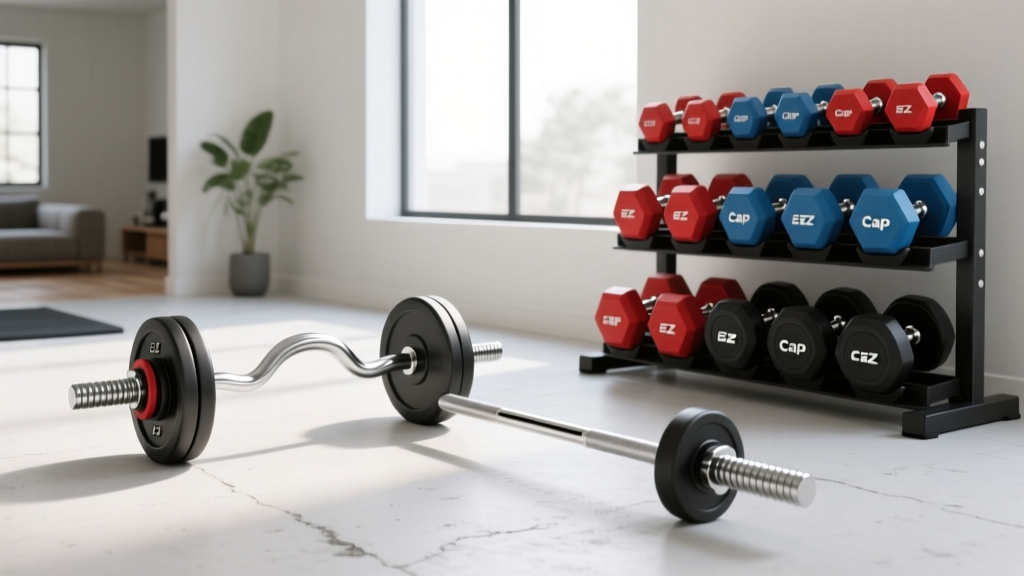
EZ Bar vs Straight Bar Layouts & Cap Barbell Dumbbell Storage
Optimize your home gym layout with our EZ curl bar vs straight bar space comparison and Cap Barbell dumbbell storage strategies for tight spaces.

The Geometry of the Home Gym: Why Barbell Length Matters
Designing a functional home gym in 2026 is less about acquiring the heaviest iron and more about mastering spatial geometry. For lifters operating in standard two-car garages or spare bedrooms (typically 150 to 300 square feet), every inch of clearance dictates workflow, safety, and equipment longevity. When evaluating free weights, the debate of an EZ curl bar vs straight bar usually centers on wrist biomechanics and muscle activation. However, from a space optimization and layout design perspective, the physical footprint, storage requirements, and rack compatibility of these bars present entirely different challenges.
According to facility layout guidelines emphasized by the National Strength and Conditioning Association (NSCA), a minimum of 36 inches of clearance is required on all sides of a primary lifting zone to ensure safe plate loading and emergency spotting. In a 10-foot wide garage (120 inches), deploying a standard 86-inch Olympic straight bar leaves a mere 17 inches of lateral clearance per side. This violates fundamental safety spacing. Conversely, a 47-inch EZ curl bar leaves 36.5 inches per side, perfectly aligning with safety protocols while maximizing the usable floor plan.
Dimensional Breakdown: EZ Curl Bar vs. Straight Bar
To understand the spatial impact, we must look beyond marketing claims and examine the exact metallurgy and dimensions of popular budget-to-mid-tier options. The CAP Barbell OB-85 (EZ) and the CAP Barbell OB-60 (Short Straight) are staples in compact home gyms. Here is how their physical dimensions translate to real-world spatial requirements.
| Specification | CAP OB-85 EZ Curl Bar | CAP OB-60 Short Straight Bar | Standard 86' Olympic Bar |
|---|---|---|---|
| Total Length | 47 inches | 60 inches | 86 inches |
| Shaft Length | 31 inches | 36 inches | 51.5 inches |
| Sleeve Length | 9.5 inches | 12 inches | 16.5 inches |
| Weight | 15 lbs | 35 lbs | 45 lbs |
| Wall Mount Storage Width | 48 inches | 62 inches | 88 inches |
| Lateral Clearance (10ft Room) | 36.5 inches (Safe) | 30 inches (Tight) | 17 inches (Unsafe) |
As highlighted by equipment testing experts at Garage Gym Reviews, the shorter sleeve length of the EZ bar (9.5 inches) also limits plate capacity. While this is a drawback for heavy compound lifts, it inherently forces a smaller physical footprint during use, preventing the bar from encroaching on adjacent equipment zones.
The Power Rack Compatibility Trap
The most critical edge case in home gym layout design is power rack J-cup spacing. Standard power racks feature an interior width of 49 inches. This creates a massive spatial paradox for the EZ curl bar.
WARNING: The 47-Inch J-Cup FailureA standard 47-inch EZ curl bar has a 31-inch shaft and two 9.5-inch sleeves. The total length is 47 inches. If your power rack has a 49-inch interior width, the EZ bar physically cannot rest on the J-cups. It will fall through the center of the rack. If you are integrating an EZ bar into a rack-based layout, you must either purchase a specialized 'short' straight bar (like the 60-inch OB-60) or invest in a narrower squat stand setup with adjustable exterior widths.
This incompatibility forces many space-conscious lifters to abandon the EZ bar for rack-based movements, relegating it strictly to floor-based isolation work. If your layout relies on a single, multi-purpose barbell for both floor curls and rack squats, the 60-inch short straight bar is the superior spatial and functional compromise.
Integrating the Cap Barbell Dumbbell Set into Tight Layouts
While specialty bars handle specific isolation movements, a comprehensive cap barbell dumbbell set (such as the CAP Hex 5-50 lb cast-iron or urethane collection) remains the backbone of unilateral training in space-constrained environments. Dumbbells eliminate the need for a barbell's massive lateral clearance, allowing you to perform heavy pressing and rowing movements directly in front of a wall or mirror without worrying about sleeve overhang.
However, storing a 10-pair dumbbell set introduces its own spatial hurdles. The official CAP Barbell storage ecosystem offers two primary configurations, each with drastically different floor plan impacts.
A-Frame vs. Horizontal Rack Footprints
- A-Frame Vertical Rack (Model RACK-050): Requires a footprint of just 24 x 24 inches (4 square feet). The vertical orientation utilizes Z-axis (height) space rather than X-Y floor space. Ideal for tight corners or placing directly adjacent to a power rack upright.
- 3-Tier Horizontal Rack: Requires a footprint of 48 x 24 inches (8 square feet), plus an additional 18 inches of frontal clearance for bending and lifting. Total spatial impact: ~14 square feet.
'In a sub-200 square foot gym, floor space is a depreciating asset. Always prioritize vertical storage solutions like the A-Frame for dumbbells and wall-mounted holsters for specialty bars to preserve the central lifting platform.'
2026 Layout Blueprints for Narrow Garages
If you are designing a layout for a narrow space (e.g., a single-car garage or a 10x20 foot basement zone), follow this step-by-step spatial hierarchy to maximize utility without sacrificing safety.
- Anchor the Rack: Place your power rack against the furthest back wall. Ensure 24 inches of clearance behind the uprights for lat pulldown attachments or plate storage.
- Deploy the Short Straight Bar: Use a 60-inch straight bar as your primary rackable barbell. It fits 49-inch interior J-cups while leaving 30 inches of lateral clearance for loading bumpers.
- Floor-Zone the EZ Bar: Store the 47-inch EZ curl bar on a dual-prong wall mount situated 4 feet off the ground, positioned outside the rack's swing radius. Use it strictly for floor-based skull crushers and upright rows.
- Corner the Dumbbells: Position your cap barbell dumbbell set on an A-frame rack in the front corner nearest the entry point. This creates an immediate 'grab-and-go' zone for warm-ups and accessory work without cluttering the primary barbell pathway.
Summary Matrix: Space vs. Utility
| Equipment | Primary Spatial Advantage | Primary Spatial Drawback | Best Layout Placement |
|---|---|---|---|
| 47' EZ Curl Bar | Minimal lateral clearance; safe for narrow rooms. | Cannot fit standard 49' power rack J-cups. | Wall-mounted outside the rack zone. |
| 60' Short Straight Bar | Rackable; balances length and plate capacity. | Requires 62' wall space for horizontal storage. | Inside the rack or on low wall holsters. |
| 86' Olympic Straight Bar | Maximum sleeve capacity for heavy loading. | Violates 36' safety clearance in rooms under 12' wide. | Only for wide, dedicated platform zones. |
| Cap Barbell Dumbbell Set | Zero lateral overhang; allows wall-facing lifts. | Heavy cumulative footprint if stored horizontally. | Vertical A-Frame in an unused corner. |
Ultimately, optimizing your free weight zone requires looking past the exercises themselves and engineering the room around the iron. By respecting the dimensional realities of the EZ curl bar vs straight bar debate, and intelligently racking your cap barbell dumbbell collection, you can transform a cramped garage into a highly efficient, professional-grade training facility in 2026.
More gear to consider
All reviews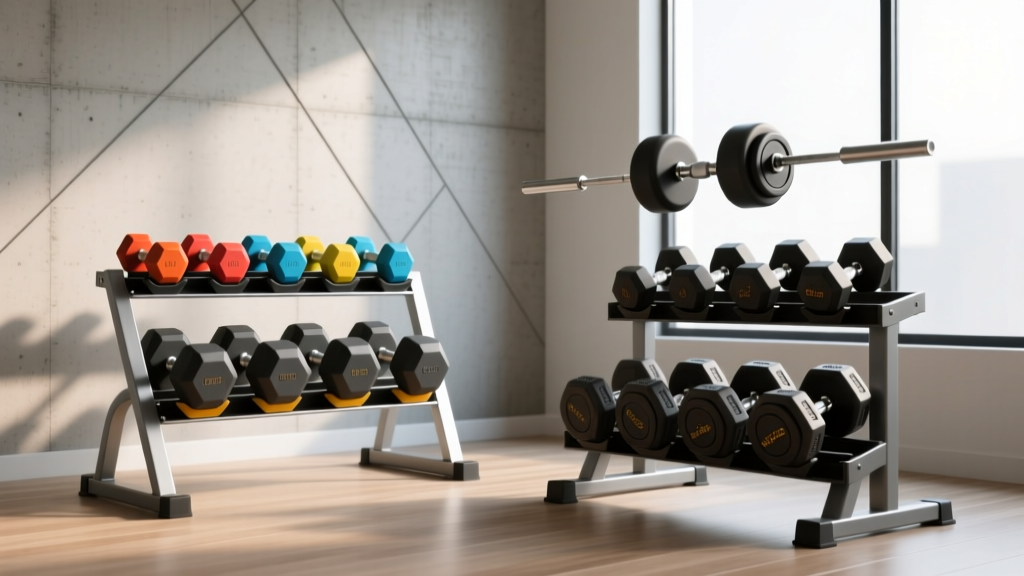
Gym Space: Urethane vs Hex for the Dumbbell Clean and Press Exercise
What Size Dumbbells Should I Use? The Case for Kettlebells in 2026

Bumper vs Iron Plate Costs: Funding Your Back Workout Using Dumbbells
Rubber Hex vs Urethane: Good Dumbbell Workouts at Home Gear Trends

Pause Dumbbell Incline Press: Fixing Neoprene Form & Grip
