Barbell Clamp Comparison: Safety Beyond Dumbbell Exercises Images
Compare barbell collar and clamp types for 2026. Discover which lock-jaw, lever, or spring clip secures your plates best during heavy lifts and drops.

The Unsung Heroes of the Home Gym
When building a free weight setup in 2026, lifters obsess over barbell knurl patterns, bumper plate durometer ratings, and power rack steel gauges. Yet, many frequently bottleneck their safety and workflow with subpar retention hardware. A barbell collar is the only barrier between a 400-pound squat and a catastrophic plate shift. Whether you are dropping bumper plates from overhead or grinding out heavy eccentrics, lateral force is the enemy of the barbell sleeve.
In this comprehensive head-to-head comparison, we break down the four primary barbell collar and clamp types on the market. We will analyze clamping force, change speed, material degradation, and edge cases like sleeve tolerances, ensuring you choose the exact hardware your training demands.
The Physics of Plate Retention and Lateral Force
Before comparing models, we must understand the physics of a loaded barbell. When a barbell is dropped, the kinetic energy transfers through the sleeve. If the collar lacks sufficient lateral clamping force, the plates separate. This 'plate gap' alters the barbell's center of gravity mid-lift, leading to asymmetric loading and severe joint torque.
Warning: According to the International Weightlifting Federation (IWF) Technical Rules, competition collars must weigh exactly 2.5 kg each and apply massive inward pressure to prevent any plate movement during Olympic drops. While home gym lifters do not need 2.5 kg competition clamps, the principle of zero plate-gap remains critical for safety.Head-to-Head: The 4 Main Barbell Collar Types
1. Spring Clip Collars (The Budget Standard)
The traditional chrome spring clip is the default inclusion with most budget barbell packages. Utilizing two steel coils and a wire frame, they rely on manual compression to slide onto the sleeve.
- Clamping Force: Very Low (approx. 10-15 lbs of lateral pressure).
- Change Speed: Slow (8-12 seconds per side, requiring two hands and significant grip endurance).
- Failure Mode: Metal fatigue. Over 12-18 months of daily use, the springs lose their tension memory, resulting in a loose fit that slides off during dynamic movements like hang cleans.
- Best For: Light accessory work, youth lifting, or emergency backups.
2. Lever/Clamp Collars (The Home Gym Workhorse)
Lever clamps, such as the Rogue HG 2.0 Aluminum Collars or the Bullclamp, use a cam-lever mechanism to pull a rigid or semi-rigid band tight against the sleeve. These are the gold standard for modern home and commercial gyms.
- Clamping Force: High (150-200+ lbs of lateral pressure).
- Change Speed: Extremely Fast (2-3 seconds per side, one-handed operation).
- Failure Mode: Plastic/rubber pad degradation. If left in direct UV sunlight or unheated garages below freezing, the interior grip pads can harden and crack.
- Best For: Powerlifting, general strength, and high-frequency plate changes.
3. Snap/Lock-Jaw Collars (The Drop-Safe Specialist)
Lock-Jaw collars utilize an injection-molded nylon hinge that snaps shut over the sleeve, secured by a secondary locking latch. They are incredibly popular in CrossFit affiliates due to their speed and secure grip during high-repetition drop sets.
- Clamping Force: Medium-High (Relies on exact 50mm sleeve friction rather than adjustable tension).
- Change Speed: Fast (3-4 seconds per side).
- Failure Mode: Hinge snapping. If dropped directly on the plastic hinge mechanism from a height of 6+ feet repeatedly, the nylon can fracture.
- Best For: Olympic weightlifting, CrossFit, and high-impact dropping.
4. Competition IWF/IPF Collars (The Elite Standard)
These are heavy-duty, calibrated steel clamps that use a threaded screw or spin-lock mechanism to apply immense pressure. As noted by BarBend's equipment experts, these are mandatory for sanctioned meets but are generally overkill for home use due to their weight and slow change times.
- Clamping Force: Maximum (Calibrated to competition standards).
- Change Speed: Slow (15+ seconds, requires two hands).
- Failure Mode: Thread stripping if cross-threaded by careless loaders.
- Best For: Sanctioned powerlifting/weightlifting meets and strongman events.
Comparison Matrix: 2026 Market Leaders
| Collar Type | Example Model | Approx. Price (Pair) | Weight (Per Collar) | Drop Rating | One-Handed? |
|---|---|---|---|---|---|
| Spring Clip | Generic Chrome Clip | $10 - $15 | 4 oz | Poor | No |
| Lever Clamp | Rogue HG 2.0 / Bullclamp | $45 - $55 | 6.8 oz | Excellent | Yes |
| Snap Collar | Lock-Jaw Collar | $30 - $35 | 5 oz | Very Good | Yes |
| Competition | Eleiko Olympic Clamp | $85 - $110 | 2.5 kg | Maximum | No |
Workflow Efficiency: Barbell Stripping vs. Dumbbell Transitions
Beyond pure safety, your choice of collar dictates the pacing of your training session. In modern hypertrophy programming, contrast sets and mechanical drop sets are standard. Imagine transitioning from heavy barbell floor presses to unilateral dumbbell work. You might even have your tablet propped open, referencing dumbbell exercises images to verify your eccentric wrist alignment and elbow tuck. But if you are stuck wrestling with a seized metal spring clip, your heart rate drops, your muscles cool down, and the superset window closes.
Lever clamps solve this workflow bottleneck. A 2-second flick of the wrist releases the cam, allowing you to strip 45-pound plates instantly. This efficiency keeps your rest intervals precise and maintains the neurological arousal required for heavy accessory work. When your programming demands rapid shifts between bilateral barbell lifts and unilateral dumbbell movements, quick-release hardware is not a luxury; it is a necessity for session density.
Edge Cases & Sleeve Tolerances: When Collars Slip
Not all barbells are created equal, and this is where many collar reviews fail to provide actionable advice. The Olympic standard sleeve diameter is exactly 50mm. However, budget import bars and specialized deadlift bars often feature sleeves that measure 49.5mm to 49.8mm.
The 49.8mm Sleeve Problem
If you use rigid plastic snap collars (like older Lock-Jaw models) on a 49.6mm sleeve, the collar will wobble, failing to create the friction necessary to prevent plate sliding. Conversely, lever clamps with a flexible, rubberized interior grip pad (such as the Bullclamp) will compress to fill the 0.4mm gap, maintaining a secure lock. Rule of thumb: If your barbell sleeves are not perfectly calibrated to 50mm, avoid rigid plastic snap collars and opt for adjustable lever clamps with rubber padding.
Knurling Interference and Pad Tearing
Many aggressive powerlifting bars feature a 'no-gap' design where the shaft knurling extends almost entirely to the inner sleeve lip. When you slide a lever clamp onto the sleeve, the rubber grip pad can catch on the sharp, volcano-style knurling. Over hundreds of loading cycles, this shears the rubber pad, leading to a loss of clamping force. To prevent this, always ensure you are sliding the collar on perfectly straight, or invest in collars that utilize a smooth, hard-anodized aluminum inner ring rather than a soft rubber pad.
Final Verdict: Which Collar Belongs on Your Sleeves?
For 90% of home gym owners and commercial facilities in 2026, the Lever/Clamp Collar is the undisputed champion. The combination of one-handed operation, massive lateral clamping force, and adaptability to slightly undersized sleeves makes models like the Rogue HG 2.0 or Bullclamp the smartest investment. Reserve spring clips for light warm-ups, and leave the heavy competition clamps for the sanctioned meet platforms.
Frequently Asked Questions
Can I use barbell collars on dumbbells?
No. Standard barbell collars are engineered for 50mm Olympic sleeves. Most loadable dumbbell handles feature 1-inch (25.4mm) diameter sleeves and require specific spin-lock nuts or specialized 1-inch spring clips. Attempting to modify a barbell clamp for a dumbbell handle is a severe safety hazard.
Do lever clamps scratch the barbell sleeves?
High-quality lever clamps use either rubberized grip pads or smooth, hard-anodized aluminum interiors that will not scratch chrome or zinc-coated sleeves. However, if dirt or chalk becomes trapped between the collar and the sleeve, dragging the collar across the metal can cause micro-abrasions. Wipe your sleeves down periodically to prevent this.
Why do my plates still rattle with tight collars?
Rattling is often caused by the plates themselves, not the collar. Cast iron plates with wide center holes (often exceeding 51mm) will rattle against the 50mm sleeve regardless of how tightly the collar clamps the outer edge. Bumper plates with precision-machined steel inserts will eliminate this noise when paired with a quality lever clamp.
More gear to consider
All reviews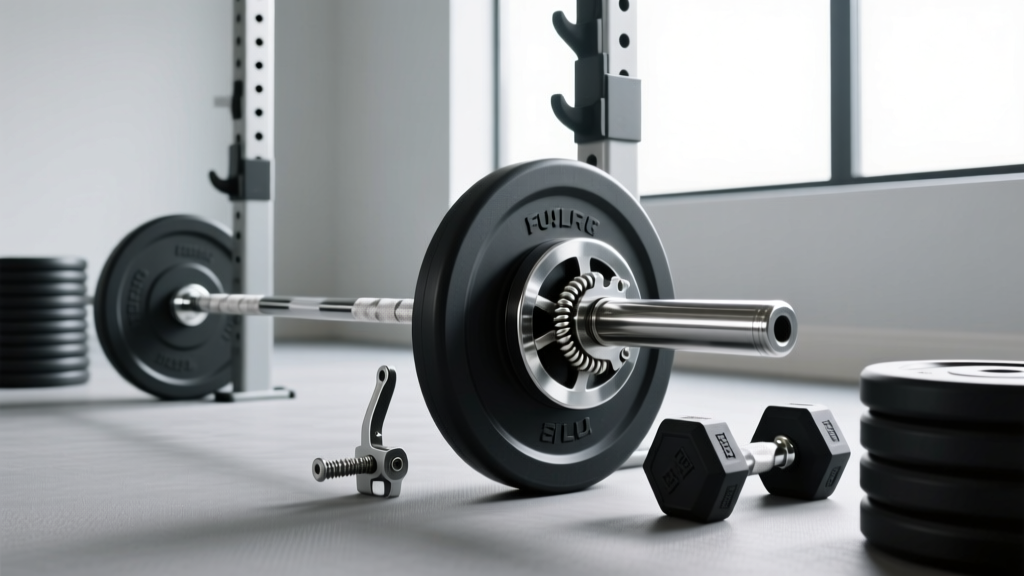
Barbell Collar vs Clamp: Securing Weight Bench Dumbbells & Bars

Fixing Your Back Workout with Dumbbells and Barbell: Neoprene Mistakes

Home Gym Setup: Olympic vs Standard Plates & Dumbbell Leg Lunges

Cast Iron vs Competition Kettlebells & Overhead Presses with Dumbbells

Budget Breakdown: White Dumbbell Set vs Bumper and Iron Plates