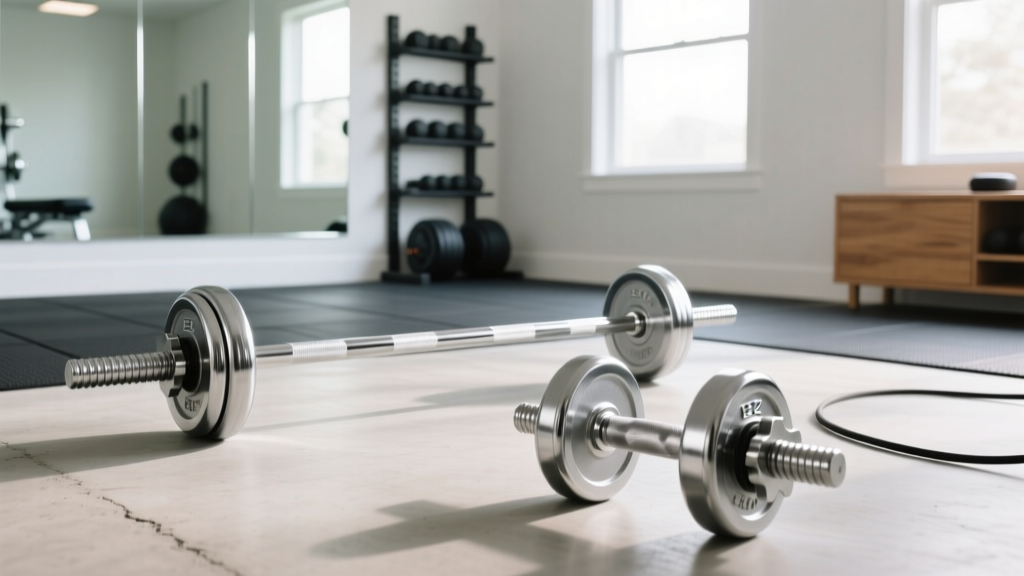
EZ Curl Bar vs Straight Bar & One Arm Dumbbell Deadlift
We break down the EZ curl bar vs straight bar debate for arm isolation, then master the one arm dumbbell deadlift for unilateral posterior strength.

Building the Ultimate Asymmetrical & Isolation Arsenal
When outfitting a home gym or refining a commercial facility's free weight zone, lifters often obsess over standard Olympic barbells and adjustable dumbbells. However, true biomechanical optimization requires specialized implements. In this 2026 expert guide, we tackle two critical, yet frequently misunderstood, free weight categories: the upper-body isolation debate of the EZ curl bar vs straight bar, and the ultimate unilateral posterior chain builder, the one arm dumbbell deadlift. Whether you are trying to salvage your elbows from chronic tendonitis or build bulletproof anti-rotation core strength, mastering these specific tools and movements is non-negotiable for advanced lifters.
Biomechanics: EZ Curl Bar vs Straight Bar
The debate between using a standard straight barbell and a cambered EZ bar for bicep curls ultimately comes down to the carrying angle of the human elbow. When your arms hang naturally at your sides with palms facing forward, your forearms angle slightly outward. This is your carrying angle.
A standard straight bar (typically 47 to 72 inches long) forces the wrists into full supination (palms perfectly flat facing up). For lifters with a pronounced carrying angle, this extreme supination creates immense valgus stress on the elbow joint, specifically targeting the medial epicondyle. Over time, this leads to medial epicondylitis, commonly known as golfer's elbow. According to biomechanical analyses reviewed by BarBend, the EZ bar's angled grips allow for a semi-supinated wrist position, significantly reducing torque on the elbow while maintaining high electromyography (EMG) activation in the biceps brachii and brachioradialis.
| Feature | Standard Straight Bar (e.g., Ohio Bar) | Olympic EZ Curl Bar |
|---|---|---|
| Grip Position | Full Supination (0°) | Semi-Supinated (30° to 45°) |
| Elbow Joint Stress | High (Medial Epicondyle) | Low to Moderate |
| Primary Muscle Bias | Short Head of Biceps | Brachioradialis & Long Head |
| Average Weight (2026) | 45 lbs (20 kg) | 15 lbs to 35 lbs (7 to 16 kg) |
| Max Load Capacity | 1,500+ lbs | 300 to 800 lbs |
2026 Expert Top Picks: Curl Bars & Straight Bars
Based on our hands-on testing of knurling depth, sleeve rotation, and tensile strength, here are the top picks for your free weight rack this year.
1. Rogue Fitness Curl Bar (Best Overall EZ Bar)
Priced around $165, the Rogue Curl Bar remains the gold standard. It features a 190,000 PSI tensile strength steel shaft and dual knurl marks. The camber angles are perfectly calibrated at 30 and 45 degrees, accommodating both close-grip preacher curls and wide-grip standing curls. The composite bushings provide a smooth spin without the wobble found in cheaper $80 Amazon alternatives.
2. Texas Barbell Power Bar (Best Straight Bar for Heavy Isolation)
If you insist on using a straight bar for heavy reverse curls or strict strict supinated curls, you need a bar with zero whip. The Texas Barbell Power Bar ($295) features 205,000 PSI tensile strength and an incredibly aggressive knurl. Its stiffness ensures that when you are grinding out a heavy 5-rep max curl, the bar won't oscillate and throw off your center of gravity.
Expert Tip: Never use your primary Olympic weightlifting bar for heavy straight-bar curls. The aggressive knurl will tear your calluses, and the high whip of a deadlift or Olympic bar will destabilize the eccentric portion of your curl.The Unilateral Hinge: Mastering the One Arm Dumbbell Deadlift
While the EZ and straight bars dominate upper-body isolation, the lower body and core require asymmetrical loading to correct imbalances. Enter the one arm dumbbell deadlift (often programmed as a unilateral suitcase deadlift or single-arm Romanian deadlift). This movement is a staple in elite strength and conditioning programs because it simultaneously trains the posterior chain (glutes, hamstrings) and the lateral core (quadratus lumborum, obliques).
When you hold a heavy dumbbell in only one hand—such as a 100 lb Rogue Rubber Hex Dumbbell—your body naturally wants to laterally flex toward the load. Your contralateral core musculature must fire maximally to maintain a neutral spine. As noted by strength experts at T-Nation, this anti-lateral-flexion stimulus is vastly superior to traditional side planks for building functional, athletic core stiffness.
Step-by-Step Execution
- The Stance: Stand with feet hip-width apart. Place a heavy dumbbell or kettlebell on the floor directly outside your right foot.
- The Hinge: Push your hips back (do not just bend your knees). Keep your spine completely neutral. Reach down and grip the dumbbell with your right hand using a neutral (hammer) grip.
- The Bracing: Before lifting, take a deep diaphragmatic breath. Brace your core as if anticipating a punch to the stomach. Ensure your shoulders are level—do not let the loaded shoulder dip.
- The Drive: Drive your feet through the floor and extend your hips. The dumbbell should travel in a perfectly vertical line, grazing your leg. Do not let the weight pull you into rotation.
- The Eccentric: Reverse the movement by hinging at the hips, maintaining the exact same vertical bar path and level shoulders until the weight rests on the floor.
- Helicoptering: Allowing the torso to twist toward the dumbbell. Fix this by imagining a wall directly behind your back.
- Shoulder Dipping: Letting the latissimus dorsi relax, causing the loaded shoulder to drop toward the floor. Keep your scapula depressed and packed.
- Squatting the Hinge: Bending the knees too much and turning the movement into a lunge. The shin must remain mostly vertical; the hips must travel backward.
Programming Integration: Pairing Isolation with Unilateral Hinges
To maximize gym efficiency and leverage the unique benefits of both the EZ bar and the one arm dumbbell deadlift, pair them in a specialized superset. This combination pairs a low-central-nervous-system (CNS) isolation movement with a high-CNS unilateral compound movement, optimizing blood flow and time under tension.
The 2026 'Armor Building' Superset
- A1. One Arm Dumbbell Deadlift: 4 sets of 6-8 reps per side. (Rest 60 seconds). Focus on heavy loading and perfect anti-rotation. Use a 70-100 lb dumbbell depending on your strength level.
- A2. EZ Bar Strict Curl: 4 sets of 10-12 reps. (Rest 90 seconds). Use the inner 30-degree grips to spare the elbows. Focus on a 3-second eccentric lowering phase.
Expert Verdict & Buying Advice
If you are building a home gym on a budget, skip the cheap, low-tensile straight bars that bend under heavy loads. Invest in a high-quality EZ curl bar (like the Rogue or CAP Barbell Super Curl) to protect your elbows during arm isolation work. For your lower body and core, bypass the expensive trap bars and specialty leverages; a simple pair of heavy hex dumbbells is all you need to master the one arm dumbbell deadlift. By understanding the specific biomechanical purposes of these implements, you will train smarter, avoid chronic joint pain, and build a more resilient, symmetrical physique.
Frequently Asked Questions
Can I use a straight bar for deadlifts instead of a dumbbell?
Yes, the traditional bilateral barbell deadlift is the king of posterior chain builders. However, the one arm dumbbell deadlift specifically targets the quadratus lumborum and obliques through anti-rotation and anti-lateral flexion, which a standard bilateral barbell deadlift does not achieve to the same degree.
Is the EZ curl bar better for triceps as well?
Absolutely. The EZ bar is exceptional for skull crushers and close-grip bench presses. The semi-supinated grip places the triceps' long head under a massive stretch while significantly reducing the wrist extension pain often associated with straight-bar triceps extensions.
How heavy should my dumbbell be for the one arm deadlift?
As a general benchmark, intermediate lifters should aim to use a dumbbell equivalent to 30-40% of their body weight for working sets of 8 reps. Advanced lifters can push this to 50% or more, provided the spine remains perfectly neutral and the shoulders stay level. Always check current equipment specs on authoritative sites like Rogue Fitness to ensure your bars and dumbbells meet safety ratings for heavy loads.
More gear to consider
All reviews
Budget Dumbbell Racks for the Dumbbell Romanian Dead Lift (2026)
Power Rack vs Squat Rack vs Stand for Dumbbell Ground to Overhead
EZ vs Straight Bar: Layouts & Dumbbell Hollow Hold Space Tips

Collar Comparison: Beyond Back Workouts with Dumbbells Women's

Beyond the 30 Minute Full Body Dumbbell Workout: Barbell Buying Guide