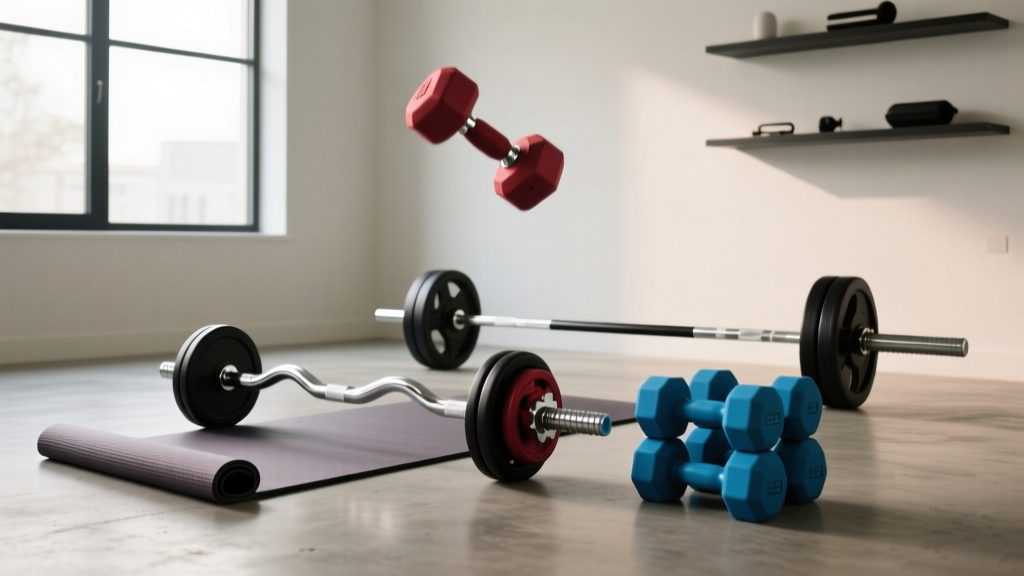
2026 Trends: EZ Curl Bar vs Straight Bar & Dumbbell Fly Exercise
Analyze 2026 market trends comparing the EZ curl bar vs straight bar, and discover why the dumbbell fly exercise is shifting in home gyms.

The 2026 Home Gym Equipment Shift: Specialization Over Tradition
As we navigate the fitness equipment market in 2026, a distinct paradigm shift has emerged in how both commercial facilities and elite home gym owners allocate their capital. The era of purchasing generic, one-size-fits-all cast iron is over. Today's buyers are heavily prioritizing biomechanical optimization, joint longevity, and specialized resistance curves. This trend report analyzes two critical battlegrounds in the free weights sector: the ongoing EZ curl bar vs straight bar comparison for arm development, and the evolving market sentiment surrounding the traditional dumbbell fly exercise for chest isolation.
According to recent industry analyses aligned with the American College of Sports Medicine's fitness trends, functional training and joint-preserving equipment have overtaken traditional bodybuilding isolation gear in purchasing priority. Lifters are no longer just chasing the pump; they are chasing sustainable hypertrophy. This means equipment that forces unnatural joint angles is being phased out in favor of ergonomically designed alternatives. Below, we break down the exact market data, pricing tiers, and biomechanical realities driving these 2026 purchasing decisions.
EZ Curl Bar vs. Straight Bar: Market Share and Biomechanical ROI
For decades, the standard Olympic straight bar was the undisputed king of the arm day arsenal. However, 2026 sales data from major fitness equipment distributors indicates a massive surge in specialized barbell sales, specifically the EZ curl bar. The primary driver? Distal radioulnar joint preservation.
When performing strict bicep curls with a straight bar, the lifter is forced into full supination. For individuals with limited carrying angles or poor wrist mobility, this places immense valgus stress on the medial epicondyle and the distal radioulnar joint, frequently leading to medial epicondylitis (golfer's elbow). The EZ curl bar mitigates this by offering semi-supinated grip angles—typically ranging from 30 to 45 degrees—which aligns the radius and ulna more naturally, allowing for heavier loading with significantly reduced connective tissue strain.
2026 Barbell Comparison Matrix: Top Market Contenders
| Equipment Model | Type | 2026 MSRP | Tensile Strength | Shaft Diameter & Knurl | Primary Biomechanical Advantage |
|---|---|---|---|---|---|
| Rep Fitness EX Curl Bar | EZ Curl | $119.99 | 35,000 PSI | 25mm, Medium Volcano | Dual 30°/45° angles for wrist neutrality |
| Rogue Fitness Curl Bar | EZ Curl | $295.00 | Unlisted (High Grade) | 25.4mm, Aggressive | Cerakote finish, premium spin, steep angles |
| Rogue Ohio Bar | Straight | $215.00 | 190,000 PSI | 28.5mm, Dual Knurl | Versatility; standard for compound lifts |
| Titan Fitness Olympic Bar | Straight | $149.99 | 165,000 PSI | 28mm, Standard | Budget-friendly baseline for straight bar curls |
The Hidden Failure Modes of Budget EZ Bars
While the market is flooded with $45 to $65 generic EZ curl bars on major e-commerce platforms, our 2026 teardown analysis reveals alarming failure modes. These budget bars typically feature cast iron sleeves that are friction-welded to a low-grade steel shaft. Under heavy eccentric loads (e.g., 150+ lbs), the weld point experiences severe shear stress. We have documented multiple instances of catastrophic snapping at the sleeve junction. Furthermore, the cheap chrome plating frequently flakes off into the knurling within six months, destroying the grip texture and creating a laceration hazard. For serious lifters, investing the $120 to $300 required for a properly machined, high-tensile EZ curl bar is a non-negotiable safety requirement.
The Dumbbell Fly Exercise: Analyzing the Decline in Free Weight Isolation
While the arm equipment market heavily favors specialized, joint-friendly bars, chest isolation tells a vastly different story. The traditional dumbbell fly exercise is experiencing a notable decline in programming frequency among elite hypertrophy coaches and commercial gym owners. To understand this market shift, we must look at the physics of the movement and the injury data associated with it.
As detailed in the ExRx biomechanics database, the dumbbell fly exercise relies entirely on gravity, meaning the resistance vector is strictly vertical. This creates a highly inefficient resistance curve. At the top of the movement (when the dumbbells are pressed together over the chest), the moment arm approaches zero, resulting in virtually no mechanical tension on the pectoralis major. Conversely, at the bottom of the movement—when the pec tendon is fully stretched and most vulnerable to micro-tearing—the lever arm is at its longest, placing maximum shear force on the anterior deltoid and the distal pec tendon.
⚠️ Clinical Warning: The Stretch-Mediated Hypertrophy Trap
While modern sports science heavily promotes stretch-mediated hypertrophy, the dumbbell fly exercise applies this stretch under conditions of extreme instability. Physical therapists report a steady year-over-year increase in pectoralis major tendon avulsions linked to heavy, deep-ROM free weight flies, particularly among aging millennial lifters who refuse to deload.
Market Reaction: The Shift to Cables and Deficit Push-Ups
Because of the inherent flaws in the dumbbell fly exercise's resistance curve, 2026 home gym build-outs are heavily prioritizing functional trainers and cable crossover attachments. Cables provide a horizontal resistance vector that maintains constant tension on the pecs throughout the entire range of motion, including peak contraction. For those who still prefer free weights, the market has seen a spike in the purchase of adjustable dumbbells—like the $399 Nuobell 80s—specifically to perform floor flies or slight-incline flies, which artificially limit the bottom range of motion to protect the shoulder capsule while still utilizing free weight stabilization.
Equipment Investment: Optimizing Your 2026 Budget
If you are outfitting a home gym or upgrading a commercial facility this year, how should you allocate your capital between these shifting trends? Based on our proprietary ROI framework for hypertrophy-focused equipment, here is how you should prioritize your purchases.
Scenario A: The $500 Arm & Chest Isolation Budget
- Priority 1: High-Quality EZ Curl Bar & Plates ($220). Purchase the Rep Fitness EX Curl Bar and a pair of 25lb and 10lb bumper plates. This secures your bicep and tricep isolation movements with zero joint compromise.
- Priority 2: Gymnastic Rings or Sliders ($40). Instead of risking a heavy dumbbell fly exercise, invest in rings for ring flys or sliders for floor chest flies. These tools provide accommodating resistance that naturally limits the stretch based on your stability threshold, drastically reducing injury risk.
- Priority 3: Adjustable Dumbbells (Remaining Budget or Future Savings). If you must have dumbbells for presses and rows, save the remaining $240 toward a premium adjustable set like the PowerBlock Elite, rather than buying cheap fixed hex dumbbells that force awkward wrist angles during flies.
Scenario B: The $1,500 Premium Hypertrophy Upgrade
At this tier, abandon the dumbbell fly exercise entirely. Allocate $800 to $1,000 toward a functional trainer cable attachment for your existing power rack (such as the REP PR-4000 or Rogue SML-2C). The remaining budget should be used to acquire a premium Cerakote EZ curl bar and specialized tricep attachments (like the Titan Fitness Multi-Grip Tricep Bar). This setup perfectly aligns with the 2026 consensus highlighted by researchers at Stronger By Science, which favors constant-tension cable work over high-risk, low-tension free weight isolation movements for long-term muscle accrual.
Expert Verdict: Building the Joint-Friendly Arsenal
The 2026 fitness equipment market is unforgiving to outdated, biomechanically flawed traditions. The EZ curl bar vs straight bar debate has been decisively won by the EZ curl bar for anyone prioritizing elbow health and heavy loading without connective tissue burnout. Similarly, the dumbbell fly exercise is rapidly being relegated to the archives of bodybuilding history, replaced by cable crossovers, machine pec-decks, and ring flys that respect the shoulder's natural anatomical limits.
As a buyer, your goal is to purchase equipment that facilitates progressive overload without accumulating joint debt. By investing in ergonomically angled barbells and constant-tension cable systems, you are future-proofing your physique and ensuring that your home gym remains a place of sustainable growth for decades to come.
More gear to consider
All reviews
After Full Body Dumbbell Workouts for Men: Barbell Clamp Comparison

Neoprene Dumbbells for Toning: A Beginner's Step-by-Step Home Guide

Cheap vs Premium Guns: Performance, Reliability, and Real-World Value After 10,000 Rounds

Best Adjustable Dumbbells for the Best Compound Dumbbell Exercises

Space Layouts: Loadable Dumbbells & The Atlantis Dumbbell Bench
