EZ Curl Bar vs Straight Bar for Dumbbell Apartments: 2026 Trends
Analyze the EZ curl bar vs straight bar debate for small spaces. Discover 2026 market trends, spatial economics, and biomechanics for dumbbell apartments.

The Rise of the 'Dumbbell Apartment' in 2026
The urban fitness landscape has shifted dramatically. As commercial gym memberships fluctuate and urban square footage remains at a premium, the 'dumbbell apartment' has evolved from a makeshift corner of adjustable iron into a highly optimized micro-gym. Historically, renters relied exclusively on adjustable dumbbells to navigate strict lease agreements regarding floor loading and noise. However, as the home fitness equipment market continues its post-pandemic stabilization—projected to reach new heights in specialized compact gear according to Grand View Research—apartment dwellers are seeking targeted hypertrophy tools that dumbbells alone cannot replicate. This brings us to a critical crossroads for small-space lifters: the EZ curl bar vs straight bar debate.
While a standard 7-foot Olympic barbell is a non-starter for most rental units due to its 86-inch wingspan and the sheer danger of dropping 300+ pounds on engineered subflooring, shorter specialty bars have flooded the market. But which offers the highest return on investment, joint preservation, and spatial efficiency for the modern renter? This 2026 trend report breaks down the biomechanics, spatial economics, and market realities of integrating these bars into tight living spaces.
Spatial Economics: Mapping the Footprint
When outfitting a dumbbell apartment, every square inch of floor space and wall storage is heavily contested. The decision between an EZ curl bar and a compact straight bar (typically 5-foot or 6-foot Olympic variants) hinges on your storage infrastructure and training radius.
| Metric | Standard EZ Curl Bar | 5-Foot Straight Bar | 7-Foot Straight Bar (Reference) |
|---|---|---|---|
| Total Length | 47 - 50 inches | 60 inches | 86 inches |
| Bar Weight | 15 - 22 lbs | 35 lbs | 44 - 45 lbs |
| Loadable Sleeve | 10 - 12 inches | 13 inches | 16.3 inches |
| Wall Storage | Standard J-Hooks | Requires Wide Rack | Requires Standard Rack |
| Avg. Price (2026) | $110 - $180 | $140 - $200 | $250+ |
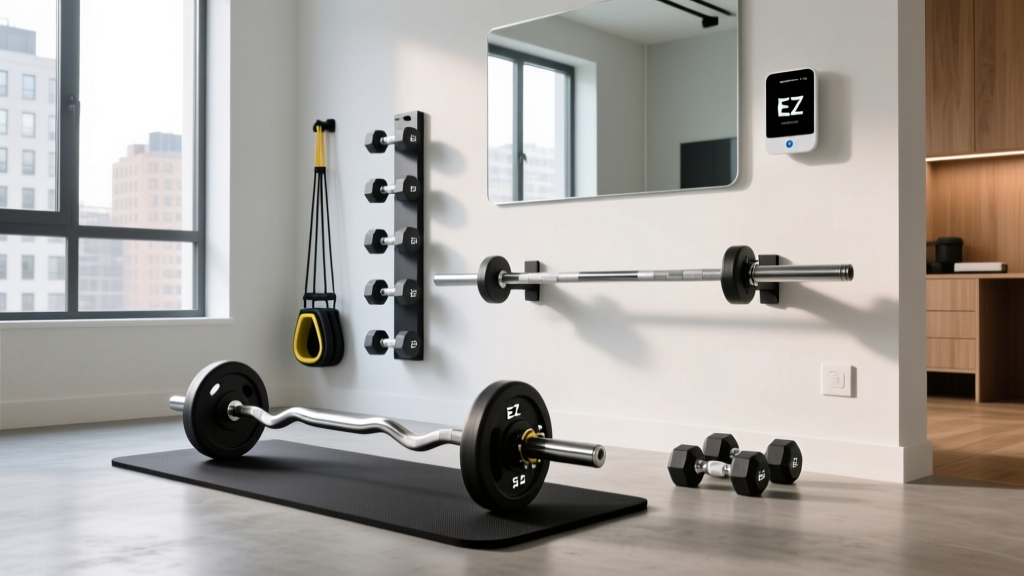
For the true 'dumbbell apartment' setup—where a full power rack is absent and equipment is stored in closets or under beds—the EZ curl bar is the undisputed king of spatial efficiency. A 47-inch bar can easily slide under a standard bed frame or hang on a single heavy-duty wall peg, whereas a 5-foot straight bar often requires dedicated vertical storage or a squat stand with 48-inch cross-members.
Biomechanical Realities: Wrist Health and Muscle Activation
Beyond spatial constraints, the physiological impact of your bar choice dictates long-term training sustainability. The primary argument for the EZ curl bar has always been ergonomic. The angled grips (typically set at 30 to 45 degrees) allow for a semi-supinated grip, reducing the valgus stress on the wrists and elbows during flexion movements.
The EMG Data: Biceps vs. Brachialis
Electromyography (EMG) studies consistently show that while straight bars elicit slightly higher peak activation in the short head of the biceps brachii due to full supination, EZ curl bars shift significant load to the brachialis and brachioradialis. For apartment lifters performing high-volume skull crushers and close-grip bench presses in the early morning hours—where joint warm-up time is limited—the EZ bar's neutral-ish grip drastically reduces the risk of medial epicondylitis (golfer's elbow).
Expert Insight: 'If your primary goal is strict bicep peaking and you possess the wrist mobility, the straight bar is superior. But for 80% of lifters, especially those training in cold apartment environments without extensive warm-up routines, the EZ curl bar provides a safer, more sustainable path to arm hypertrophy without the connective tissue toll.' — Biomechanics & Hypertrophy Literature
The Renter's Decision Framework: Noise, Floors, and Leases
Living in a multi-family dwelling introduces variables that suburban garage gym owners rarely consider. The 'dumbbell apartment' ethos is built on mitigating acoustic transfer and structural stress.
- Floor Loading Limits: Most residential apartment floors are rated for 40-50 pounds per square foot live load. A lifter dropping a 200lb straight barbell setup creates a momentary spike that can crack engineered hardwood or damage the subfloor. An EZ curl bar, rarely loaded past 150 lbs and almost never dropped from a standing position, presents a fraction of the structural risk.
- Acoustic Dampening: Straight bars require larger, heavier bumper plates to absorb shock if dropped. EZ curl bars are typically paired with cast iron or urethane plates. While urethane is quieter, the smaller physical profile of an EZ bar setup means you are more likely to perform controlled, slow eccentrics (like lying tricep extensions) rather than explosive, noisy movements.
- Lease Restrictions: Many modern luxury leases explicitly ban 'Olympic weightlifting equipment.' A 5-foot straight barbell can easily be flagged by property managers as a liability. An EZ curl bar, however, often flies under the radar, categorized mentally alongside standard dumbbells.
Top 2026 Compact Bar Recommendations for Small Spaces
Based on current market availability, tensile strength ratings, and apartment-friendly footprints, here are the top performers for 2026.
1. Rogue Curl Bar (The Gold Standard)
Priced around $145, the Rogue Curl Bar remains the benchmark. At 47.25 inches and 20 lbs, it features a 190,000 PSI tensile strength shaft and composite bushings. The medium volcano knurling provides ample grip for heavy skull crushers without tearing calluses. Its hard chrome finish resists the humidity fluctuations common in apartment closets.
2. REP Fitness Curl Bar (The Budget-Conscious Pick)
For renters on a stricter budget, the REP Fitness Curl Bar (approx. $110) offers exceptional value. It features a slightly more aggressive knurl and a unique multi-grip angle setup that accommodates both narrow and wide hand placements. At 18 lbs, it is slightly lighter, making it highly maneuverable in tight bedroom gyms.
3. Titan Fitness 5-Foot Olympic Barbell (The Hybrid Option)
If you refuse to sacrifice compound movements like front squats or floor presses, a 5-foot straight bar is mandatory. Titan's 5-foot option ($149) offers 13-inch loadable sleeves—enough to stack three 45lb bumper plates per side. However, be warned: the 60-inch length requires a wider stance for floor presses, which can be awkward in narrow apartment hallways or small bedrooms.
Final Verdict: Optimizing the Dumbbell Apartment
The transition from a purely dumbbell-based apartment gym to a hybrid setup requires strategic capital allocation. If your training split heavily prioritizes arm hypertrophy, joint longevity, and absolute minimal storage requirements, the EZ curl bar is the undisputed champion of the 2026 small-space market. It respects your lease, protects your floors, and spares your wrists.
However, if your programming demands versatile pressing and rowing mechanics that an EZ bar's fixed, angled sleeves cannot safely accommodate, investing in a high-quality 5-foot straight bar paired with a set of low-profile urethane plates is your best alternative. Ultimately, the modern dumbbell apartment is no longer a compromise; with the right specialty bar, it is a highly lethal hypertrophy laboratory.
More gear to consider
All reviews
Power Rack vs Squat Rack vs Squat Stand: Dumbbell Mat Bench NYT Guide

Loadable Dumbbells: The Best Lateral Pulldown Dumbbell Alternative

Sumo Deadlifts With Dumbbells: Top Neoprene Picks Compared
Loadable Dumbbells for the Dumbbell Box Squat: 2026 Budget Guide

Neutral Grip Dumbbell Bench Press: Power Rack vs Squat Stand Setup