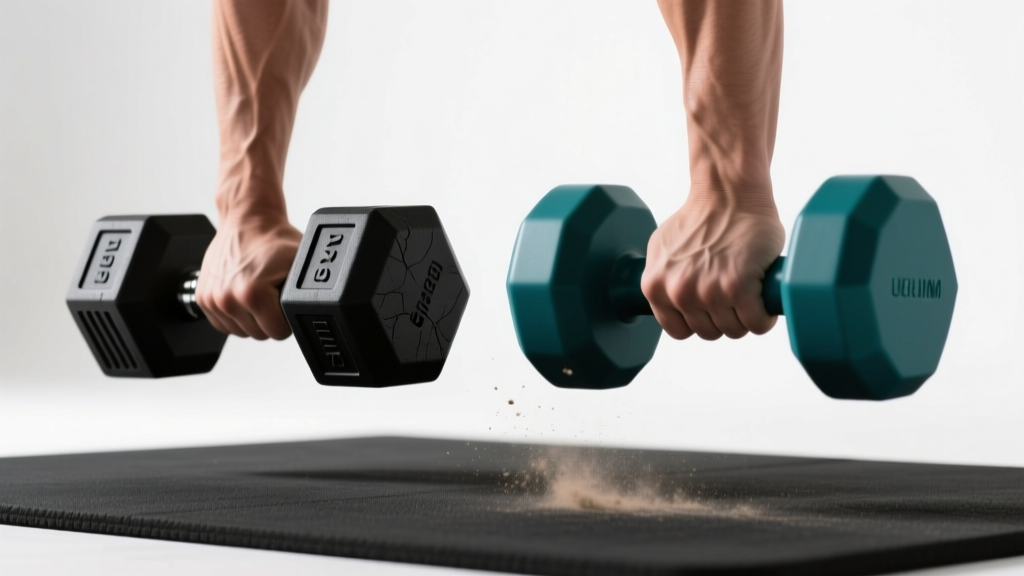
EZ Curl Bar vs Straight Bar vs Dual Dumbbell Upright Row
Compare the EZ curl bar, straight bar, and dual dumbbell upright row. Discover the best budget breakdown, biomechanics, and value for your home gym.

When outfitting a home gym for upper-body pulling and arm isolation, lifters are often caught in a crossfire of equipment choices. The classic debate usually centers on the EZ curl bar vs straight bar for bicep and deltoid work. However, as space and budget constraints tighten in 2026, a third contender has emerged as a highly efficient alternative: the adjustable dumbbell setup, specifically leveraged for the dual dumbbell upright row and independent curling movements. This guide breaks down the biomechanics, hidden costs, and spatial economics of each option to help you maximize your equipment ROI.
The Biomechanics: Wrist Health and Muscle Activation
To understand the true value of these implements, we must first look at how they interact with human joint mechanics. The standard 7-foot Olympic straight bar forces the lifter into full supination (palms facing directly up) during curls. While this theoretically maximizes the short head of the biceps brachii, it places immense valgus stress on the wrist joint, particularly for lifters with a high carrying angle (cubitus valgus).
The EZ curl bar, with its 15-to-30-degree angled grips, allows for a semi-supinated grip. This slight deviation aligns the radius and ulna more naturally, reducing torque on the distal radioulnar joint. However, neither barbell variation solves the inherent issues of bilateral fixed-path pulling for the shoulders.
'The fixed grip of a straight barbell forces the wrists into extreme supination during curls and extreme internal rotation during upright rows. For lifters with limited wrist mobility or a history of shoulder impingement, independent implements are not just a luxury; they are a biomechanical necessity.' — Biomechanics of Resistance Training
The Dual Dumbbell Upright Row: A Biomechanical Masterclass
For decades, the barbell upright row was a staple for lateral deltoid and trapezius development. However, sports medicine professionals have increasingly flagged it as a high-risk movement. According to the Cleveland Clinic, shoulder impingement syndrome occurs when the rotator cuff tendons are pinched during repetitive overhead or elevated internal rotation movements.
When you use a straight bar for an upright row, your hands are locked in a narrow, pronated grip. As you elevate the bar, the humerus is forced into internal rotation, driving the greater tubercle directly into the acromion process. This is a recipe for supraspinatus tendonitis.
Enter the dual dumbbell upright row. By utilizing independent dumbbells, you are no longer locked into a fixed bar path or a fixed grip width. You can adopt a slightly wider, shoulder-width grip and allow the wrists to naturally rotate into a neutral or semi-pronated position as you pull. As documented by ExRx.net, the dumbbell variation allows for natural scapular upward rotation and clears the subacromial space, drastically reducing impingement risk while maintaining high tension on the medial deltoids and upper traps.
2026 Budget Breakdown: The Hidden 'Plate Tax'
Many home gym beginners overlook the 'plate tax' when budgeting for specialized bars. When you buy a $110 Rogue Curl Bar, you cannot use it without Olympic plates. A quality set of 160lbs of virgin rubber bumper plates will cost between $180 and $220. Therefore, your actual entry price for the EZ bar setup is over $300. Furthermore, as you get stronger, your EZ bar will max out its sleeve capacity (usually around 200-250lbs total) much faster than a straight bar, forcing you to buy expensive calibrated steel plates to continue progressing.
| Equipment Setup | Base Hardware Cost | Required Weight Plates | Total Entry Cost (Approx.) | Versatility Index |
|---|---|---|---|---|
| 7ft Olympic Straight Bar | $150 - $250 | 160lb Bumper Set ($180) | $330 - $430 | High (Full Body) |
| Olympic EZ Curl Bar | $85 - $135 | 160lb Bumper Set ($180) | $265 - $315 | Low (Arms/Shoulders) |
| Adjustable Dumbbells (Pair, 5-52.5lbs) | $349 (e.g., Nuobell) | None Required | $349 | Very High (Unilateral/Bilateral) |
Cost-Per-Use and Programming Value
When analyzing value, we must consider how often the equipment will be utilized in a standard mesocycle. A straight barbell is a daily driver. You will use it for deadlifts, squats, and bench presses multiple times a week. Its cost-per-use drops to pennies within the first month. The EZ curl bar, conversely, is an isolation specialist. It will likely only see action 2 to 3 times a week on arm days. Adjustable dumbbells bridge this gap. They allow for heavy unilateral leg work (Bulgarian split squats), chest isolation, and the joint-friendly dual dumbbell upright row. A well-structured 12-week hypertrophy block can be executed entirely with a pair of 52.5lb adjustable dumbbells, making the $349 investment an incredibly high-yield asset.
Spatial Economics: Footprint and Storage Value
Value is not just about dollars spent; it is about dollars spent per square foot of your home gym. A standard Olympic straight bar measures 79 to 86 inches in length and requires a 7-foot rack or wall mount. An EZ curl bar typically spans 47 inches, making it easier to store in a closet or under a bed.
However, a pair of 5-52.5lb adjustable dumbbells occupies a footprint of roughly 16 x 8 inches. For apartment dwellers or garage gym owners maximizing limited square footage, the spatial value of adjustable dumbbells is unmatched. You gain the ability to perform independent presses and rows without dedicating 15 square feet to a barbell and plate tree.
⚠️ Failure Mode Alert: Adjustable Dumbbells
While adjustable dumbbells offer incredible value, their primary failure mode is the internal selector mechanism. Dropping a dial-based dumbbell or a twist-handle model from even waist height can shatter the plastic retention pins, rendering the $350 investment useless. Always perform the dual dumbbell upright row and heavy curls with a controlled eccentric, never dropping the weights on the floor.
The Final Verdict: Where Should You Invest?
The choice between an EZ curl bar, a straight bar, and adjustable dumbbells ultimately depends on your training age, joint health, and spatial budget.
- Buy the Straight Bar if: You are focused on powerlifting, heavy compound pulls, and have the floor space for a full rack setup. It remains the undisputed king of cost-per-use for full-body strength.
- Buy the EZ Curl Bar if: You already own a plate collection, suffer from wrist pain during straight-bar curls, and have the disposable income for specialized isolation implements.
- Buy Adjustable Dumbbells if: You want maximum versatility, need to protect your shoulders via the dual dumbbell upright row, and have a strict budget of around $350 with limited floor space.
By prioritizing joint longevity and spatial efficiency, the adjustable dumbbell setup often wins the value war for the modern home gym enthusiast, proving that sometimes the best bar for the job is no bar at all.
More gear to consider
All reviews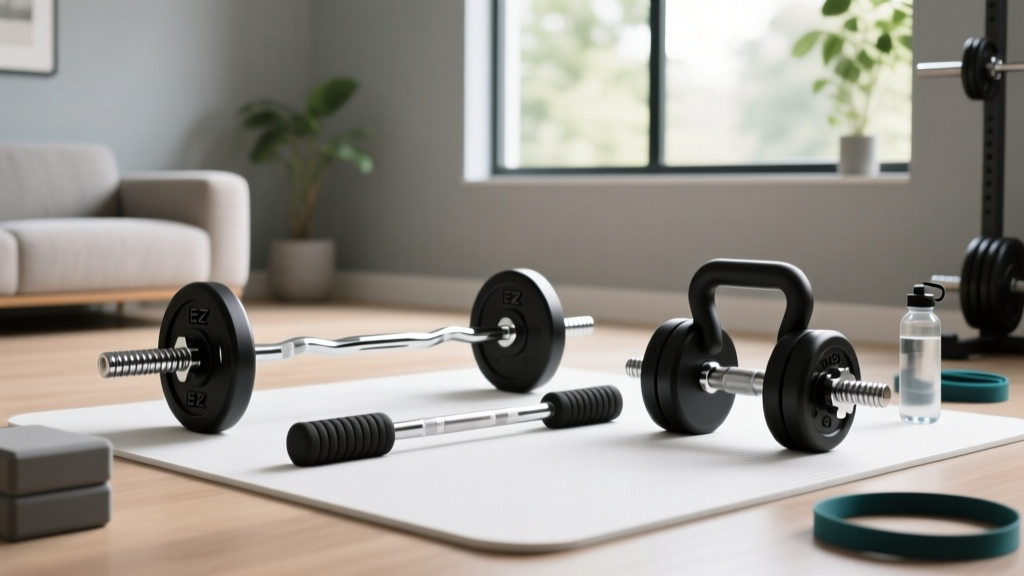
EZ Bar vs Straight Bar vs Dumbbell With Handle: 2026 Budget Guide

Dumbbell for Back Exercise Limits: Barbell Weight & Knurling Guide
Beyond Vinyl Dumbbells: 2026 Loadable Plate Market Trends
Rubber Hex vs Urethane: Value for Jumping Squats with Dumbbells

Full Leg Workout with Dumbbells: Space Layouts & Hex vs Urethane