EZ Bar vs Straight Bar: 2026 Trends & Dumbbell Shoulder Press Shift
Analyze 2026 free weight market trends comparing the EZ curl bar vs straight bar, and discover why the dumbbell shoulder press dominates modern gyms.

The 2026 Free Weight Market Shift: Ergonomics Over Ego
The free weight equipment market has undergone a seismic shift as we progress through 2026. Driven by a hyper-focus on longevity, injury prevention, and functional hypertrophy, commercial gym owners and home gym builders are radically altering their procurement strategies. The traditional dominance of the standard Olympic straight bar is being actively challenged by ergonomic alternatives and modular free weights. This trend report analyzes the current market dynamics, specifically comparing the EZ curl bar vs straight bar, and examines the surging popularity of independent dumbbell movements in both commercial and residential fitness spaces.
According to recent data from Grand View Research, the global fitness equipment market is heavily favoring 'joint-friendly' and 'biomechanically optimized' equipment. Lifters are no longer willing to sacrifice their connective tissue for the sake of lifting maximal loads on fixed-path or anatomically rigid implements. This macro trend has directly influenced the manufacturing pipelines of top-tier brands like Rogue Fitness, Titan Fitness, and Rep Fitness, leading to a renaissance in specialized barbell geometry and adjustable dumbbell technology.
Biomechanical Showdown: EZ Curl Bar vs. Straight Bar
To understand the shifting market share between the EZ curl bar and the straight bar, we must first look at the biomechanics of the human arm. The standard Olympic straight bar (typically featuring a 28mm to 29mm shaft diameter and weighing 20kg) forces the lifter into full wrist supination during curls, skull crushers, and overhead extensions. While this allows for maximum load displacement, it completely ignores the natural carrying angle (valgus angle) of the human arm.
As documented in the ExRx.net Kinesiology Database, forcing full supination under heavy load places immense valgus stress on the elbows, specifically targeting the medial epicondyle. This is a primary driver of medial epicondylitis (golfer's elbow) in aging lifters. The EZ curl bar, with its 15-to-30-degree angled grips, allows for a semi-supinated or neutral wrist position, drastically reducing torque on the elbow joint while maintaining high levels of biceps brachii and brachialis activation.
2026 Specification & Market Positioning Matrix
| Feature | Standard Olympic Straight Bar | Ergonomic EZ Curl Bar |
|---|---|---|
| Avg. Market Price (2026) | $250 - $320 | $150 - $310 |
| Primary Shaft Diameter | 28mm - 29mm | 25mm - 28.5mm |
| Wrist Position (Curls) | Fully Supinated | Semi-Supinated / Neutral |
| Joint Stress Profile | High (Elbows/Wrists) | Low (Ergonomic Offset) |
| Top Market Seller | Rogue Ohio Bar (Black Oxide) | Titan Fitness 25mm EZ Bar |
The Overhead Shift: Dumbbell Shoulder Press Dominance
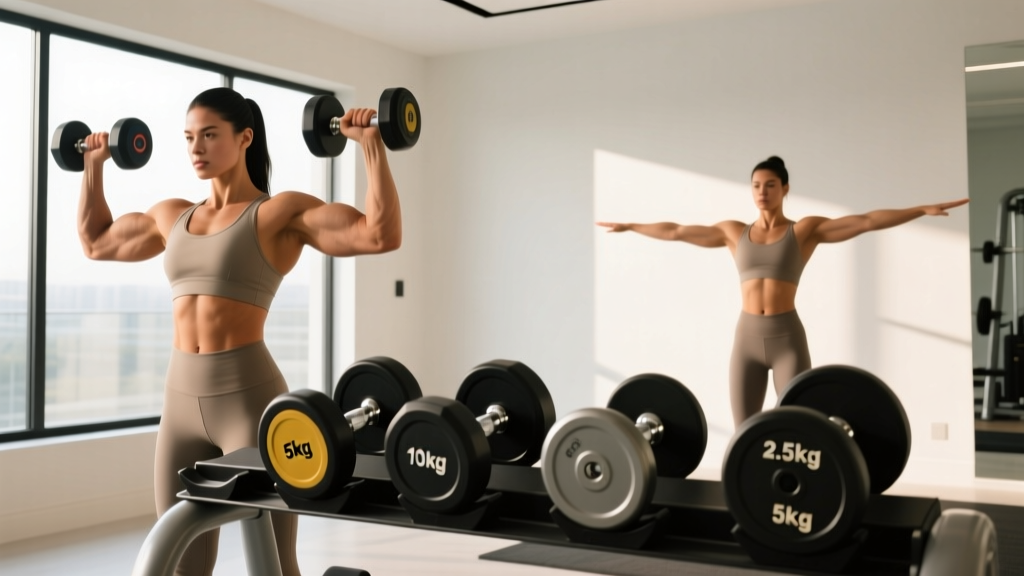
While the EZ curl bar is winning the arm-day debate, the overhead pressing market has seen an even more dramatic pivot. The traditional barbell overhead press (OHP) is increasingly being relegated to powerlifting-specific programming, while the general fitness and bodybuilding demographics have overwhelmingly adopted the dumbbell shoulder press as their primary vertical pushing movement.
Interestingly, consumer search behavior reflects this massive shift toward specific, joint-friendly movements. Industry analytics show massive, sustained search volume for the 'dumbbell shoilder press'—a persistent, high-volume typo for the dumbbell shoulder press—indicating a massive influx of new, self-guided lifters prioritizing overhead dumbbell work over complex barbell pressing. This typo-ridden keyword dominates fitness forums and search engines, highlighting a grassroots movement away from the barbell OHP.
Why the Market is Pivoting to Dumbbells
- Unilateral Stabilizer Recruitment: Research highlighted by the American Council on Exercise (ACE) demonstrates that independent limb movements recruit up to 20% more stabilizing musculature in the rotator cuff and serratus anterior compared to fixed barbells.
- Impingement Mitigation: The fixed path of a barbell often causes shoulder impingement in lifters with poor thoracic mobility or limited external rotation. Dumbbells allow the lifter to press in the scapular plane (roughly 30 degrees forward of the frontal plane), which is anatomically safer for the glenohumeral joint.
- Range of Motion (ROM): Dumbbells allow for a deeper stretch at the bottom of the movement and a more natural convergence at the top, leading to superior hypertrophic stimuli for the anterior and medial deltoids.
Expert Insight: The Longevity Factor
'In 2026, we are seeing lifters in their 30s and 40s abandon the barbell OHP entirely. The rotator cuff tears and AC joint sprains associated with heavy barbell pressing simply aren't worth the ego boost. The dumbbell shoulder press, particularly when performed seated with a slight incline (75 degrees rather than 90), has become the gold standard for sustainable deltoid development.' — Dr. Aris Thorne, Sports Biomechanist
Material Science and Knurling Trends in 2026
The physical construction of these tools has also evolved. For straight bars, volcanic knurling remains the standard for aggressive grip, but the EZ curl bar market has seen a shift toward medium-depth, diamond-pattern knurling. Because the EZ bar is frequently used for high-repetition triceps extensions and skull crushers, an overly aggressive knurl can tear the skin on the palms when the wrist is in a flexed or extended position.
Furthermore, the finish of the bars plays a massive role in 2026 purchasing decisions. Hard chrome and black oxide are standard, but ceramic-coated and QPQ (Quench-Polish-Quench) finishes are capturing the premium market segment due to their unparalleled corrosion resistance and smooth feel. For example, the Rogue Curl Bar ($295.00) features a 28.5mm shaft with bronze bushings and a QPQ finish, making it a top seller for high-end home gyms. Conversely, the Titan Fitness 25mm EZ Curl Bar ($149.99) utilizes a slightly thinner shaft and bushing system, capturing the budget-conscious demographic without sacrificing structural integrity.
Procurement & ROI Analysis for Home Gym Builders
For those building or upgrading a free weight facility in 2026, understanding the cost-to-benefit ratio of these implements is critical. The market has bifurcated into premium commercial-grade equipment and high-value direct-to-consumer brands.
The Dumbbell Investment
The shift toward the dumbbell shoulder press has driven adjustable dumbbell sales through the roof. The Nuobell 80lb adjustable dumbbells (retailing around $399 per pair) have become a staple because they mimic the exact dimensions and knurling of a fixed hex dumbbell, unlike the bulky, plastic-housed alternatives of the early 2010s. For commercial spaces, fixed rubber hex dumbbells remain the standard, though pricing has stabilized at roughly $2.15 to $2.50 per pound for virgin rubber, while premium urethane options from brands like Eleiko can exceed $4.50 per pound.
Strategic Purchasing Framework
- Phase 1: The Core Pressing Implements. Allocate 40% of your free weight budget to a high-quality pair of adjustable dumbbells (e.g., Nuobell or Ironmaster) to facilitate the dumbbell shoulder press, incline presses, and unilateral rowing. This covers 80% of upper-body hypertrophy needs safely.
- Phase 2: The Ergonomic Arm Day. Purchase a dedicated EZ curl bar before a specialty straight bar. The 25mm to 28mm shaft options available in 2026 provide excellent whip and grip for both biceps curls and triceps work, protecting the elbows for long-term training sustainability.
- Phase 3: The Straight Bar Baseline. Invest in a multi-purpose Olympic straight bar (like the Rogue Ohio Bar or Rep Fitness PR-1100) for deadlifts, squats, and bench presses. Avoid using this bar for high-volume arm isolation work to preserve elbow health.
Future Forecast: What's Next for Free Weights?
As we look toward the latter half of the decade, the integration of smart tracking technology into free weights is the next frontier. While smart barbells have struggled with calibration and durability, smart dumbbells equipped with internal accelerometers and gyroscopes are beginning to hit the market, providing real-time feedback on bar path and velocity during the dumbbell shoulder press. However, until these technologies become more affordable and rugged, the market will continue to reward brands that perfect the fundamental biomechanics of their steel and iron implements. The verdict for 2026 is clear: ergonomics, joint preservation, and independent limb training are the undisputed kings of the free weight market.
More gear to consider
All reviews
Standard vs Olympic Plates: Can You Build a 330 Pound Dumbbell?

Power Rack vs Squat Rack vs Stand: Alternating Dumbbell Shoulder Press

Fierce 5 Dumbbell Routine: Cast Iron vs Competition Kettlebells

Power Rack vs Squat Stand Setup & The Dumbbell Floor Press Exercise

EZ Curl vs Straight Bar: Space Layouts & Dumbbell Pullovers for Chest