Space-Saving Storage to Elevate Your Home Dumbbell Workout
Maximize your home gym space with the best dumbbell racks and storage layouts. Optimize your floor plan for a safer, more efficient dumbbell workout.

The Hidden Friction of Poor Weight Storage
A seamless dumbbell workout is defined by flow. Whether you are executing a high-density superset, a mechanical drop set, or a complex circuit, the transition between movements should cost you zero mental energy and minimal physical fatigue. Yet, in many home gyms, the layout forces lifters to navigate a minefield of scattered hex dumbbells, adjustable weight handles, and poorly positioned benches. This spatial disorganization doesn't just look messy; it actively degrades your training stimulus by extending rest periods and compromising your biomechanics before the set even begins.
Optimizing your free weight storage is not merely an aesthetic choice—it is a critical component of facility design that impacts safety, spinal loading, and workout density. In this guide, we break down the exact spatial requirements, hardware specifications, and layout frameworks needed to build a high-performance dumbbell storage system in 2026, regardless of whether you have a sprawling garage gym or a compact apartment corner.
The Biomechanics of Weight Retrieval
Before selecting a rack, we must address the biomechanical cost of picking up heavy weights. Retrieving a pair of 50-pound or 70-pound dumbbells from the floor requires a deep hip hinge or a full squat. If your storage solution forces you to repeatedly bend down to floor level to grab your working weights, you are expending ATP and accumulating lower-back fatigue before your primary lifts (like Romanian deadlifts or heavy goblet squats) even start.
According to principles outlined by strength and conditioning experts, the ideal retrieval height for heavy dumbbells (40 lbs and above) is between 28 and 32 inches from the floor. This allows the lifter to engage the lats, brace the core, and lift the weight with a neutral spine, mimicking a block pull rather than a deficit deadlift. Conversely, lighter dumbbells (5 to 25 lbs) used for isolation work like lateral raises or tricep extensions should be stored higher, between 36 and 48 inches, allowing for a simple reach-and-grab motion without spinal flexion.
Spatial Breakdown: Tiered vs. Vertical vs. Wall-Mounted
Choosing the right storage apparatus requires balancing your available square footage against the physical dimensions of your dumbbell set. Below is a structural comparison of the three primary storage categories available on the market today.
| Rack Type | Model Example | Footprint (L x W) | Max Capacity | Price Range (2026) | Best Application |
|---|---|---|---|---|---|
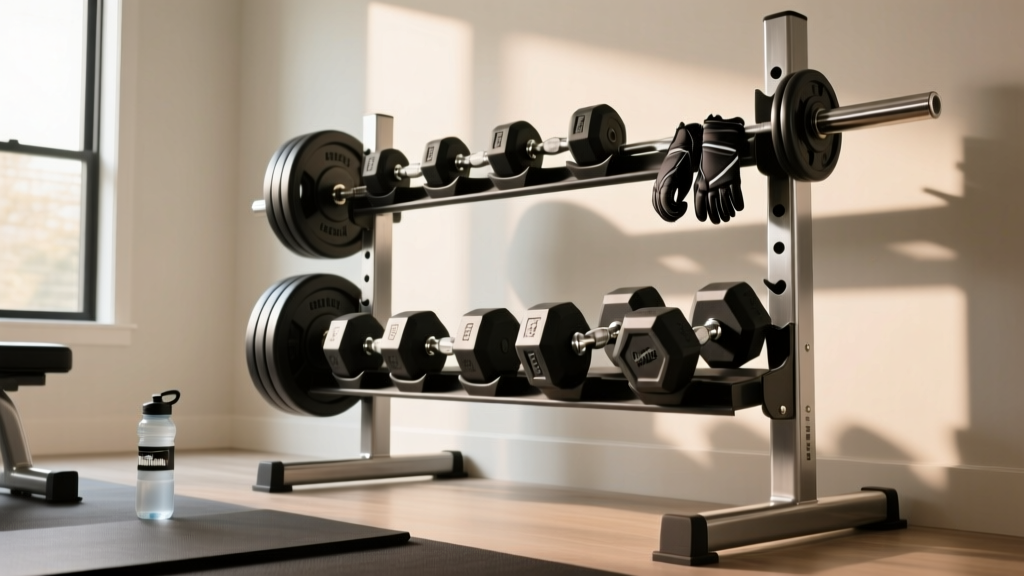
| 3-Tier Horizontal | Rep Fitness 3-Tier Rack | 48" x 24" | 5-50 lb set | $299 - $399 | Standard hex/urethane sets |
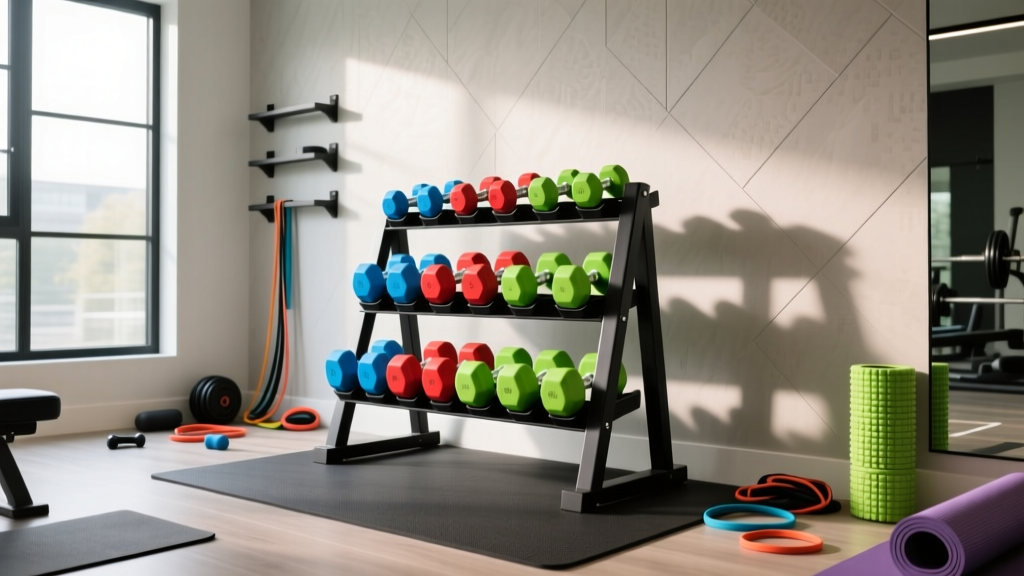
| A-Frame Vertical | Rogue A-Frame Dumbbell Rack | 30" x 30" | 5-50 lb set | $195 - $245 | Micro-gyms, tight corners |
| Wall-Mounted | Fringe Sport Wall Pegs | 48" x 6" (on wall) | Varies by stud | $120 - $180 | Zero-floorprint layouts |
Calculating Your Clearance Zones
The physical footprint of the rack is only half the equation. You must also calculate the clearance zone—the empty space required to safely maneuver the weights off the rack. For a standard 3-tier horizontal rack (like those found in commercial facilities), you need a minimum of 36 inches of clearance in front of the unit. This allows you to step into a staggered stance, deadlift the heavy pair off the bottom tier, and step back without your heels clipping the rack's base supports.
For A-Frame racks, the footprint is smaller, but the vertical clearance is paramount. Ensure you have at least 60 inches of vertical space free of overhead obstructions (like garage door tracks or low basement ceilings) to safely press or clean weights off the top pegs.
The 'Triangle Flow' Layout Framework
To maximize the efficiency of your dumbbell workout, implement the Triangle Flow Framework. This spatial design principle dictates that your primary training zone should form an equilateral or isosceles triangle between three anchor points:
- Point A: The Storage Hub (Your dumbbell rack or adjustable dumbbell docking station).
- Point B: The Action Zone (Your adjustable bench or open floor mat space).
- Point C: The Drop/Transition Zone (A designated empty space or secondary mat for dropping fatigued weights safely).
In an optimized layout, the distance between Point A and Point B should never exceed 6 to 8 feet (roughly 2 to 3 steps). Why? Because during high-intensity drop sets or heavy farmer's carries, grip endurance and cardiovascular output drop precipitously if you have to walk across the room to retrieve your next set of weights. By keeping the rack within a 3-step radius of your bench, you maintain the metabolic density of the workout while minimizing the risk of dropping a heavy weight on your foot during transit.
CRITICAL WARNING: Wall-Mounting Hardware Failures
If you opt for a wall-mounted storage solution to save floor space, never rely on drywall anchors or toggle bolts. A standard pair of 50lb dumbbells exerts dynamic shear force that will rip drywall toggles out catastrophically. You must anchor wall racks directly into 16-inch on-center wood studs using 3/8" x 3" hex-head lag screws. If your gym is in a garage with metal studs, you must use specialized snap toggles rated for minimum 250lbs of shear per screw, or reinforce the wall with 3/4" plywood backing screwed into the metal framing before mounting the rack.
Hardware Compatibility and Failure Modes
Not all dumbbells interact with racks equally. When sourcing storage, you must account for the specific geometry and material of your weights. For a comprehensive look at how different weights pair with racks, industry experts at Garage Gym Reviews frequently highlight the mismatch between commercial racks and modern adjustable dumbbells.
The Adjustable Dumbbell Dilemma
If your dumbbell workout relies on adjustable models like Nuobell or PowerBlock, standard tiered racks designed for cast-iron hex dumbbells will fail you. Nuobells, for instance, have a longer handle profile and a wider center of gravity. Placing them on narrow, 10-inch deep tiered saddles results in overhang, creating a severe tipping hazard. Adjustable dumbbell users should seek out specialized horizontal trays or reinforced A-frame cradles with a minimum depth of 14 inches.
Saddle Material Degradation
Cheaper storage racks often feature hard plastic or bare steel saddles. Over time, the repeated dropping of rubber-encased dumbbells onto hard plastic will crack the saddle lips, especially in unheated garages where plastics become brittle in winter. Bare steel saddles will strip the rubber coating off your dumbbells and transfer rust onto the weight heads. Always look for racks featuring high-density polyethylene (HDPE) or vulcanized rubber saddle liners. Premium options from brands like Rogue Fitness utilize laser-cut steel with protective UHMW plastic inserts that prevent both hardware degradation and acoustic noise pollution during weight changes.
Curating Your Storage Ecosystem
Ultimately, the goal of space optimization is to remove friction from your training. A well-designed layout respects the physics of the weights, the biomechanics of the lifter, and the spatial constraints of the room. When building out your facility, prioritize heavy-gauge steel (11-gauge or thicker) over flimsy 14-gauge tubing, respect the 36-inch clearance rule, and map your floor plan using the Triangle Flow method.
By treating your dumbbell rack not as an afterthought, but as a primary piece of performance equipment, you ensure that every dumbbell workout begins with perfect mechanics and ends with maximum output. For further equipment specifications and spatial planning, reviewing the dimensional blueprints provided by manufacturers like Rep Fitness can help you map your exact floor plan before making a purchase.
More gear to consider
All reviews
EZ vs Straight Bar Space Layouts & Dumbbell Equivalent to 225 Bench

45 lb Dumbbell Set Budget: Rubber Hex vs Urethane Value

Cast Iron vs Competition Kettlebells: Budget Breakdown & Exercises for Upper Body with Dumbbells

Space-Saving Rack Layouts for Light Dumbbells & Storage

Power Rack vs Squat Rack: Setup for Contralateral Dumbbell Pickup