
How to Store Weights for Dumbbell Exercises for Whole Body Routines
Optimize your home gym layout with the best dumbbell racks and storage solutions designed for seamless whole body workout routines and space efficiency.

The Spatial Demands of Full-Body Dumbbell Training
When programming dumbbell exercises for whole body development, the transition time and physical footprint between movements are just as critical as the weight on the handle. Full-body routines frequently incorporate expansive, multi-planar movements like dumbbell thrusters, walking lunges, renegade rows, and kettlebell-style dumbbell swings. If your storage solution forces you into a cramped corner or requires awkward spinal flexion to retrieve heavy iron, you compromise both your workout density and your injury resilience.
Space optimization in a home gym is not merely about fitting equipment into a room; it is about engineering a 'flow state' environment. According to facility design guidelines emphasized by the National Strength and Conditioning Association (NSCA), adequate clearance zones around free weight storage are mandatory to prevent collisions and ensure safe lifting mechanics during the pickup and set-down phases of a lift. For whole-body dumbbell circuits, where heart rates are elevated and spatial awareness is slightly diminished, your rack placement dictates the success of your layout.
The 'First Rep' Injury Vector
Over 30% of lower back strains in home gyms occur not during the working set, but during the initial deadlift required to clean heavy dumbbells off an improperly designed, low-profile A-frame rack. Optimizing your storage height is a biomechanical necessity, not just an aesthetic choice.
Rack Typologies: Footprint vs. Capacity Matrix
Choosing the right storage unit requires balancing your available square footage against the physical dimensions of your dumbbell set. A standard 5-50 lb rubber hex dumbbell set requires approximately 48 inches of horizontal shelf space. Below is a structural comparison of the primary storage typologies available in the 2026 market.
| Rack Type | Floor Footprint | Max Load Capacity | Best Layout Application | Avg. Price Range |
|---|---|---|---|---|
| 3-Tier Horizontal | 48' x 24' (12 sq ft) | 800 - 1,200 lbs | Dedicated lifting zones, garage gyms | $299 - $450 |
| A-Frame Vertical | 24' x 24' (4 sq ft) | 150 - 300 lbs | Tight corners, light neoprene sets | $79 - $129 |
| Wall-Mounted Saddle | 0 sq ft (Floor) | Dependent on studs | Maximizing open floor for lunges/swings | $120 - $250 |
| 2-Tier Angled | 48' x 20' (10 sq ft) | 600 - 800 lbs | Multi-purpose rooms, spare bedrooms | $199 - $299 |
Top Tier Storage Solutions for Compact Home Gyms
To execute dumbbell exercises for whole body routines seamlessly, you need equipment that offers ergonomic retrieval and unshakeable stability. Here is an expert analysis of the top-performing racks for space-conscious lifters.
1. Rep Fitness DB-5000 3-Tier Rack (The Ergonomic Standard)
The Rep Fitness DB-5000 utilizes an angled shelf design that tilts the dumbbell handles toward the user at a 15-degree incline. This is a massive advantage for space optimization because it reduces the required bending depth, allowing you to place the rack closer to a wall (leaving just 18 inches of clearance instead of the standard 30 inches). Priced around $299, its 44-inch width accommodates most 5-50lb hex sets perfectly, though urethane-coated dumbbells with wider heads may require the 58-inch version.
2. Rogue 3-Tier Dumbbell Rack (The Heavy-Duty Anchor)
For lifters utilizing heavy, round-head urethane dumbbells (50-100+ lbs), the Rogue 3-Tier Dumbbell Rack remains the gold standard. The saddle-style shelves prevent rolling—a critical safety feature when dropping heavy weights after an exhausting set of dumbbell floor presses. At $395 and weighing 84 lbs empty, its sheer mass prevents tipping. However, its 48-inch length and 25-inch depth demand a dedicated footprint, making it best suited for garages where floor space is less restricted than in interior rooms.
3. The Wall-Mounted Saddle System (The Ultimate Space Hack)
If your primary goal is clearing floor space for expansive dumbbell exercises for whole body movements like Bulgarian split squats or lateral lunges, wall-mounted saddle brackets are unmatched. Brands like Titan Fitness offer individual wall saddles that allow you to stagger dumbbells vertically along a stud line. This completely eliminates the floor footprint, turning a dead wall into a high-capacity storage matrix.
Blueprinting Your Layout: The 3-Point Clearance Rule
When designing your gym layout, do not measure the rack; measure the movement envelope radiating from the rack. For full-body dumbbell training, apply the 3-Point Clearance Rule to ensure your storage placement does not bottleneck your workout.
- The Swing Radius (6 Feet): If your routine includes dumbbell swings or snatches, you need a minimum of 6 feet of unobstructed clearance directly in front of the rack. Placing a rack in the center of a 10x10 room effectively destroys your swing zone.
- The Lateral Lunge Corridor (4 Feet): Side lunges and Cossack squats require wide lateral movement. Ensure your rack is placed on the short wall of a rectangular room, allowing the long wall to serve as your lateral corridor.
- The Drop Zone (2 Feet): Never place a rack flush against a drywall partition. Heavy rubber or urethane dumbbells dropped hastily after a set of thrusters will easily punch through standard 1/2-inch drywall. Maintain a 2-foot buffer or install industrial rubber matting on the wall behind the rack.
Structural Warnings: The Reality of Wall-Mounting Heavy Iron
Wall-mounted storage is the holy grail of space optimization, but it introduces severe structural risks if executed improperly. A pair of 70 lb dumbbells exerts immense sheer force on a wall bracket.
Expert Warning: Never mount heavy dumbbell saddles into drywall anchors, toggle bolts, or brick veneer. You must anchor directly into the structural studs of your home.
Standard residential framing utilizes 2x4 or 2x6 studs spaced 16 inches on-center (OC). To safely mount a wall rack holding more than 200 lbs of cumulative weight, you must use 3/8-inch x 3-inch structural lag screws driven directly into the center of the stud. Pre-drilling with a 7/32-inch bit is mandatory to prevent the stud from splitting under the torque of the lag screw. If your desired layout places the rack where no stud exists, you must install a horizontal 2x6 ledger board across multiple studs, and then mount your saddles to the ledger board.
Common Storage Mistakes That Ruin Full-Body Workouts
Even with premium equipment, poor spatial planning can derail your training. Avoid these frequent layout errors:
- The A-Frame Tipping Hazard: Cheap, lightweight A-frame racks are notorious for tipping forward when a user aggressively pulls a heavy dumbbell from the top tier. If you must use an A-frame in a tight space, bolt the base to a 3/4-inch plywood platform and weigh it down with your weight plates.
- Ignoring Urethane Off-Gassing: If you are optimizing a small, enclosed space (like a basement or spare bedroom) and storing a large set of cheap rubber dumbbells, the VOC off-gassing will make the room unusable. Invest in virgin urethane dumbbells and store them near an active HVAC return vent.
- Asymmetrical Loading on Shelves: When storing adjustable dumbbells (like PowerBlocks or Nuobells) alongside fixed hex bells, users often overload one side of a 2-tier rack. This creates a torsional twist on the rack's welded joints over time, leading to micro-fractures in the steel. Always balance the load symmetrically.
Final Thoughts on Gym Flow
Optimizing your home gym for dumbbell exercises for whole body routines requires a shift in perspective. Stop viewing your dumbbell rack as a passive shelf and start treating it as the central anchor of your workout's kinetic flow. By selecting a rack with the correct ergonomic tilt, enforcing strict movement clearances, and respecting the structural limits of your walls, you transform a cluttered room into a high-performance training facility. Measure twice, mount securely, and let the layout drive your gains.
More gear to consider
All reviews
EZ Curl vs Straight Bar: Evolving Women's Arm Dumbbell Exercises

Olympic vs Standard Plates Setup & Dumbbell Single-Arm Row Guide
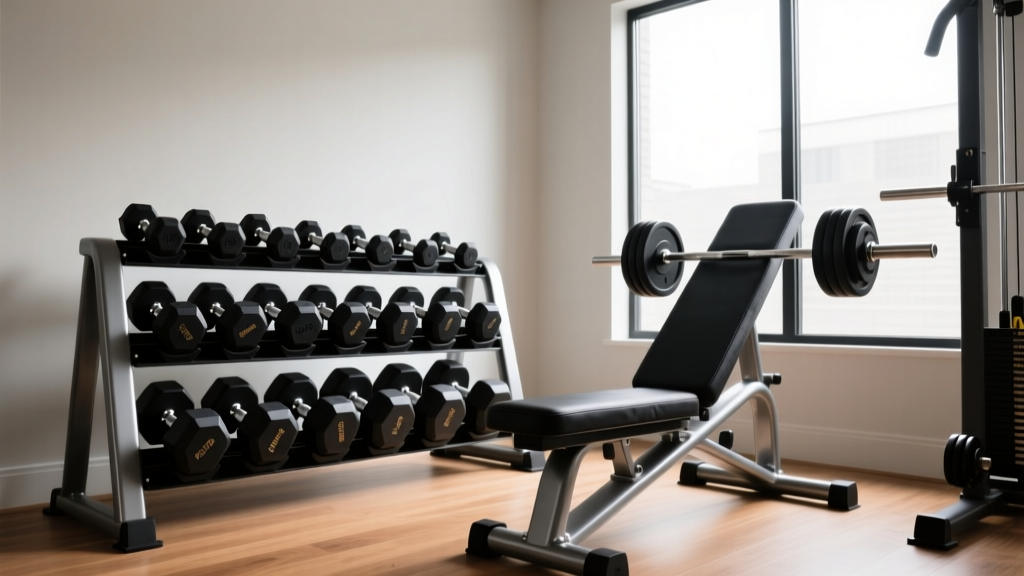
Dumbbell Rack Storage for the Single Arm Dumbbell Bench Row
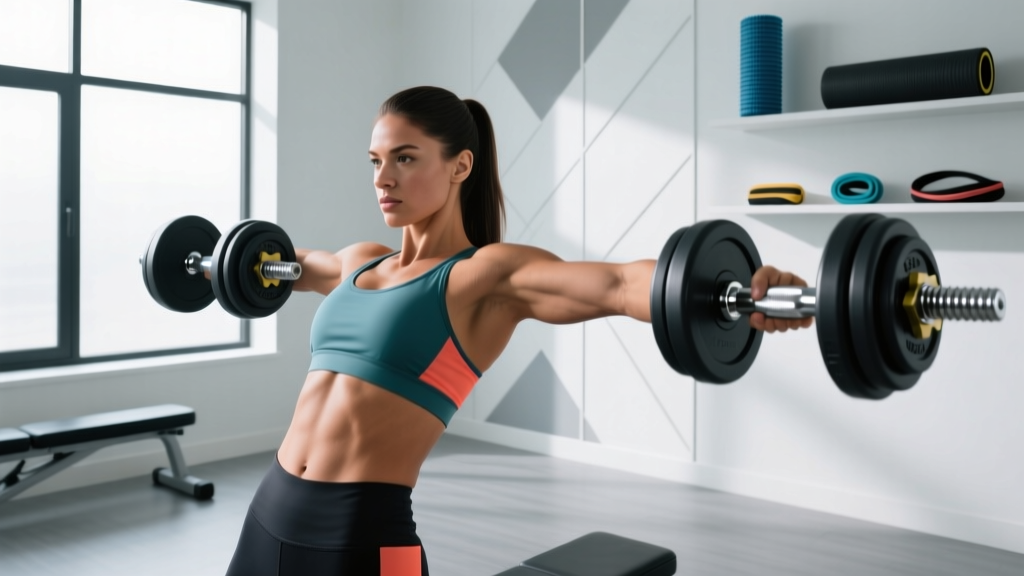
Loadable Dumbbells for Rear Dumbbell Flys: Value Breakdown

Olympic vs Standard Plates: Setup & Workouts with Dumbbells for Arms
