Storage Layouts for Different Types of Dumbbell Workouts
Optimize your gym space by matching dumbbell racks and storage layouts to the specific types of dumbbell workouts you perform. Expert layout guides inside.

The Biomechanics of Storage: Matching Racks to Your Routine
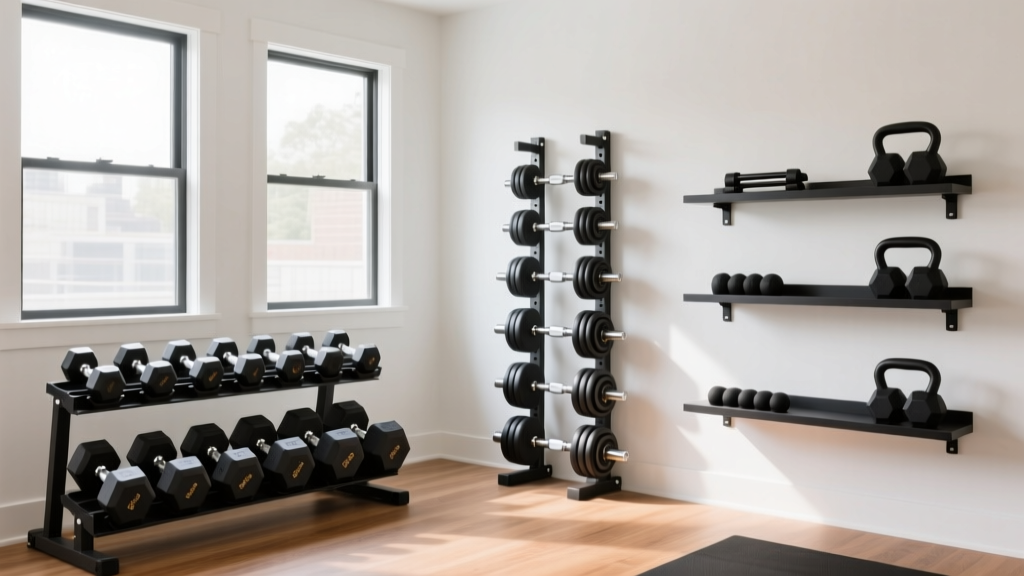
When designing a home or garage gym, the specific types of dumbbell workouts you plan to execute should be the primary driver of your spatial layout and rack selection. Too often, lifters purchase a generic storage solution only to realize it disrupts their training flow, causes unnecessary fatigue during transitions, or creates a safety hazard in a confined space. As of 2026, the shift toward modular, space-efficient home gyms requires a strategic approach to equipment storage.
According to facility design guidelines emphasized by the National Strength and Conditioning Association (NSCA), the ergonomics of equipment retrieval directly impact workout intensity and safety. Grabbing a 50 lb dumbbell from a floor-level rack during a heavy hypertrophy session is vastly different from needing rapid, sequential access to 15 lb, 20 lb, and 25 lb dumbbells during a high-intensity circuit. Let us break down how to optimize your layout based on your primary training modalities.
High-Volume Circuit Training (The 3-Tier Horizontal Approach)
Circuit training and muscular endurance workouts rely on minimal rest periods and rapid weight transitions. If your routine involves drop sets, EMOMs (Every Minute on the Minute), or complex flows, you need a 3-Tier Horizontal Dumbbell Rack.
- Layout Strategy: Place the rack parallel to your primary workout bench or mat. This allows you to step laterally, swap weights, and step back into the execution zone in under two seconds.
- Equipment Spotlight: The Rogue 3-Tier Dumbbell Rack (priced around $595-$695 in 2026) offers 72 inches of linear space per tier. The angled shelves (typically set at a 15-to-20-degree incline) allow for natural wrist alignment when gripping the handle, reducing forearm strain before the set even begins.
- Space Footprint: Roughly 74" L x 24" W. Best suited for garages or basements with long, unbroken wall space.
Heavy Strength & Hypertrophy (The A-Frame & Vertical Tier)
If your primary focus is heavy strength training, powerbuilding, or traditional hypertrophy (e.g., heavy dumbbell presses, Bulgarian split squats, and weighted lunges), you are likely using a full 5-100 lb set. Horizontal racks consume too much linear wall space for heavy sets.
- Layout Strategy: Utilize an A-Frame Rack positioned in a corner or at the terminus of your lifting platform. This centralizes the heaviest weights, minimizing the distance you must carry a 90 lb dumbbell back to your bench—a critical safety factor when your grip is failing.
- Equipment Spotlight: The Rep Fitness A-Frame Dumbbell Rack (approx. $299) features a compact 24" x 24" footprint but boasts a 1,000 lb weight capacity. The vertical stacking keeps the footprint minimal while keeping heavy iron at hip-and-chest level.
HIIT and Functional Flow (Radial & Wall-Mounted Solutions)
For HIIT, cardio-focused dumbbell workouts, or functional flow routines utilizing lighter neoprene or urethane dumbbells (typically 5-30 lbs), floor space is your most valuable asset. You need open square footage for movements like dumbbell thrusters, renegade rows, and lateral shuffles.
- Layout Strategy: Clear the floor entirely by utilizing Wall-Mounted Storage or compact radial pedestals.
- Equipment Spotlight: The Bells of Steel Wall Mount Dumbbell Rack (approx. $149) bolts directly into your wall studs, holding up to 300 lbs while occupying zero floor space. Alternatively, adjustable dumbbell ecosystems like PowerBlock or Nuobell paired with their proprietary slimline pedestals eliminate the need for multi-dumbbell racks entirely, condensing an entire 5-50 lb set into a 20" x 20" corner footprint.
Spatial Footprint vs. Weight Capacity Matrix
Choosing the right rack requires balancing your available square footage against the total mass of your dumbbell set. Below is a comparative matrix of popular 2026 storage solutions tailored to different spatial constraints and workout types.
| Rack Type | Example Model | Footprint (L x W) | Max Capacity | Best Workout Type |
|---|---|---|---|---|
| 3-Tier Horizontal | Rogue 3-Tier (72") | 74" x 24" | ~1,200 lbs | Circuits, Drop Sets, Endurance |
| A-Frame Vertical | Rep Fitness A-Frame | 24" x 24" | 1,000 lbs | Heavy Hypertrophy, Strength |
| Wall-Mounted | Bells of Steel Wall Mount | 26" x 6" (Wall) | 300 lbs | HIIT, Light Functional Flow |
| Adjustable Pedestal | PowerBlock Commercial Stand | 20" x 20" | 250 lbs (Per pair) | General Fitness, Small Spaces |
Layout Design: The 'Triangle of Efficiency' in Home Gyms
To truly optimize your space, storage cannot be viewed in isolation. The American Council on Exercise (ACE) frequently highlights the importance of safe movement corridors in home fitness environments. We recommend applying the Triangle of Efficiency framework to your gym layout:
- The Storage Node: Where your dumbbells live. This should be placed against a load-bearing wall, especially if you are storing over 500 lbs of iron on a second-floor or suspended subfloor.
- The Execution Node: Your bench, mat, or platform. This must be positioned exactly 36 to 48 inches away from the Storage Node. This specific distance allows you to carry heavy dumbbells safely without your elbows hitting the rack, while keeping the walk short enough to prevent premature grip fatigue.
- The Drop/Rest Node: A designated clear zone adjacent to the Execution Node where you can safely drop or set down weights mid-set if you reach muscular failure. Never position your storage rack so close to your bench that a failed dumbbell press could result in the weight bouncing off the rack and onto your face.
Edge Cases and Failure Modes in Dumbbell Storage
Even with the right rack, improper layout and environmental factors can lead to equipment failure or injury. Be aware of these non-obvious edge cases:
Warning: Floor Joist OverloadingA fully loaded 5-100 lb rubber hex dumbbell set weighs roughly 1,050 lbs. When concentrated on the four small legs of an A-Frame rack, the point-load pressure can exceed the live-load capacity of standard residential floor joists (typically designed for 40 PSF). If storing a massive set on an upper level or over a basement crawlspace, always position the rack directly over a load-bearing beam or distribute the weight using a heavy-duty 3/4" plywood platform.
Rubber Degradation and Shelf Angles
If you are storing rubber-coated or urethane dumbbells on steeply angled shelves (greater than 25 degrees), gravity will constantly pull the rubber heads downward against the retaining lips. Over several years, this sustained pressure, combined with UV exposure from garage windows, causes the rubber to split or deform. For long-term preservation of premium urethane sets, opt for flat-shelf storage or ensure your angled racks feature wide, padded retaining brackets rather than thin metal lips.
The Adjustable Dumbbell Drop Hazard
Modern adjustable dumbbells (like Nuobell or Bowflex SelectTech) contain intricate internal locking pins and dials. Storing them on standard tiered racks where they can be easily bumped or knocked off by a stray kettlebell swing is a recipe for a $400 mechanical failure. Adjustable dumbbells must always be stored on their dedicated, flat-base pedestals or in recessed wall cradles that prevent lateral tipping.
Frequently Asked Questions
Can I mix kettlebells and dumbbells on the same rack?
While physically possible on heavy-duty flat shelves, it is highly discouraged for space optimization. Kettlebells have a radically different center of gravity and base width. Mixing them on tiered dumbbell racks leads to wasted linear space and increases the risk of a kettlebell rolling off an angled shelf. Use a dedicated flat-bottomed kettlebell tray or a separate low-profile gravity rack.
How much clearance do I need around a dumbbell rack?
You need a minimum of 24 inches of clearance on the loading/unloading side of the rack to allow for safe bending, lifting, and carrying. If the rack is placed in a corner, ensure you have at least 18 inches of clearance on the adjacent side to retrieve the heaviest dumbbells without twisting your spine under load.
Are wall-mounted racks safe for drywall?
No. Wall-mounted storage solutions must be bolted directly into wooden or steel wall studs using heavy-duty lag screws (typically 3/8" x 3"). Drywall anchors, even heavy-duty toggle bolts, cannot support the dynamic load of someone repeatedly lifting and replacing 30 lb dumbbells. If your gym space lacks exposed studs, you must install a 3/4" plywood backing board anchored to the studs, and then mount the rack to the plywood.
More gear to consider
All reviews
After Full Body Dumbbell Workouts for Men: Barbell Clamp Comparison
Loadable Dumbbell Care for the Lying Tricep Extension with Dumbbells

Budget Racks for Shoulder Exercises With Dumbbells for Women

Troubleshooting Adjustable Dumbbells for Dumbbells Only Workouts

Best Loadable Dumbbells for Seated Alternating Dumbbell Arnold Press
