Dumbbell Side Bend Good or Bad? Form Tips & Rack Layout Guide
Is the dumbbell side bend good or bad? We break down the biomechanics, plus how to optimize your dumbbell rack layout for safe, efficient lateral movements.

Designing a functional home gym requires more than just buying the right equipment; it demands a strategic approach to spatial flow and exercise biomechanics. One of the most common debates in core training revolves around a specific movement: is the dumbbell side bend good or bad for your spine and obliques? The answer heavily depends on your execution, the load you choose, and—crucially—whether your gym layout actually provides the physical clearance to perform the movement safely. In this comprehensive guide, we will dissect the biomechanics of the lateral flexion movement, and then pivot to the hardware side, exploring the best dumbbell rack and storage solutions to optimize your floor plan for unrestricted, multi-planar training in 2026.
The Biomechanics Debate: Is the Dumbbell Side Bend Good or Bad?
To determine if the dumbbell side bend is a valuable addition to your routine or a spinal liability, we must look at the frontal plane mechanics. The primary target of this exercise is the quadratus lumborum (QL) and the oblique muscle group. When executed with strict form, it is an excellent movement for building lateral core stability and addressing muscular imbalances.
However, the movement earns a 'bad' reputation when lifters use excessive momentum or hyper-extend the lumbar spine. According to the exercise mechanics outlined by ExRx, the side bend should involve a controlled lateral flexion where the hips remain entirely stationary. The most common failure mode occurs when lifters shift their hips laterally to counterbalance a heavy dumbbell, which introduces dangerous shear forces to the lumbar vertebrae rather than isolating the obliques.
⚠️ Biomechanical Warning: Never perform side bends with a dumbbell in both hands simultaneously. Holding a weight in the non-working hand acts as a counterbalance, effectively canceling out the resistance curve on the working side and forcing the spine into unnecessary compression without the benefit of targeted oblique overload.Spatial Requirements: Designing the Lateral Movement Zone
Why does a core exercise dictate your equipment storage layout? Because lateral movements require a specific 'movement envelope.' If your dumbbell rack is shoved into a tight corner or placed too close to your lifting platform, you physically cannot perform side bends, lateral raises, or dumbbell lunges without scraping your knuckles against the steel uprights or rubber tray lips.
Calculating Your Movement Envelope
To safely execute a dumbbell side bend with a 50 lb hex dumbbell, you must account for the following spatial dimensions:
- Dumbbell Length: A standard 50 lb urethane hex dumbbell measures approximately 14.5 inches from end to end.
- Arm Extension: The average male arm length from shoulder to knuckle is roughly 30 inches.
- Lateral Flexion Arc: A proper side bend drops the shoulder approximately 12 to 15 inches toward the floor.
When you combine these factors, the dumbbell head will travel in an arc that extends roughly 36 to 40 inches away from the lifter's center of mass. Therefore, your dumbbell rack must be positioned with a minimum lateral clearance of 48 inches from the center of your primary lifting zone to prevent equipment collisions and protect your drywall.
Top Dumbbell Storage Solutions for Optimized Layouts
Selecting the right rack is about balancing footprint efficiency with weight capacity. As of 2026, the market has shifted heavily toward modular, bolt-together designs that allow for precise tray angling, which reduces wrist strain during pickup. Below is a comparison of the top-tier storage solutions for space-conscious gyms.
| Rack Model | Footprint (W x D) | Capacity & Tiers | Tray Angle & Lip | Est. Price (2026) |
|---|---|---|---|---|
| Rogue 3-Tier Dumbbell Rack | 47" x 22" | 10 Pairs (5-50 lbs) | 15° Tilt, 2" Safety Lip | $295.00 |
| REP Fitness 3-Tier Rack | 43" x 21" | 10 Pairs (5-50 lbs) | Flat Tray, 3" Curved Lip | $189.99 |
| PowerBlock Vertical Stand | 12" x 12" | 1 Pair (Adjustable) | Vertical Slot, Urethane Pad | $89.00 |
Deep Dive: Tray Angles and Urethane Preservation
When evaluating the Rogue 3-Tier Dumbbell Rack, the 15-degree tray tilt is a standout feature for ergonomic space optimization. Flat trays (like older budget models) force the lifter to bend excessively at the waist to grab the bottom tier, which compromises lumbar positioning before the set even begins. The angled tray keeps the dumbbell handles at a natural wrist angle. Furthermore, modern 2026 urethane coatings are highly durable, but dragging them across flat steel lips can cause micro-tears. The rolled, welded safety lips on premium racks prevent this degradation, ensuring your investment survives years of heavy use.
The 'Triangle of Efficiency' Layout Framework
To maximize space optimization and ensure you have the necessary clearance for exercises like the side bend, implement the 'Triangle of Efficiency' in your home gym layout. This framework, supported by facility design principles advocated by organizations like the National Strength and Conditioning Association (NSCA), minimizes wasted steps and prevents equipment bottlenecks.
- Point A: The Anchor (Dumbbell Rack)
Place your rack against the longest uninterrupted wall. Ensure the 48-inch lateral clearance zone is completely free of benches, plyo boxes, or plate trees. Bolt the rack to the floor or wall if it is a 3-tier model; a fully loaded 3-tier rack can weigh over 600 lbs, and pulling a heavy dumbbell from the top tier can shift the center of gravity forward, creating a tipping hazard on uneven rubber matting. - Point B: The Execution Zone (Adjustable Bench)
Position your adjustable bench at a 45-degree angle relative to the rack, roughly 4 feet away. This angle allows you to grab a pair of dumbbells, pivot, and sit on the bench in two fluid steps without having to walk backward or navigate around obstacles while holding 100+ lbs of combined weight. - Point C: The Feedback Loop (Mirror Placement)
Mount your shatterproof gym mirror on the wall adjacent to the rack, not directly behind it. For lateral movements like the side bend, you need to view your frontal plane alignment. If the mirror is behind the rack, you will be forced to twist your cervical spine to check your form, which defeats the purpose of the isolated core movement.
"Proper facility layout is not just about fitting equipment into a room; it is about engineering the flow of human movement to reduce transition times and mitigate the risk of impact injuries in high-traffic lifting zones." — NSCA Facility Design Guidelines
Frequently Asked Questions
Can I use a vertical dumbbell stand to save space instead of a 3-tier rack?
Vertical stands (like the PowerBlock or Bowitch vertical towers) are exceptional for saving square footage, often requiring less than 2 square feet of floor space. However, they are generally limited to adjustable dumbbells or specific fixed-weight sets. If you use traditional hex or round urethane dumbbells, a vertical tower is not viable, and a compact 2-tier horizontal rack is your best space-saving alternative.
How do I protect my floor from rack indentation?
A fully loaded steel dumbbell rack exerts massive point-load pressure on its four feet. To prevent permanent indentation in standard 3/4-inch horse stall mats or home gym rubber tiles, place 6-inch x 6-inch steel load-distribution plates under each foot. This spreads the weight across a wider surface area and prevents the rack legs from slicing through the rubber over time.
Is the dumbbell side bend bad for people with herniated discs?
If you have a history of lumbar disc herniation, lateral flexion under load can exacerbate the condition by pushing the disc material further toward the nerve root. In this case, the side bend is definitively 'bad' for your specific anatomy. Opt for isometric lateral holds, such as the side plank, which builds the quadratus lumborum and obliques without introducing dynamic shear forces to the spinal discs.
More gear to consider
All reviews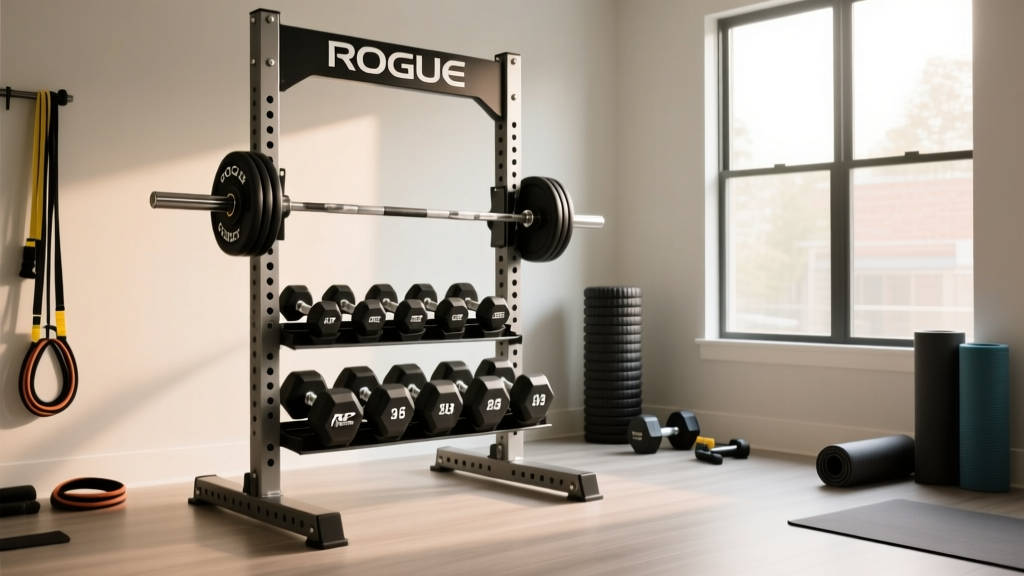
Best Dumbbell Racks to Organize Your Home Dumbbell Program (2026)

2026 Market Trends: Racks for the Back Squat Dumbbell Alternative
Rubber Hex vs Urethane: 2026 Dumbbell Cost & Market Trends

Barbell Collars vs Clamps for the Single-Leg Dumbbell Deadlift

EZ Bar vs Straight Bar: Space Tips for Full Arm Workouts With Dumbbells