
Dumbbell Seesaw Press & Kettlebell Guide: Cast Iron vs Competition
Master the dumbbell seesaw press and choose the right weights. Our 2026 hands-on kettlebell buying guide compares cast iron vs competition models.

Building the Ultimate Free-Weight Arsenal
Designing a functional, high-performance home gym in 2026 requires more than simply purchasing the heaviest iron available. It demands a strategic understanding of biomechanics, equipment tolerances, and how different tools complement one another. Whether you are perfecting the dumbbell seesaw press to build unilateral shoulder stability or exploring ballistic kettlebell movements, the equipment you choose dictates your progress. In this expert guide, we break down the mechanics of alternating presses and deliver a definitive kettlebell buying guide: cast iron vs competition, complete with hands-on reviews of top models to help you allocate your budget effectively.
The Dumbbell Seesaw Press: Core and Shoulder Synergy
Before diving into kettlebell selection, we must address a foundational pressing movement that bridges the gap between dumbbell and kettlebell training. According to exercise biomechanics directories like ExRx, the anterior deltoid and triceps brachii are the primary movers in overhead pressing. However, the dumbbell seesaw press introduces a massive core stabilization demand.
Unlike a standard alternating press where both dumbbells return to the shoulders, the seesaw press requires one dumbbell to remain anchored (either at the shoulder or locked out overhead) while the other presses. This creates a continuous, asymmetrical contralateral load. Your obliques and quadratus lumborum must fire relentlessly to prevent lateral flexion. Mastering this movement with dumbbells is a prerequisite before attempting high-volume alternating kettlebell presses, as the offset center of mass in a kettlebell will exponentially increase the anti-rotation demand on your core.
Expert Insight: When performing the seesaw press, focus on 'rooting' your feet and bracing your core as if preparing for a punch. The anchored dumbbell is not just resting; it is an active counterbalance that forces your serratus anterior to work overtime to stabilize the scapula.Kettlebell Buying Guide: Cast Iron vs. Competition
When expanding your free-weight rack beyond dumbbells, kettlebells are the logical next step. However, the 2026 market is flooded with options, and the debate between cast iron and competition kettlebells remains a primary sticking point for buyers. The right choice depends entirely on your training modality, grip strength, and space constraints.
Cast Iron Kettlebells: The Traditional Workhorse
Cast iron kettlebells are the classic, single-piece molds most lifters start with. Brands like Rogue Fitness and Rep Fitness dominate this space. The primary characteristic of cast iron bells is that their physical dimensions scale with their weight. A 12kg cast iron bell is significantly smaller than a 32kg bell, and the handle thickness usually increases as the weight goes up (ranging from 30mm on lighter bells to over 40mm on heavy ones).
- Pros: Highly durable, lower cost per pound, excellent for heavy grinds (squats, deadlifts) where a thicker handle builds grip strength.
- Cons: Inconsistent dimensions ruin muscle memory for technical lifts like snatches and cleans. The thicker handles on heavier bells can cause grip fatigue during high-rep pressing sets.
- Pricing: Generally ranges from $1.50 to $2.20 per pound, though shipping surcharges for heavy freight can impact the final cost.
Competition Kettlebells: Precision and Uniformity
Competition kettlebells are engineered for consistency. Whether you are holding an 8kg or a 48kg bell, the dimensions are identical: exactly 280mm in height and 210mm in width. Furthermore, the handle diameter is standardized, typically at 35mm (or 33mm for specific women's competition lines). As detailed in the Kettlebell Kings Competition Collection, these bells feature a steel shell with a hollow core filled with ball bearings or scrap metal to achieve the target weight while maintaining the exact outer dimensions.
- Pros: Flawless for technical consistency. Your forearm and wrist positioning remain identical whether you are warming up with 16kg or maxing out with 32kg. The 35mm handle is optimal for the 'rack position' and overhead pressing.
- Cons: Significantly more expensive. The wider, uniform bell can feel cumbersome for individuals with smaller frames during heavy two-handed swings.
- Pricing: Premium pricing, typically ranging from $3.50 to $5.00+ per pound.
Hands-On Comparison Matrix
To help you visualize the differences, we tested and measured top models from leading manufacturers. Below is our 2026 comparison matrix based on hands-on rack testing.
| Feature | Rogue Cast Iron | KB Kings Competition | Onnit Primal Bell |
|---|---|---|---|
| Material | Solid Cast Iron | Steel Shell / Filled Core | Solid Cast Iron |
| Handle Diameter (24kg) | ~33mm - 35mm (Varies) | 35mm (Uniform) | ~35mm |
| Bell Dimensions | Scales with Weight | 280mm x 210mm (Always) | Scales with Weight |
| Best Use Case | Heavy Grinds, Goblet Squats | Snatches, Cleans, Pressing | General Fitness, Flow |
| Avg. Cost per Pound | $1.85 | $4.20 | $2.50 |
Translating the Seesaw Press to Kettlebells
How does the dumbbell seesaw press translate when you swap to kettlebells? The transition is not as seamless as you might think. When holding a dumbbell in the rack position, the weight sits directly over your forearm, creating a relatively straight line of force through the wrist and elbow.
A kettlebell, however, rests against the outside of the forearm with its center of mass offset and hovering above your wrist. When you attempt a kettlebell seesaw press (alternating strict presses while keeping the non-working bell in the rack), the rotational torque on the resting wrist is immense.
Warning on Failure Modes: Attempting high-volume kettlebell seesaw presses without adequate wrist mobility and core bracing often leads to valgus stress on the elbow and hyperextension of the resting wrist. Always master the movement with dumbbells first, then transition to a lighter competition kettlebell (12kg or 16kg) to groove the new rack-position mechanics.
Expert Top Picks for 2026
- Best Overall Cast Iron: Rogue Kettlebells. The powder-coat finish is exceptionally grippy without tearing calluses, and the flat, machined base ensures they won't roll away during renegade rows or plank pull-throughs.
- Best Competition Bell: Kettlebell Kings Competition Series. The 35mm handle is perfectly polished for high-rep snatches, and the color-coded bodies make weight selection in a busy gym or garage rack instantaneous.
- Best Hybrid for Pressing: Vulcan Absolute Competition Kettlebells. Vulcan offers a slightly more forgiving window (the space between the handle and the bell) which accommodates lifters with thicker wrists who struggle with the tight rack position on standard competition bells.
Final Verdict and Budget Allocation
If your primary goal is raw strength, heavy carries, and foundational movements, invest your budget in cast iron kettlebells. The cost savings per pound allow you to build a wider range of heavy weights. However, if your training revolves around endurance, high-rep ballistic lifts, and translating pressing mechanics like the dumbbell seesaw press into the kettlebell strict press, competition kettlebells are non-negotiable. The uniform handle diameter and consistent window size will protect your wrists and ensure that your technical groove remains unbroken, regardless of the weight in your hand.
More gear to consider
All reviews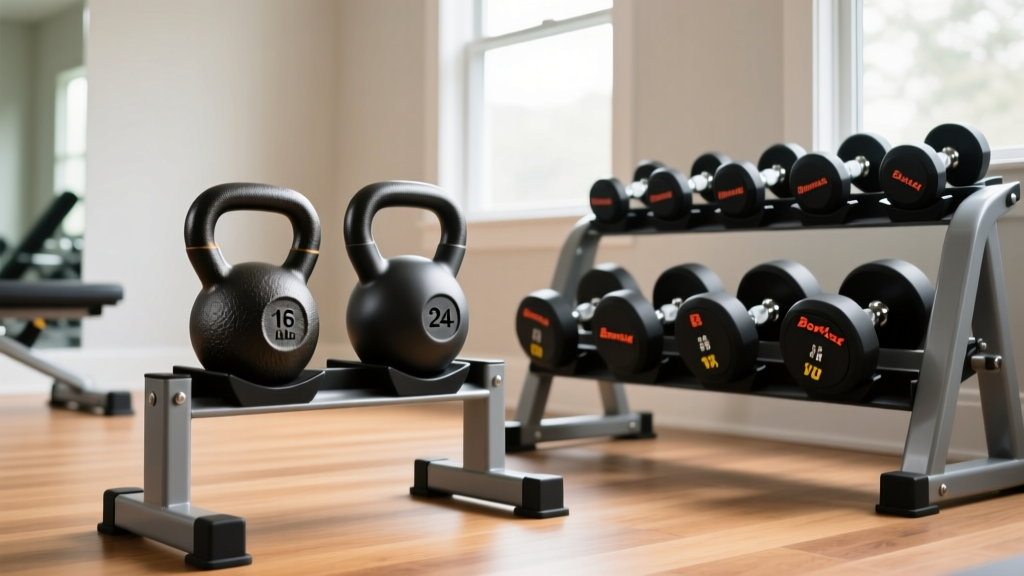
Gym Layouts: Kettlebell Sizing & How to Adjust Bowflex Dumbbells
Beyond Lat Pull Downs With Dumbbells: Barbell Weight & Knurl Guide
Bumper vs Iron Plates: Gym Layout & Dumbbell Front Shoulder Press

Is Cable Lateral Raise Better Than Dumbbell? Loadable Dumbbell Guide
Power Rack vs Squat Rack vs Stand: Dumbbell Chest Workouts at Home
