Dumbbell Rollover Guide: 2026 Storage Budget Analysis
Plan your 2026 dumbbell rollover with our budget breakdown. Compare A-frame, tiered, and rolling storage racks for maximum value and space efficiency.

Defining the Dumbbell Rollover in Modern Gym Economics
In the fitness equipment industry and advanced home gym building, a dumbbell rollover refers to the strategic liquidation of an entry-level weight set to fund a commercial-grade or heavier-tier upgrade. Typically, this means cycling out a standard 5–50 lb rubber hex set to acquire a 5–100 lb urethane set. However, a dumbbell rollover is never just about the weights; it inherently triggers a mandatory storage infrastructure upgrade. The rack that held 550 lbs of rubber hex cannot safely or efficiently house 2,050 lbs of urethane.
As of 2026, supply chain stabilization has leveled out steel pricing for storage racks, but raw material costs for urethane have pushed premium dumbbell prices up by roughly 12% over the last three years. This makes the budget breakdown of your storage solution more critical than ever. According to equipment analysts at Garage Gym Reviews, mismatching your new dumbbell inventory with an inadequate rack is the number one cause of premature equipment damage and safety hazards in home and boutique commercial gyms.
This guide provides a comprehensive budget breakdown and value analysis for upgrading your dumbbell storage ecosystem during a rollover, focusing on structural integrity, spatial footprint, and long-term ROI.
The True Cost of the Rollover: Weights vs. Storage
When planning your budget, it is vital to understand the depreciation curves of free weights versus storage racks. Dumbbells, particularly urethane and premium rubber, hold their resale value exceptionally well—often retaining 60% to 75% of their retail price on the secondary market. Storage racks, conversely, suffer from severe depreciation due to freight shipping costs and assembly labor.
Expert Insight: Never cheap out on the rack during a dumbbell rollover. You will likely sell your old dumbbells to fund the new ones, but you will almost never recoup the cost of a cheap, bent, or rusted storage rack. Buy the storage infrastructure for the next upgrade, not just the current one.Liquidation Math: Funding the Storage Upgrade
Let us look at a real-world 2026 rollover scenario. You are selling a used 5–50 lb rubber hex set (originally purchased for $450) for $275 on the secondary market. You are buying a 5–100 lb urethane set for $2,100. Your net weight cost is $1,825. If you allocate a strict 10% overhead rule for storage and handling, your budget for a new heavy-duty rack and floor protection should be exactly $210. This budget constraint immediately eliminates cheap, big-box store racks and points us toward direct-to-consumer fitness brands.
Storage Rack Tiers: Value vs. Footprint Analysis
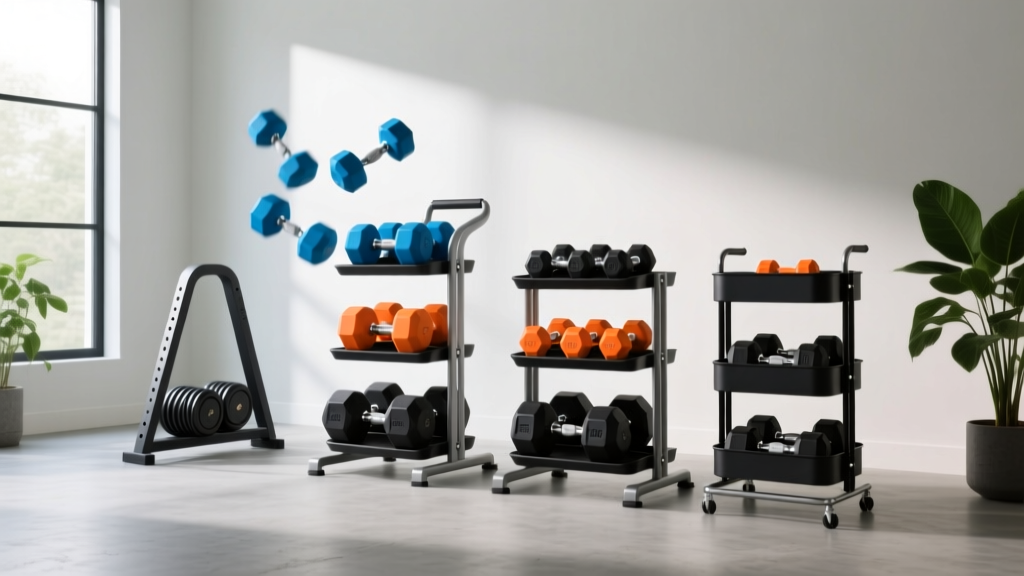
When upgrading your storage, you must balance the physical footprint of the rack against its weight capacity and steel gauge thickness. Below is a breakdown of the three primary rack tiers available during a rollover.
Tier 1: The 2-Tier Horizontal Rack (The Budget Saver)
Best for: 5–50 lb sets (Max 600 lbs total capacity).
Typical 2026 Price: $99 – $149
Steel Gauge: 14-gauge (approx. 0.075 inches thick)
Footprint: 48" W x 22" D
The 2-tier horizontal rack is the entry-level standard. Brands like Bells of Steel offer robust 2-tier options that maximize floor space width but require significant bending and squatting to retrieve heavier weights from the bottom tier. While budget-friendly, a 14-gauge steel frame will begin to deflect (bow) if you attempt to overload it with a 5–75 lb set. It is only recommended if your rollover caps at the 50 lb mark.
Tier 2: The 3-Tier A-Frame (The Space Optimizer)
Best for: 5–75 lb sets (Max 900 lbs total capacity).
Typical 2026 Price: $179 – $249
Steel Gauge: 11-gauge (approx. 0.120 inches thick)
Footprint: 35" W x 28" D
The A-Frame is the undisputed king of the home gym rollover. By utilizing a vertical, angled design, it reduces the width footprint while utilizing vertical space. The Rep Fitness SR-4000 series is a prime example, utilizing 11-gauge steel and heavy-duty gussets at the weld points. The angled trays allow gravity to assist in seating the dumbbells, reducing the 'clack' and wear on the urethane heads. The value proposition here is immense: you get commercial-grade 11-gauge steel for under $200.
Tier 3: Mobile Rolling Racks (The Facility Standard)
Best for: 5–100+ lb sets or multi-use spaces (Max 1,200+ lbs capacity).
Typical 2026 Price: $399 – $599
Steel Gauge: 11-gauge with reinforced caster mounts
Footprint: 52" W x 28" D
If your rollover involves a full 5–100 lb set, or if you operate a boutique studio where floor space must be cleared for group classes, a mobile rolling rack is mandatory. Titan Fitness offers a premier 3-tier mobile rack featuring heavy-duty locking casters. The critical value metric here is the caster mounting plate; budget racks weld casters directly to thin tubing, leading to catastrophic shear failures under a 1,000 lb load. Premium racks use a reinforced 3/16-inch steel base plate.
2026 Dumbbell Storage Comparison Matrix
| Rack Type | Model Example | Est. 2026 Price | Max Capacity | Footprint | Value Score |
|---|---|---|---|---|---|
| 2-Tier Horizontal | Bells of Steel 2-Tier | $129 | 600 lbs | 48" x 22" | 7.5 / 10 |
| 3-Tier A-Frame | Rep Fitness SR-4000 | $199 | 900 lbs | 35" x 28" | 9.5 / 10 |
| Mobile Rolling | Titan Fitness Mobile | $449 | 1,200 lbs | 52" x 28" | 8.5 / 10 |
| Wall-Mounted | Rogue Wall Hangers | $150 (per pair) | 150 lbs | 4" x 6" | 6.0 / 10 |
Hidden Costs in Storage Upgrades
When finalizing your rollover budget, failing to account for hidden logistical costs will blow past your 10% overhead rule. Consider the following expenses:
- Freight and Shipping Surcharges: A 3-tier A-frame rack weighs between 75 and 95 lbs. While many brands offer 'free shipping,' this is often baked into the retail price, or subject to residential delivery surcharges ($40–$75) if you do not have a commercial loading dock.
- Hardware and Assembly Time: Budget racks often use low-grade hex bolts that strip under torque. Factor in $15 for a high-quality metric socket set and 45 minutes of labor. Commercial racks utilize carriage bolts and nyloc nuts, drastically reducing assembly frustration.
- Drop Pad Integration: According to facility guidelines published by the National Strength and Conditioning Association (NSCA), free weight areas require specialized flooring to mitigate acoustic transfer and structural vibration. If your new rack sits on standard laminate or thin foam tiles, the concentrated point-load of a 900 lb rack will crack your subfloor. Budget $80 for a 4x6 ft, 3/4-inch thick vulcanized rubber mat to place exclusively beneath the rack.
Executing the Rollover: A Step-by-Step Framework
To ensure a seamless transition from your old inventory to your new storage ecosystem, follow this execution protocol:
- Audit and Measure (Week 1): Before listing your old dumbbells for sale, measure the handle length and head width of your new target dumbbells. Urethane dumbbells in the 5–15 lb range often feature wider heads than rubber hex equivalents. Ensure your target A-Frame rack trays have at least 2.5 inches of lateral clearance per pair.
- Liquidate with Local Pickup (Week 2): Sell your old set via local marketplace apps to avoid the exorbitant cost of shipping 500 lbs of iron. Use the cash to immediately purchase the rack, allowing it to arrive and off-gas (if it has rubber tray liners) before the new weights arrive.
- Map the Safety Zone (Week 3): The NSCA recommends a minimum of 36 inches of clear walkway space on all sides of a dumbbell rack to prevent tripping hazards and allow for safe loading/unloading. Tape off this zone on your gym floor before bolting the rack together.
- Assemble and Torque (Week 4): Assemble the rack on the rubber drop pad. Use a calibrated torque wrench to tighten all structural bolts to the manufacturer's specifications (typically 40-50 ft-lbs for 1/2-inch carriage bolts). Re-torque after 30 days of use, as steel settles under continuous heavy loads.
'A successful dumbbell rollover is not just about acquiring heavier iron; it is about engineering a storage environment that respects the physics of the load and the ergonomics of the athlete. The rack is the foundation of that environment.'
Final Verdict on Rollover Value
When executing a dumbbell rollover in 2026, the 3-Tier A-Frame rack remains the undisputed champion of value analysis. It offers the 11-gauge steel necessary for commercial loads, an angled tray design that preserves the lifespan of expensive urethane heads, and a footprint that respects the spatial constraints of modern home and boutique gyms. By accurately calculating your liquidation returns and factoring in hidden freight and flooring costs, you can upgrade your entire free-weight ecosystem without compromising on safety or structural integrity.
More gear to consider
All reviews
Power Rack vs Squat Rack vs Stand: Good Leg Exercises with Dumbbells

EZ Curl Bar vs Straight Bar: Space Layouts for Dumbbell Muscle Gain
Frankoman Dumbbell Review: Adjustable Weight Troubleshooting & Mistakes

EZ vs Straight Bar: Space Layouts & Dumbbell Push Ups Muscles Worked

Lying Down Dumbbell Press: Rubber vs Urethane Maintenance
