
Best Dumbbell Racks for Seated Dumbbell Rear Raises 2026
Discover the best 3-tier dumbbell racks of 2026 optimized for light isolation work like seated dumbbell rear raises. Expert reviews, specs, and setup tips.

The Hidden Ergonomics of Dumbbell Storage
When outfitting a home or commercial gym, lifters often obsess over the dumbbells themselves—debating urethane versus rubber, or hex versus round—while treating the storage rack as an afterthought. But as any seasoned strength coach knows, your equipment's workflow dictates your training intensity. This is especially true for high-volume isolation movements. If you are programming supersets or mechanical drop sets that culminate in seated dumbbell rear raises, a poorly designed rack will actively sabotage your workout.
The posterior deltoid is a relatively small muscle group. According to the ExRx.net Kinesiology Database, the rear delts function primarily in horizontal abduction and external rotation. Because the lever arm (your extended arm) is long during a seated dumbbell rear raise, the absolute load required to stimulate hypertrophy is surprisingly low—typically ranging from 5 lbs to 25 lbs for the vast majority of lifters. The problem? Most budget-friendly, 2-tier dumbbell racks only accommodate weights starting at 15 or 20 lbs on their top shelf, leaving your crucial 5, 8, 10, and 12.5 lb pairs scattered on the floor or crammed awkwardly onto a bench.
Expert Insight: Bending over to pick up light dumbbells from the floor between sets of seated rear raises forces repetitive lumbar flexion. This not only breaks your mind-muscle connection but also pre-fatigues your erector spinae, compromising your posture for subsequent heavy compound lifts like deadlifts or barbell rows.Why Rack Tiering Dictates Your Rear Delt Workouts
To execute seated dumbbell rear raises with strict form, your torso should be hinged at 45 to 60 degrees, or ideally, supported against an incline bench. Reaching laterally or slightly forward to grab a 10 lb dumbbell from an ergonomically angled top tier keeps your spine neutral and your focus entirely on the scapular retraction and posterior deltoid contraction.
Furthermore, the ACE Fitness Exercise Database emphasizes the importance of controlled eccentrics and strict joint alignment for shoulder health. Fumbling with poorly stored, oddly shaped weights disrupts this control. In 2026, the gold standard for accommodating both heavy compounds and light isolation work is the 3-tier rack with a dedicated lightweight tray. Below, we break down the top performers based on hands-on testing, steel gauge, and specific workflow efficiency.
Hands-On Reviews: Top Dumbbell Racks of 2026
1. Rogue Fitness 3-Tier Dumbbell Rack
The Rogue 3-Tier remains the undisputed heavyweight champion of commercial and high-end home gyms. Constructed from 11-gauge steel with 3x3-inch uprights, it is virtually indestructible. But its real value for isolation work lies in its top tier, which is specifically angled to cradle 5 lb to 15 lb dumbbells securely.
- Price: ~$545 (Rack only)
- Capacity: Holds up to 15 pairs (5-50 lbs) or 20 pairs (5-35 lbs)
- Footprint: 48" W x 28" D
- Workflow Score for Rear Raises: 9.5/10
The Verdict: The top tray features a UHMW plastic liner that protects your dumbbell handles from scratching. When performing drop sets on seated dumbbell rear raises (e.g., 20 lbs ➔ 15 lbs ➔ 10 lbs), the Rogue rack allows you to swap weights in under two seconds without standing up or rounding your back. The only drawback is the premium price tag and the sheer weight of the unit (over 130 lbs empty).
2. Rep Fitness 3-Tier Dumbbell Rack (REP-DR-3)
Rep Fitness has carved out a massive niche by offering 90% of Rogue's quality at 70% of the price. The REP-DR-3 features a unique 'scoop' tray design on the top tier, which is a game-changer for lighter weights.
- Price: ~$429
- Capacity: Holds up to 15 pairs
- Footprint: 46" W x 25" D
- Workflow Score for Rear Raises: 9/10
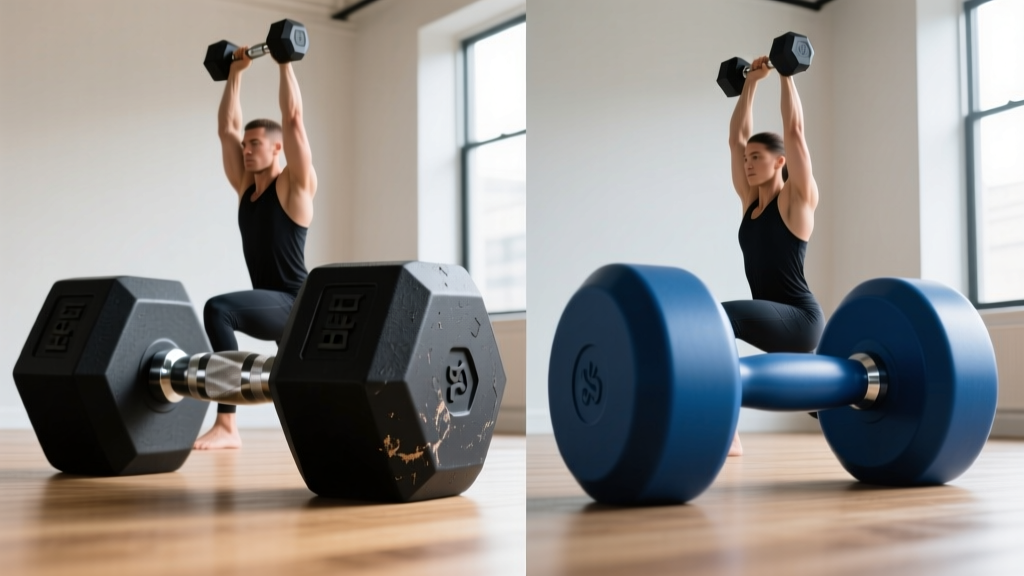
The Verdict: The scoop tray is brilliant for round-headed urethane dumbbells, preventing them from rolling. However, we noticed a specific failure mode: if you use cheap, oversized rubber hex dumbbells, the thick rubber heads can wedge into the scoop, causing annoying snags when you try to quickly grab your 12.5s for a burnout set of seated dumbbell rear raises. Pair this rack with high-tolerance urethane bells for the best experience.
3. PowerBlock Commercial Dumbbell Tower
Not everyone uses fixed dumbbells. If your gym relies on adjustable dumbbells for space efficiency, you need a storage solution that matches. The PowerBlock Tower is designed specifically for the Elite and Pro series.
- Price: ~$299
- Capacity: 3 pairs of adjustable dumbbells + expansion kits
- Footprint: 24" W x 24" D (Ultra-compact)
- Workflow Score for Rear Raises: 7.5/10
The Verdict: While it saves massive amounts of floor space, adjustable dumbbells require you to manually swap pins or slide selectors between drops. Doing this mid-set during seated dumbbell rear raises extends your rest periods and cools down the target muscle. It is a great storage solution, but inferior to fixed 3-tier racks for high-intensity drop-set workflows.
Comparative Matrix: Storage Solutions at a Glance
| Feature | Rogue 3-Tier | Rep Fitness REP-DR-3 | PowerBlock Tower |
|---|---|---|---|
| Steel Gauge | 11-Gauge | 14-Gauge | 12-Gauge |
| Min Weight Tier | 5 lbs (Angled Tray) | 5 lbs (Scoop Tray) | N/A (Adjustable) |
| Bolt-Down Required? | Mandatory | Highly Recommended | Optional |
| Best For | Commercial / Heavy Use | Home Gyms / Value | Small Spaces |
Facility Layout and Safety Clearances
According to guidelines referenced by the National Strength and Conditioning Association (NSCA), proper equipment spacing is critical for both safety and operational flow. When installing a 3-tier dumbbell rack, you must account for the 'load zone'.
The 36-Inch Rule
Always maintain a minimum of 36 inches of clearance between the front of the dumbbell rack and the nearest bench or machine. When you are holding a pair of 50 lb dumbbells, you need space to walk backward safely before sitting down. If your rack is shoved into a corner or placed too close to a squat rack, you risk tripping or dropping heavy weights on your feet.
Flooring and Anchoring
A fully loaded 3-tier rack can easily exceed 1,200 lbs. This massive weight concentration requires proper flooring and anchoring.
- Subfloor Protection: Use 3/4-inch vulcanized rubber mats directly under the rack. Thinner mats (like 3/8-inch) will compress over time, causing the rack to become unlevel, which makes the top-tier dumbbells rattle or slide.
- Anchoring: Both Rogue and Rep Fitness provide bolt-down tabs. If you are placing the rack on a concrete slab, use wedge anchors. If the rack is on a wood subfloor or rubber mat over plywood, you must bolt it through the subfloor into the structural joists. A top-heavy 3-tier rack can tip forward if a user aggressively yanks a heavy pair from the bottom tier while the top tier is fully loaded.
Frequently Asked Questions
Can I just use a 2-tier rack and put light dumbbells on a shelf?
You can, but it ruins the ergonomic flow of your workout. For exercises like seated dumbbell rear raises, lateral raises, or light tricep kickbacks, you want the 5-15 lb dumbbells at waist or chest height. A dedicated 3-tier rack keeps all weights within your natural peripheral vision and reach, eliminating the need to walk to a separate shelf or bend to the floor.
Do I need a saddle-style or tray-style top tier?
Tray-style (like the Rep Fitness scoop) is generally better for round urethane dumbbells, as it cradles the head securely. Saddle-style (individual slots) is better if you use hex dumbbells, as it prevents the flat edges from overlapping and getting stuck. Match your rack tier style to the geometry of your dumbbell heads.
How do I clean and maintain the rack tiers?
Sweat and chalk buildup on the angled tiers can make the rails slick, causing lighter dumbbells to slide out of position. Wipe down the UHMW plastic or steel rails weekly with a mild, non-corrosive cleaner. Avoid harsh bleach-based solutions, as they can degrade the protective coatings and cause the steel to oxidize over time.
More gear to consider
All reviews
Neoprene Sets for a Shoulder Workout With Dumbbells for Women

Power Rack vs Squat Stand: Lower Chest Workouts with Dumbbells

Power Rack vs Squat Rack vs Stand: Best for Dumbbell Arm Exercise?
Rubber Hex vs Urethane: Care for the Dumbbell Step Back Lunge

Barbell vs Dumbbell Shrugs: Troubleshooting Neoprene Home Workouts
