
Best Dumbbell Racks for the Lying Dumbbell Pullover to Extension
Optimize your home gym layout with the best dumbbell racks for the lying dumbbell pullover to extension. Discover space-saving storage and safety tips.

The Spatial Demands of Complex Superset Movements
The lying dumbbell pullover to extension is a high-yield, multi-joint superset movement that targets the latissimus dorsi, pectoralis major, and the long head of the triceps in one continuous sequence. However, executing this movement safely in a compact home gym requires meticulous spatial planning. When designing a home gym layout in 2026, most lifters focus on the footprint of their power rack or cardio equipment, treating dumbbell storage as an afterthought. This is a critical error.
According to biomechanics data cataloged by ExRx on the dumbbell pullover, the eccentric phase of the movement requires the dumbbell to travel 12 to 18 inches past the top edge of the bench. When you immediately transition into the lying triceps extension, your elbows act as a hinge, demanding strict overhead clearance and a safe 'drop zone' for fatigued muscles. If your dumbbell rack is improperly positioned, you risk smashing the weights into the steel uprights or, worse, compromising your form to avoid a collision. This guide breaks down exactly how to select and position dumbbell storage solutions to optimize space without sacrificing safety for high-clearance movements.
Calculating the Longitudinal Footprint and Clearance Zones
Before purchasing a rack, you must calculate the true longitudinal footprint of your lifting zone. A standard commercial flat bench measures 45 inches in length. The average male arm length, combined with the width of a standard hex dumbbell, adds roughly 30 inches of overhead reach during the pullover phase.
⚠ The 36-Inch Head-Clearance RuleThe National Strength and Conditioning Association (NSCA) facility design guidelines mandate a minimum of 36 inches of clearance behind the head of a bench for overhead and supine movements. For the pullover-to-extension combo, where momentum and fatigue factor into the eccentric deceleration, you need a minimum of 42 inches of unobstructed floor space behind the bench head. (Source: NSCA Education & Facility Standards).
If you place a standard 3-tier dumbbell rack directly behind the head of your bench, the math fails: 45" (bench) + 42" (clearance) + 24" (rack depth) = 111 inches (9.25 feet). In a standard 10x10 spare bedroom, this layout leaves virtually no walking path. Therefore, your storage solution must be repositioned laterally or utilize vertical wall space.
Tiered vs. A-Frame vs. Wall-Mounted: A Footprint Analysis
Not all racks are created equal when space optimization is the priority. Below is a comparison of the three primary dumbbell storage configurations and how they interact with high-clearance bench movements.
| Rack Type | Average Footprint (W x D) | Head-Clearance Compatibility | Best Layout Position |
|---|---|---|---|
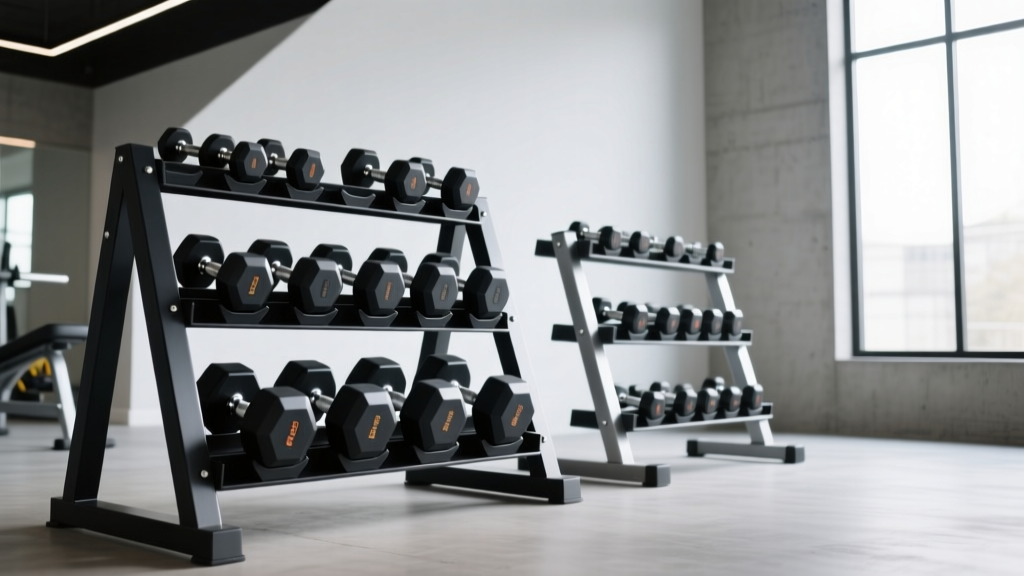
| 3-Tier Horizontal | 48" W x 24" D | Poor (Blocks overhead arc if placed at head) | Foot of the bench or lateral wall |
| A-Frame Vertical | 24" W x 24" D | Excellent (Small footprint allows corner tucking) | Diagonal corner behind bench head |
| Wall-Mounted Saddle | 48" W x 8" D | Superior (Frees up 100% of floor clearance) | Directly behind bench head on wall |
The Geometry of Safety: Why Hex Dumbbells are Mandatory
When performing the lying dumbbell pullover to extension, the transition point—moving from a straight-arm lat stretch to a bent-elbow triceps crush—requires immense wrist stability. Furthermore, when your triceps reach failure, you must safely drop or place the dumbbells on the floor beside your head.
- Round Urethane Dumbbells: If placed on the floor near the bench legs or dropped hastily, round dumbbells can roll. A rolling 35-pound dumbbell in a tight, 50-square-foot layout is a severe ankle and impact hazard.
- Hex Rubber/Neoprene Dumbbells: The flat edges prevent rolling and provide a tactile, aligned grip surface. When you reach behind your head to grab the next set for your pullover, the flat edge allows you to blindly align your grip without looking, keeping your focus on the spatial awareness of the rack behind you.
Designing the Optimal 60-Square-Foot Dumbbell Zone
To perfectly accommodate this exercise in a compact room, follow this step-by-step spatial mapping protocol:
- Anchor the Bench: Place the head of your bench 42 inches away from the back wall. This satisfies the NSCA safety clearance for the pullover arc.
- Install Wall-Mounted Storage: Mount a 2-tier or 3-tier wall saddle rack at a height of 36 to 48 inches on the back wall. This keeps the heavy dumbbells at waist/chest level for safe lifting off the rack, while leaving the floor completely clear for the eccentric arm travel.
- Create the Lateral Drop Zone: Ensure 24 inches of lateral space on both the left and right sides of the bench. When failing a triceps extension, you will naturally guide the dumbbells to the floor beside your torso, not behind your head.
Top Space-Optimized Rack Recommendations for 2026
Based on current market availability, footprint efficiency, and compatibility with high-clearance movements, these are the top storage solutions for the space-conscious lifter.
1. Rogue Wall-Mount Dumbbell Saddle Rack
Footprint: 4" projection from wall
Estimated Cost: $145 - $195 (Rack only)
Why it works: By eliminating floor-standing legs entirely, Rogue's wall-mount saddles allow you to push your bench further back while maintaining the 42-inch clearance rule. You can position the bench head directly beneath the lowest tier of stored dumbbells without fear of striking steel uprights during the pullover stretch. Pair this with Rogue's Rubber Hex Dumbbells ($2.25/lb) for maximum anti-roll safety.
2. Titan Fitness A-Frame Dumbbell Rack
Footprint: 24" W x 24" D
Estimated Cost: $149.99
Why it works: If wall mounting is impossible (e.g., renting an apartment with drywall restrictions), the A-Frame is the ultimate space-saver. Its 2x2 foot base allows you to tuck it into the diagonal corner behind your bench. The vertical stacking means the top tier is easily accessible for your lighter triceps extension weights, while the heavier pullover dumbbells sit securely at the wide, stable base.
3. Rep Fitness 3-Tier Dumbbell Rack (48-Inch)
Footprint: 48" W x 23" D
Estimated Cost: $159.99
Why it works: If you have a wider room but lack depth, place this rack at the foot of the bench rather than the head. This completely removes the rack from the pullover's overhead trajectory. Rep's Urethane Hex dumbbells ($1.60/lb) feature an ergonomic contoured handle that reduces wrist strain during the awkward transition phase of the pullover-to-extension superset.
Pro-Tip on Weight Selection: Because the pullover leverages a longer moment arm than the triceps extension, most lifters must drop weight between the two phases of the superset. Store your 'pullover' weight (e.g., 40 lbs) on the middle tier and your 'extension' weight (e.g., 25 lbs) on the top tier directly above it. This vertical stacking allows for a rapid, 2-second weight swap without walking across the room, keeping your muscles under tension and your heart rate elevated.
Frequently Asked Questions
Can I use an adjustable bench for the pullover to extension?
Yes, but ensure the bench is set to a completely flat (0-degree) position. Even a slight 15-degree incline alters the biomechanical path of the pullover, shifting the stress away from the lats and onto the anterior deltoids, while simultaneously reducing your overhead clearance by up to 8 inches.
What is the safest way to pick up heavy dumbbells for this movement?
Never deadlift heavy hex dumbbells from the floor and swing them back. Use the 'knee-kick' method: sit on the edge of the bench, rest the dumbbells on your knees, and kick them up one at a time as you roll backward into the supine position. This requires a clear lateral footprint, reinforcing why your rack must not be placed immediately adjacent to the side of the bench.
Final Thoughts on Layout and Longevity
Mastering the lying dumbbell pullover to extension in a home gym is less about raw strength and more about environmental design. By respecting the 42-inch overhead clearance rule, opting for anti-roll hex geometries, and utilizing vertical or A-frame storage solutions, you transform a cramped spare room into a biomechanically sound training facility. Invest in the right spatial layout today, and your joints, your drywall, and your triceps will thank you for years to come.
More gear to consider
All reviews
EZ Bar vs Straight Bar & Seated Bent Over Two Arm Dumbbell Triceps Extension

Troubleshooting Light Dumbbell Workouts With Neoprene Coated Sets

Best Neoprene Dumbbells for the Dumbbell Squat to Press: 2026 Guide

Olympic Barbell Buying Guide: Weight, Knurling & Dumbbell Cable Flyes Pairings
Define Dumbbell Storage: 2026 Rack Budget Breakdown
