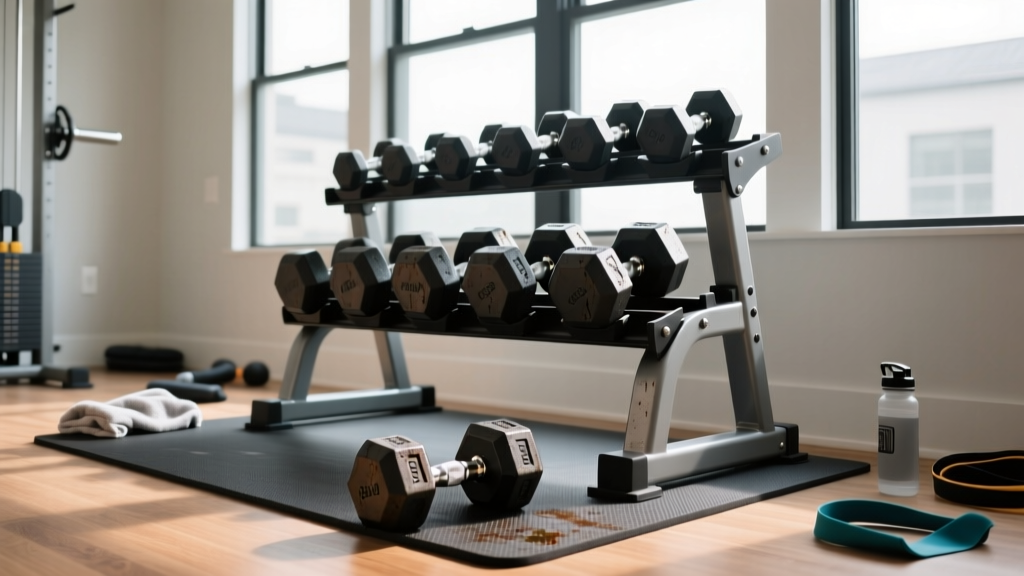
Space-Saving Dumbbell Racks for Russian Deadlifts with Dumbbells
Optimize your home gym layout for Russian deadlifts with dumbbells. Discover space-saving rack solutions, exact dimensions, and strategic floor plans.

The Biomechanics of Space: Why Floor Clearance Matters
Designing a highly functional micro-gym or garage fitness space requires more than just purchasing the right equipment; it demands a rigorous understanding of movement geometry. When programming russian deadlifts with dumbbells, the spatial requirements are uniquely demanding. Unlike standard bilateral hinges performed with a barbell, the dumbbell variation—often executed with a wide, sumo-style stance or a deep single-leg/goblet hinge—requires a pristine 'sweep zone' around the lifter.
According to biomechanical analyses of hip hinge patterns documented by ExRx.net, maintaining a neutral spine during deep hip flexion requires the torso to track perfectly between or just behind the knees. For a wide-stance russian deadlift, this means the lifter's feet may be positioned 35 to 45 inches apart. If a traditional A-frame dumbbell rack is placed too close to the lifting platform, its protruding base (often extending 28 to 32 inches into the room) will physically block the lifter's heels, forcing an unnatural toe-in that compromises hip mechanics and invites lumbar shear.
Space Optimization Rule #1: The 'sweep zone' for wide-stance dumbbell hinges requires a minimum unobstructed floor area of 5x5 feet. Your storage solution must respect this perimeter.Vertical vs. Horizontal: Choosing the Right Rack Profile
To accommodate the expansive footprint of dynamic floor movements, we must shift our storage paradigm from horizontal sprawl to vertical density or wall-integration. As of 2026, the market has heavily favored modular, high-density storage systems that prioritize floor recovery. Here is how the top tier of space-saving racks compares for this specific use case.
3-Tier Horizontal Racks (The Space Champion)
The 3-tier horizontal rack is the gold standard for compact home gyms. By utilizing three tiers instead of the traditional five, the rack's depth is drastically reduced. The Rogue Fitness 3-Tier Dumbbell Rack, for example, boasts a footprint of just 23 inches deep by 31 inches wide. This allows you to push the rack flush against a wall or tuck it into a corner, leaving the center of the room completely open for the lateral foot placement required for russian deadlifts with dumbbells.
Wall-Mounted Cradles (The Ultimate Minimalist Setup)
For single-car garages or basement gyms where every square foot of rubber matting is precious, wall-mounted cradles eliminate the floor footprint entirely. Heavy-duty steel brackets bolted directly into wall studs can hold pairs up to 50 lbs. While they limit total capacity, they offer zero floor interference, making them ideal for minimalist lifters who only keep 3 to 5 pairs of high-use dumbbells.
The A-Frame Warning
While A-frame towers are popular in commercial gyms for their 360-degree accessibility, they are the enemy of space optimization. A standard 5-tier A-frame requires a 28x28 inch base and demands 36 inches of clearance on all sides for safe retrieval. In a home gym under 400 square feet, an A-frame will inevitably encroach on your deadlift platform.
| Rack Type / Model | Footprint (Depth x Width) | Est. Price (2026) | Sweep Zone Interference |
|---|---|---|---|
| Rogue 3-Tier Horizontal | 23' x 31' | $425 | Low (Wall-huggable) |
| Titan Wall-Mount Cradles | 0' x 41' (Wall only) | $159 | None |
| Standard 5-Tier A-Frame | 28' x 25' | $180 | High (Requires 36' clearance) |
Strategic Layout Design for Compact Home Gyms
Integrating your dumbbell rack into a space optimized for russian deadlifts with dumbbells requires a deliberate, step-by-step layout mapping process. Follow this framework to maximize your usable square footage:
- Map the Primary Hinge Zone: Lay down your lifting platform or horse-stall mats. Identify the exact center point where your feet will plant during a wide-stance deadlift. Mark a 5-foot radius from this center point. This is your 'No-Storage Zone'.
- Calculate the Rack Shadow: Measure the depth of your chosen rack. If using a 23-inch deep 3-tier rack, place it exactly 61 inches away from the center of your lifting zone (60 inches for the sweep zone + 1 inch for wall clearance if applicable).
- Establish the Transit Corridor: Ensure there is a minimum 24-inch wide walking path between the rack and the lifting zone. When hauling a 100 lb dumbbell back to the rack after a heavy set, you need a clear, unobstructed path to avoid tripping hazards.
- Anchor and Secure: Even space-saving racks can tip if a heavy dumbbell is dropped onto the top tier. Always bolt horizontal racks to the wall studs using 3/8-inch lag screws.
Heavy-Duty Considerations for High-Capacity Storage
Russian deadlifts with dumbbells frequently utilize heavy, single-dumbbell loads ranging from 70 to 120 lbs, or matched pairs of 50+ lbs for advanced lifters. This places immense point-load stress on the rack's cradles and welds.
When evaluating space-saving racks, do not compromise on steel gauge to save a few inches of depth. Look for racks constructed from 11-gauge or 7-gauge steel. Many budget-friendly, ultra-compact racks on the market use 14-gauge steel, which is prone to bending and weld fatigue when repeatedly loaded with hex dumbbells exceeding 80 lbs per pair. Furthermore, ensure the rack features UHMW (Ultra-High Molecular Weight) plastic liners on the cradles. These liners not only protect the knurling and coating of your dumbbells but also dampen the acoustic shock of dropping heavy iron into the rack, a crucial factor in residential garage gyms.
'In micro-gym design, the floor is your most expensive real estate. Every inch of storage that protrudes horizontally is an inch stolen from your biomechanical freedom. Prioritize vertical density and wall integration to preserve the integrity of your lifting platform.'
— Home Gym Engineering Principles, 2025 FitGearPulse Layout Report
Frequently Asked Questions
Can I use a wall-mounted rack for dumbbells over 100 lbs?
Yes, but with strict caveats. The wall must be constructed of solid wood studs (not metal studs or drywall alone), and you must use heavy-duty structural lag bolts. Additionally, wall-mounted racks are generally rated for a total distributed load; ensure the specific bracket you are using is rated for the point-load of a single 100+ lb dumbbell.
Does the shape of the dumbbell affect rack spacing?
Absolutely. Hex-head dumbbells stack predictably and require standard 8.5-inch to 9-inch tier spacing. Urethane round-head dumbbells, however, can roll and require contoured cradles or deeper tiers to prevent shifting. If you use round dumbbells for your russian deadlifts, ensure your space-saving rack has anti-roll lips or contoured saddles.
What is the best matting to use around the rack?
Use 3/4-inch thick vulcanized rubber mats under the rack to absorb dropped weights, but transition to a flat, low-pile horse-stall mat in the actual lifting zone. Thick, squishy mats can compromise the lateral stability required for the wide stance of a heavy dumbbell deadlift.
More gear to consider
All reviews
Rack Storage & Maintenance for the Lying Dumbbell Curl

Barbell Collars Compared: Safety for Close Grip Dumbbell Bench Press

Power Rack vs Squat Rack vs Stand: Setup for Peppins Dumbbells
Dumbbell Horizontal External Shoulder Rotation: Loadable Handle Care

Kettlebells vs Dumbbell Exercises for Flabby Arms: Cast Iron Guide