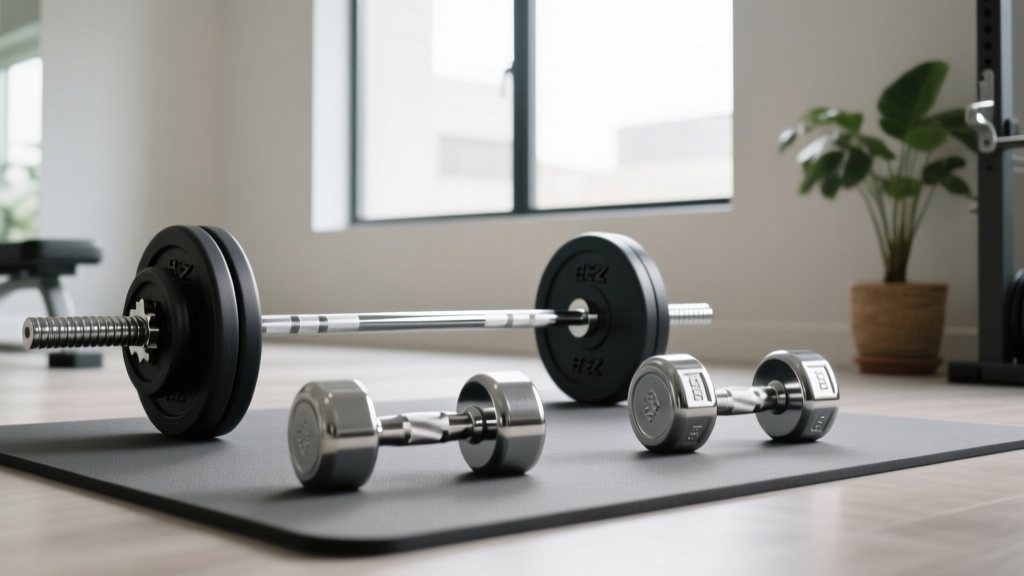
Olympic Barbell Buying Guide: Weight, Knurling & Seated Rows with Dumbbells
Master our Olympic barbell buying guide focusing on weight tolerance and knurling patterns, plus how to pair it with seated rows with dumbbells.

Building a high-performance home gym in 2026 requires more than just throwing money at the first piece of iron you see. When it comes to back development and heavy pulling mechanics, your equipment choices dictate your progress. This Olympic barbell buying guide breaks down the critical nuances of weight capacity and knurling profiles, while also exploring how to intelligently program your heavy barbell pulls alongside isolation movements like seated rows with dumbbells to maximize hypertrophy and spare your lower back.
The Anatomy of Olympic Barbell Weight and Tensile Strength
Before evaluating knurling, we must address the bar's structural integrity. The tensile strength of a barbell, measured in pounds per square inch (PSI), determines how much weight it can hold before permanently bending or snapping.
Expert Insight: Do not confuse tensile strength with yield strength. Tensile strength is the breaking point; yield strength is when the bar bends and fails to return to its original straightness. For heavy rowing and deadlifting, you want a yield strength that mirrors a high tensile rating.- 165,000 - 180,000 PSI: Entry-level and multi-purpose bars. Expect permanent bending if you regularly load past 400 lbs and drop the bar.
- 190,000 - 205,000 PSI: The gold standard for powerlifting and heavy bodybuilding rows. Bars in this range (like the iconic Rogue Ohio Power Bar) offer enough rigidity for heavy bent-over rows without excessive 'whip'.
- 210,000+ PSI: Elite competition power bars. Extremely stiff, ideal for squat and bench, but the lack of whip can make heavy barbell rows feel brutally rigid on the joints.
Head-to-Head Showdown: Rogue vs. American Barbell
To understand how knurling and weight tolerance interact, let's compare two of the most popular power bars on the 2026 market. Both handle immense weight, but their grip profiles cater to entirely different lifting philosophies.
| Feature | Rogue Ohio Power Bar | American Barbell Elite Power Bar |
|---|---|---|
| Tensile Strength | 205,000 PSI | 210,000 PSI |
| Knurl Profile | Volcano (Grippy, forgiving) | Mountain (Aggressive, sharp) |
| Shaft Diameter | 29 mm | 29 mm |
| Bushing/Bearing | Composite Bushings | Bronze Bushings |
| Approx. 2026 Price | $295.00 | $285.00 |
Decoding the Knurl: Volcano vs. Mountain
According to BarBend's comprehensive powerlifting barbell reviews, the knurl pattern is arguably the most vital tactile feature of the bar.
- Volcano Knurling (Rogue): Instead of sharp peaks, the machined grooves create a 'crater' with four distinct gripping edges per diamond. This provides massive surface area for grip during heavy Pendlay rows without tearing your calluses.
- Mountain Knurling (American Barbell): Features sharp, pronounced peaks. It bites into the skin aggressively. While excellent for 1-rep max deadlifts, high-volume barbell rows with a mountain knurl can quickly shred your palms.
Programming Heavy Pulls: Barbell Rows vs. Seated Rows with Dumbbells
Buying the right barbell is only half the equation; knowing how to program it is where true E-E-A-T separates the amateurs from the experts. Heavy barbell bent-over rows are unparalleled for overall posterior chain thickness, but they come with a massive tax on your lumbar erectors.
When your lower back is pre-exhausted from heavy squats or deadlifts, attempting 4 sets of heavy barbell rows often leads to form breakdown and spinal shear. This is where transitioning to seated rows with dumbbells becomes a biomechanical necessity for hypertrophy.
"To maximize latissimus dorsi activation while minimizing lumbar fatigue, pair heavy barbell hinge movements with chest-supported or seated unilateral dumbbell work. The seated position removes the isometric lower back constraint, allowing you to train the back to true muscular failure."
Why Seated Rows with Dumbbells Complement Your Barbell
- Unilateral Deficit Correction: A barbell locks both arms into a fixed path. Seated rows with dumbbells allow you to identify and correct left-to-right strength imbalances, pulling the elbow further past the torso for a deeper peak contraction.
- Stretch-Mediated Hypertrophy: Using adjustable dumbbells (like the Nuobell or PowerBlock Elite) allows you to control the eccentric phase meticulously. Sitting on the floor or a low bench and reaching forward with the dumbbells loads the lats in their fully stretched position, which recent kinesiology data suggests is highly stimulative for muscle growth.
- Grip Preservation: If you've just battered your CNS and torn up your hands on an aggressive mountain-knurl barbell, holding smooth-handled dumbbells for seated rows allows you to continue training the back without grip being the limiting factor.
Bushings vs. Bearings: What Matters for Rowing?
When scanning Rogue Fitness specifications or other manufacturer specs, you will see mentions of bushings and bearings.
Needle bearings allow the sleeve to spin rapidly, which is crucial for the Olympic lifts (snatch, clean and jerk). However, for powerlifting and bodybuilding rows, rapid sleeve spin is unnecessary and can actually cause the plates to shift unpredictably during slow, controlled eccentrics. Bronze or composite bushings provide a slower, more controlled sleeve rotation, offering the stability required when you are holding a 315 lb barbell in a bent-over position for a 2-second pause at the top of the movement.
2026 Purchasing Matrix: Which Setup is Right for You?
The Powerbuilder
Barbell: Rogue Ohio Power Bar (Volcano Knurl)
Accessory: Heavy adjustable dumbbells (90+ lbs)
Strategy: Heavy barbell rows for mechanical tension, followed immediately by seated rows with dumbbells for metabolic stress and stretch.
The Pure Hypertrophy Lifter
Barbell: Multi-purpose Olympic Bar (190k PSI, moderate knurl)
Accessory: Loadable dumbbell handles or 5-50 lb rack
Strategy: Chest-supported T-bar rows, relying heavily on seated rows with dumbbells to isolate the lats and rhomboids without spinal loading.
Frequently Asked Questions
Does a center knurl matter for rowing?
For bent-over barbell rows, the center knurl helps 'bite' into your shirt or back to prevent the bar from sliding down your thighs during the concentric phase. However, if you also front squat, a sharp center knurl will tear up your clavicles. Look for a bar with a smooth or lightly machined center ring if you do both.
Can I just use my Olympic barbell for everything and skip dumbbells?
You can, but it's suboptimal. The National Strength and Conditioning Association (NSCA) frequently highlights the importance of unilateral training to correct asymmetries. Relying solely on bilateral barbell rows often allows your dominant side to compensate, leading to uneven back development over time.
How do I maintain my barbell knurling?
Chalk and sweat will pack into the knurl valleys, turning a volcano knurl into a smooth hill over time. Use a stiff nylon brush (never brass or steel, which can damage the zinc or cerakote finish) and wipe it down with a light coat of 3-in-One oil once a month to prevent oxidation and maintain grip integrity.
More gear to consider
All reviews
Power Rack vs Squat Rack vs Stand for Heavy Dumbbell Press Weight

Hex vs Urethane Dumbbell Care & Decline Dumbbell Press Muscles Worked

Loadable Dumbbell Care: Why Dumbbell Hip Huggers Prevent Plate Wear

Top Dumbbell Racks for Your Home Dumbbell Workout Arms Routine
Optimize Space for Your Dumbbell Home Routine: Storage & Rack Guide