Dumbbell Hammer Press Layouts: Rubber Hex vs Urethane Space Guide
Optimize your home gym layout for the dumbbell hammer press. We compare rubber hex vs urethane dumbbells for space efficiency, durability, and cost.

The Spatial Mechanics of the Dumbbell Hammer Press
Designing a compact home gym requires a deep understanding of how specific movements dictate your floor plan. When optimizing for upper body hypertrophy, the dumbbell hammer press is a staple movement. Unlike traditional wide-grip bench presses or chest flyes that demand a massive lateral wingspan, the hammer press utilizes a neutral grip (palms facing each other). This biomechanical adjustment keeps the elbows tucked at roughly a 30 to 45-degree angle from the torso, significantly reducing the lateral clearance required on either side of the bench.
According to the exercise biomechanics database ExRx.net, the neutral grip dumbbell press heavily targets the sternal pectoralis major and anterior deltoids while minimizing shoulder impingement risks. Because your elbows stay tucked, you can position your adjustable bench much closer to power rack uprights or walls. However, this movement demands precise vertical clearance and a highly organized pickup zone, especially when handling heavy sets (80+ lbs per hand). This is where the physical geometry and material composition of your dumbbells—specifically rubber hex versus urethane—directly impact your spatial layout.
Rubber Hex vs. Urethane: Material Profiles and Storage Footprints
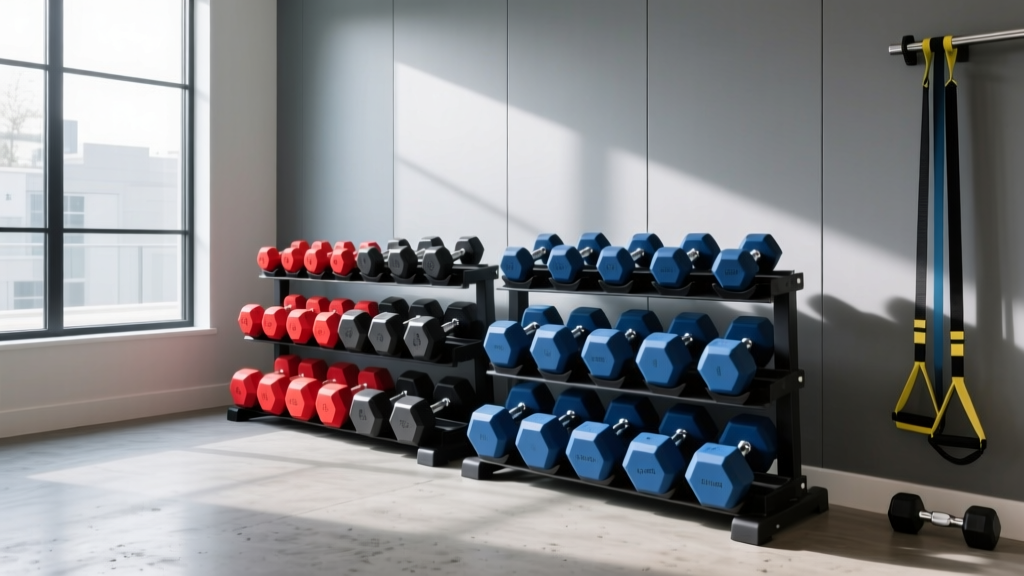
Choosing between rubber-coated hex dumbbells and solid urethane dumbbells is not just an aesthetic choice; it fundamentally alters how you store and interact with the weights in a space-constrained environment. Rubber hex dumbbells, typically featuring a cast-iron core encased in a recycled rubber shell, offer flat edges that allow for secure stacking on flat shelving or the floor. Urethane dumbbells, made from a premium polyurethane elastomer, are often round or 12-sided and require specialized cradles or tiered racks to prevent rolling and floor damage.
| Feature | Rubber Hex (e.g., REP Fitness) | Urethane (e.g., Rogue Fitness) |
|---|---|---|
| Average Cost (2026) | $1.50 - $1.90 per lb | $3.80 - $4.50 per lb |
| Shore A Hardness | 75A - 80A (Softer, higher bounce) | 88A - 92A (Denser, minimal bounce) |
| Odor / VOC Off-Gassing | Moderate to High (Requires ventilation) | None (Ideal for sealed, small rooms) |
| Stackability | Excellent (Flat hex edges) | Poor (Requires tiered rack or cradles) |
| Floor Impact Noise | Low (Rubber absorbs acoustic shock) | Moderate (Denser material transfers sound) |
For lifters building a gym in a spare bedroom, basement, or garage with poor ventilation, the VOC (volatile organic compound) off-gassing of budget rubber hex dumbbells can be a dealbreaker. As noted in product specifications from REP Fitness, while their virgin rubber formulations have improved, a 500 lb set will still emit a distinct tire-like odor for the first few weeks. Conversely, Rogue Fitness urethane dumbbells are completely odorless, making them the superior choice for enclosed, multi-purpose living spaces where air quality is paramount.
Layout Blueprint: Integrating Your Dumbbell Rack for Efficiency
When setting up your gym specifically to accommodate heavy pressing movements like the dumbbell hammer press, the transition from rack to bench must be seamless to prevent lower back fatigue before the set even begins. Here is the optimal layout protocol for a compact 10x10 foot space:
- The 3-Tier Horizontal Rack Placement: Avoid vertical A-frame racks. While A-frames save roughly 40% of floor space, they force you to bend and twist to grab heavy dumbbells from the bottom tiers. Position a 3-tier horizontal rack exactly 24 inches behind the head of your adjustable bench.
- The Scoop Zone: Leave a 36-inch clearance on the left and right sides of the bench. This allows you to sit on the edge of the bench, reach laterally to the rack or floor, and 'scoop' the dumbbells onto your knees before kicking them back into the neutral grip position for the hammer press.
- Matting Boundaries: Lay down 3/4-inch thick horse stall mats (typically 4x6 feet). Ensure the mat extends at least 18 inches beyond the dumbbell rack to catch accidental drops during the pickup phase.
Failure Modes and Edge Cases in Compact Gyms
Understanding how different materials fail in tight spaces will save you thousands of dollars in property damage and equipment replacement over the next decade.
- The Hex Corner Stress Concentrator: Rubber hex dumbbells have sharp corners. If you fail a heavy dumbbell hammer press rep and drop the weight, the entire force of the impact is concentrated on that single rubber corner. Over time, the rubber will split, exposing the cast iron core, which will then chip your concrete floor or tear through standard EVA foam mats.
- Urethane Chipping on Concrete: While premium urethane is virtually indestructible against standard wear and tear, its high Shore A hardness means it does not absorb shock as well as rubber. Dropping a 90A urethane dumbbell directly onto an un-matted concrete floor from a height of 4 feet can cause the outer shell to chip or crack.
- The Rolling Hazard: If you opt for round urethane dumbbells to save rack space, a missed rep during a hammer press can result in the dumbbell rolling under your bench or into a nearby wall, potentially damaging drywall or baseboards in a small room. Always opt for 12-sided (dodecagonal) urethane if floor space is tight and you lack a dedicated spotter.
"In a 150-square-foot garage gym, the physical footprint of your equipment is secondary to the 'dynamic footprint'—the space required to safely move, load, and unload the weights. A 3-tier rack with hex dumbbells offers the best compromise between static storage density and dynamic movement safety."
Cost vs. Space: The Financial Reality
Outfitting a full dumbbell set from 5 to 50 lbs (in 5 lb increments) requires 20 pairs. At current 2026 market rates, a rubber hex set will cost approximately $1,100 to $1,300, including a basic 3-tier rack. The same set in premium urethane, paired with a heavy-duty steel cradle rack, will easily exceed $3,200.
For the space-constrained lifter on a budget, rubber hex is the most pragmatic choice, provided you invest in high-quality 3/4-inch vulcanized rubber mats to protect your subfloor and mitigate the acoustic impact. However, if your gym is located in a finished basement or a spare room where odor, noise transfer to adjacent rooms, and aesthetic integration are top priorities, the premium paid for urethane is a necessary investment in your home's livability.
Frequently Asked Questions
Can I perform the dumbbell hammer press inside a standard power rack?
Yes, and it is highly recommended for space optimization. By placing an adjustable bench inside a power rack, you utilize the rack's safety spotter arms. Set the spotter arms just below your lowest range of motion for the hammer press. This eliminates the need for a human spotter and allows you to push to absolute failure safely, even when the bench is pushed flush against a wall to save floor space.
Do hex dumbbells damage standard adjustable benches?
The flat edges of hex dumbbells can dig into the vinyl padding of adjustable benches if dropped or rested aggressively on the seat during the pickup phase of the hammer press. Urethane's smoother, rounded edges are generally gentler on bench upholstery over years of heavy use.
More gear to consider
All reviews
Best Adjustable Dumbbells for a Hamstring Dumbbell Workout (2026)

Beyond the Dumbbell Symbol: Loadable Plates for Compact Gyms

Barbell Buying Mistakes After Weight Training Exercises With Dumbbells

Barbell Collars Compared & Seated Cable Row with Dumbbells

Bumper vs Iron Plate Comparison & Forearm with Dumbbells (2026)
