Organizing Your Dumbbell Curl Weight Collection: Storage & Layout
Optimize your home gym layout with space-saving racks. Learn how to store your dumbbell curl weight sets efficiently for better workflow, safety, and space.

The Biomechanics of Space: Defining the Isolation Zone
Designing an efficient home gym is an exercise in spatial geometry and workflow optimization. While power racks and heavy barbells dictate the structural anchor points of your training space, the smaller, high-frequency equipment often dictates the daily flow of your workouts. Specifically, the dumbbell curl weight range—typically spanning from 10 to 35 pounds—represents the most frequently accessed segment of equipment for upper-body isolation, accessory work, and physical therapy routines.
When programming for hypertrophy, lifters frequently utilize drop sets, supersets, and high-rep burnout protocols. If you constantly swap out your dumbbell curl weight pairs during a bicep curl or lateral raise complex, storing these specific weights across the room from your primary lifting zone introduces unnecessary friction. According to facility design guidelines emphasized by the American Council on Exercise (ACE), organizing equipment by biomechanical function rather than just numerical weight reduces workout fatigue and minimizes tripping hazards in high-traffic zones.
This article breaks down the exact spatial requirements, rack typologies, and layout frameworks necessary to optimize your home gym for both heavy compound movements and high-volume isolation work.
Tiered Storage vs. A-Frame: Footprint and Capacity Matrix
Choosing the right storage solution for your dumbbell curl weight inventory requires balancing floor space (footprint) against vertical accessibility. A 3-tier horizontal rack is generally the gold standard for commercial and high-end home gyms, but A-frame racks offer a smaller footprint for tighter spaces. Below is a comparative matrix of three industry-standard racks available in 2026, analyzing their dimensions, capacity, and pricing.
| Rack Model | Footprint (W x D) | Height | Capacity (Pairs) | Approx. Price | Best For |
|---|---|---|---|---|---|
| Rep Fitness 3-Tier Dumbbell Rack | 35' x 24' | 28' | 5 to 10 (depending on head size) | $249.00 | Dedicated isolation zones |
| Rogue 3-Tier Dumbbell Rack | 41' x 25' | 28' | 10 pairs | $395.00 | Full commercial-grade sets |
| Powerline A-Frame Rack | 27' x 27' | 45' | 5 pairs | $139.00 | Compact garage corners |
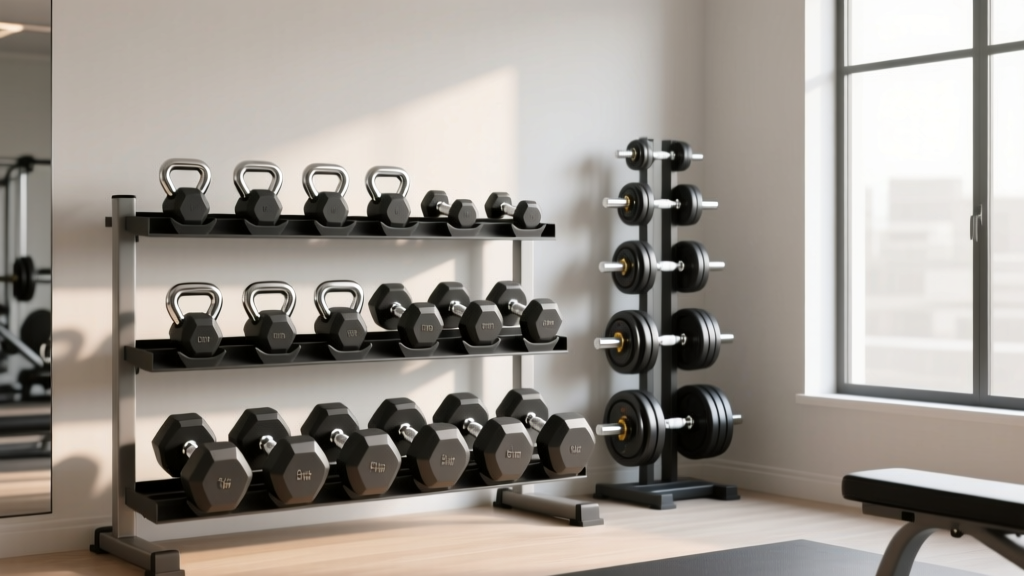
For lifters whose primary focus is the 10-35 lb dumbbell curl weight spectrum, the Rep Fitness 3-Tier rack (viewable via the Rep Fitness Dumbbell Rack catalog) offers the best ergonomic height. The top tier sits at roughly waist level, eliminating the need to bend over and compromise your lumbar spine when picking up 25 lb or 30 lb hex dumbbells for strict curls.
The 'Arm's Reach' Principle
When mapping out your layout, apply the 'Arm's Reach' principle. Stand in your primary curling stance (usually facing a mirror or an open wall). Your storage rack should be positioned exactly 36 to 48 inches to your dominant side. This allows you to execute a drop set by simply extending your arm, swapping the 30 lb dumbbells for the 20 lb pair, and immediately resuming your set without breaking your spatial anchor.
Spatial Geometry: Clearance, Angles, and Traffic Flow
Storage racks are dense, heavy obstacles. Placing them incorrectly can turn a functional home gym into a hazardous maze. Industry standards dictate a minimum of 36 inches of clearance in front of any storage rack to allow for safe loading, unloading, and transit. However, when dealing specifically with the dumbbell curl weight range, you must also account for the swinging arc of the dumbbells during exercises like hammer curls or cross-body curls.
Layout Callout: The Triangular WorkflowMap your gym into functional triangles. Your 'Isolation Triangle' should consist of:
1. The Mirror (for form feedback).
2. The Dumbbell Rack (housing your 10-35 lb sets).
3. An adjustable incline bench.
Keeping these three elements within a 64-square-foot footprint ensures that transitioning from seated incline curls to standing preacher curls requires zero unnecessary steps.
If you are utilizing an A-Frame rack to save space, be aware of the tipping hazard. A-frames have a high center of gravity. When loading or unloading your dumbbell curl weight pairs, always remove or replace weights symmetrically (one from the left, one from the right) to maintain equilibrium. For homes with seismic activity or heavy floor vibrations from dropped deadlifts, anchor the A-frame to the wall studs using heavy-duty drywall straps.
Edge Cases: Storing Adjustable and Odd-Shaped Dumbbells
The rise of adjustable dumbbells has complicated traditional storage layouts. Many lifters purchase adjustable sets to replace an entire rack of fixed weights, but they often fail to account for the non-standard dimensions of these units.
- Bowflex SelectTech 552: These measure approximately 16.9 inches in length. Standard commercial tiered racks are designed for hex dumbbells, which rarely exceed 14 inches in length. Attempting to store Bowflex units on a standard Rogue or Rep tiered rack will result in the handles overhanging the tray, creating a severe tipping risk.
- PowerBlock Elite: These feature a cubic, blocky design. While they fit easily onto most flat shelves, their lack of a traditional cylindrical handle means they can roll or shift if the storage tray is not perfectly level.
The Solution: If your dumbbell curl weight progression is handled via adjustable dumbbells, abandon the tiered rack entirely. Instead, utilize a heavy-duty steel utility cart or a custom-built wooden shelving unit with 18-inch deep shelves. This allows you to store the adjustable dumbbells alongside your resistance bands, lifting straps, and chalk, creating a unified 'accessory station' rather than a traditional dumbbell rack.
Environmental Factors: Preserving Urethane and Rubber
Where you place your storage rack directly impacts the lifespan of your equipment. Most lifters in the 10-35 lb range purchase either rubber-encased or urethane-encased hex dumbbells. While urethane is vastly superior in terms of durability and odor resistance, both materials are susceptible to environmental degradation.
'Prolonged exposure to UV light and fluctuating temperatures will cause rubber dumbbells to oxidize, resulting in a chalky residue that transfers to your hands and flooring. Urethane resists UV degradation significantly better, making it the superior choice for garage gyms with large, uninsulated windows.' — Equipment Maintenance Guidelines, Rogue Fitness Material Specs
To optimize your layout, ensure your dumbbell rack is positioned at least four feet away from any direct sunlight sources. Additionally, avoid placing the rack directly beneath HVAC vents. The constant cycle of heating and cooling can cause the steel handles to sweat (condensate), which eventually leads to rust at the junction where the steel handle meets the rubber/urethane head.
Frequently Asked Questions
How many pairs of dumbbells do I actually need for curl variations?
For most intermediate lifters, a 5-pair set spanning your working dumbbell curl weight range is sufficient. For example, owning the 15, 20, 25, 30, and 35 lb pairs allows you to perform heavy mechanical drop sets and accommodate for days when your grip or bicep fatigue is higher than usual. This 5-pair setup fits perfectly on a compact 3-tier rack without overcrowding.
Can I store kettlebells on the same rack as my curling dumbbells?
It is not recommended. Kettlebells have a radically different center of gravity and base shape. Mixing kettlebells and hex dumbbells on the same tiered tray often leads to unstable stacking, especially on the top tier. Dedicate a separate, single-tier rack or a reinforced corner shelf specifically for kettlebell swings and goblet squats.
What is the best flooring to put under a dumbbell rack?
Use 3/4-inch thick vulcanized rubber horse stall mats. While standard EVA foam puzzle tiles are cheaper, they will permanently compress under the point-load of a fully loaded 500 lb steel dumbbell rack. Stall mats provide the necessary shock absorption and structural support to protect your concrete or subflooring from long-term indentations.
More gear to consider
All reviews
Dumbbell Hammer Press Layouts: Rubber Hex vs Urethane Space Guide

Best Dumbbell Racks for Flat Bench Dumbbell Fly Setups (2026)

Loadable Dumbbells and the Dumbbell Floor Press Workout: 2026 Trends
Compact Gyms: Loadable Dumbbells for Incline Bench Row Dumbbells

Power Rack vs Squat Rack vs Stand: Setup for Workouts with 1 Dumbbell