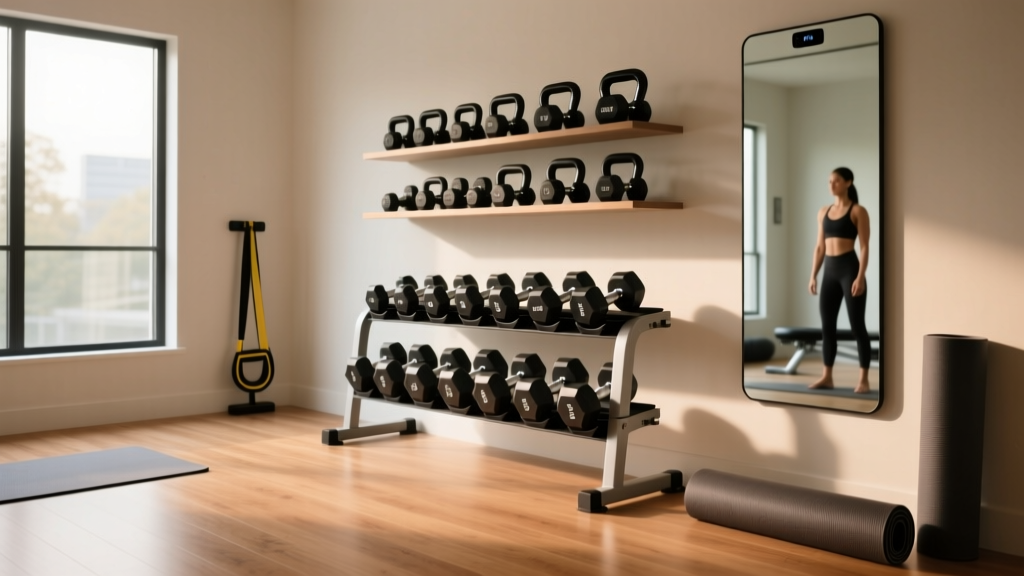
Setting Up Your Space for a Workout Program with Dumbbells
Learn how to properly configure your home gym space, assemble storage, and prepare your environment for a successful workout program with dumbbells.

The Foundation of a Successful Home Gym
Transitioning to a home-based fitness routine is one of the most effective ways to build consistency, but the physical environment you create will dictate your long-term success. When designing a space for a workout program with dumbbells, many beginners focus solely on purchasing the weights themselves, neglecting the spatial geometry, flooring requirements, and material-specific storage needs of their equipment. This is especially true when utilizing neoprene-coated dumbbells, a popular choice for home gyms due to their ergonomic grip and floor-friendly hexagonal design.
Neoprene (polychloroprene) is a synthetic rubber that offers a high coefficient of friction (approximately 0.6 to 0.8 when dry), significantly reducing grip fatigue during high-repetition isolation movements compared to bare cast iron. However, this material requires specific environmental conditions to prevent degradation. In this comprehensive walkthrough, we will cover the exact steps to prepare your room, assemble your storage infrastructure, and optimize your floor plan to support a rigorous workout program with dumbbells in 2026.
⚠️ Critical UV Warning for Neoprene: Never store neoprene dumbbells in direct sunlight or within three feet of a south-facing window without UV-blocking film. Prolonged UV exposure breaks down the polychloroprene bonds, causing the coating to chalk, peel, and expose the raw cast iron core to oxidation within 6 to 8 months.Environmental Prep: Protecting Your Neoprene Investment
Before unboxing your weights, you must evaluate the ambient conditions of your chosen workout space. Neoprene is highly resilient to sweat and moisture, but it is vulnerable to extreme thermal fluctuations and ultraviolet radiation.
Temperature and Humidity Baselines
Maintain your home gym environment between 65°F and 78°F (18°C - 25°C). While neoprene won't melt in a hot garage, sustained temperatures above 95°F (35°C) can cause the adhesive bonding the rubber to the iron core to soften, leading to 'spinning' or slipping of the coating during heavy lifts. Furthermore, keep relative humidity below 60%. According to the Centers for Disease Control and Prevention (CDC), maintaining a well-ventilated, climate-controlled space is also vital for cardiovascular recovery during intense home workouts.
Assembling the Storage Infrastructure
Dumbbells themselves require no installation, but the rack that houses them demands precise assembly to prevent catastrophic tipping. For a standard home workout program with dumbbells utilizing weights between 5 lbs and 30 lbs, a 3-tier A-frame or horizontal rack is ideal. We will use the widely adopted Yes4All 3-Tier Dumbbell Rack as our baseline for this assembly walkthrough.
Step-by-Step Rack Assembly
- Inventory and Tool Prep: Lay out all steel tubing, M8x60mm carriage bolts, and nylon lock nuts. You will need a 14mm socket wrench, a 14mm open-end wrench, and a rubber mallet. Do not use power drills for the final tightening, as over-torquing can strip the threads on budget-friendly racks.
- Base Construction: Assemble the bottom tier first on a flat surface. Insert the carriage bolts through the pre-drilled holes. Hand-tighten the nylon lock nuts to allow for slight frame flex during the next step.
- Vertical Uprights: Slot the vertical supports into the base. Use your rubber mallet to tap them flush into the receiver tubes. Ensure the angled gussets face inward to support the load vector.
- Tier Installation and Torquing: Attach the middle and top tiers. Once all tiers are slotted, go back and systematically tighten every bolt to approximately 30-40 ft-lbs of torque. The nylon insert in the lock nut should be fully engaged.
- Load Testing: Before placing your neoprene dumbbells on the rack, apply 150 lbs of downward pressure to the center of the bottom tier to seat the frame. Check for any lateral wobble.
Spatial Mapping for Your Workout Program with Dumbbells
The physical footprint of your workout area must accommodate the biomechanical realities of free weight training. Unlike machines that restrict your path of motion, dumbbells require full three-dimensional clearance.
| Movement Category | Minimum Clearance Required | Primary Risk Factor |
|---|---|---|
| Overhead Presses | 8'4" Ceiling Height | Drywall/fixture impact at full extension |
| Lateral Raises / Flyes | 8 ft x 8 ft Floor Space | Striking furniture or walls during eccentric phase |
| Walking Lunges | 12 ft Linear Path | Tripping hazards, uneven flooring transitions |
| Floor Presses / Crunches | 6 ft x 4 ft Mat Space | Spinal discomfort on hard subfloors |
Subfloor and Matting Specifications
Neoprene hex dumbbells are designed not to roll, but they are still dense cast iron. Dropping a 25 lb neoprene dumbbell from waist height generates significant localized impact force. To protect both your subfloor and the neoprene coating from micro-tearing, install 3/8-inch (8mm) vulcanized rubber mats. Avoid cheap PVC foam puzzle mats; they compress too deeply under heavy point-loads, creating an unstable base for standing exercises like Romanian deadlifts, which compromises your posterior chain engagement.
Curating the Neoprene Dumbbell Set
When outfitting your rack for a comprehensive workout program with dumbbells, the weight increments you choose will dictate your ability to apply progressive overload. The National Institute on Aging (NIA) emphasizes that gradual resistance increases are paramount for safe, long-term muscle hypertrophy and bone density improvement, especially in home environments lacking spotter assistance.
2026 Neoprene Set Pricing & Increment Strategy
- The 5 lb to 25 lb Set (5 lb jumps): Ideal for beginners focusing on upper body isolation. Current market price for a quality 6-pair set (e.g., CAP Barbell or Yes4All) ranges from $110 to $140. Cost per pound averages around $0.75.
- The 2.5 lb Increment Pairs: Crucial for lateral raises and tricep kickbacks where a 5 lb jump represents a 30%+ load increase. Expect to pay a premium of $15-$20 per pair for these specific micro-loads.
- The Heavy Limitation: Neoprene is rarely manufactured in single dumbbells above 30 lbs due to the sheer physical volume the rubber coating adds to the grip handle. For movements requiring 40+ lbs (like heavy goblet squats), transition to urethane or bare iron.
Integrating the Setup into Your Daily Routine
A well-installed home gym is only as good as its workflow. To maximize adherence to your workout program with dumbbells, implement the 'Triangle of Efficiency'. Position your dumbbell rack, your adjustable bench, and your primary visual focal point (a mirror or a screen for following guided routines) in a tight triangle. You should never have to walk more than three steps to retrieve your next set of weights. This minimizes core temperature drops between sets and keeps your heart rate in the optimal training zone.
Post-Workout Maintenance Checklist
- Sanitization: Wipe down neoprene handles with a mild, alcohol-free antibacterial wipe. High-concentration isopropyl alcohol will dry out the synthetic rubber, leading to premature cracking.
- Rack Inspection: Once a month, check the 14mm bolts on your storage rack. The repeated vibration of racking and unracking heavy weights can slowly back out nylon lock nuts over time.
- Sweat Mitigation: Ensure the floor mat beneath the rack is dried thoroughly to prevent trapped moisture from rusting the bottom tier of the metal rack.
"The friction of neoprene is a double-edged sword. It saves your grip on pulling movements, but it can cause callous tearing on dynamic movements like dumbbell snatches if you don't use a chalk alternative or wear minimalist lifting gloves." — Home Gym Biomechanics Review, 2025
Frequently Asked Questions
Can I use neoprene dumbbells in an outdoor garage gym?
You can, but it is not recommended for long-term storage. If your garage is not climate-controlled and experiences high humidity or direct sunlight, the neoprene will degrade rapidly. If you must train outdoors, bring the weights inside immediately after your session and store them in a climate-controlled interior room.
How do I remove white chalky residue from my neoprene weights?
That residue is a sign of UV and ozone degradation (blooming). While you cannot reverse the chemical breakdown, you can temporarily restore the black finish and protect the surface by wiping the dumbbells with a silicone-based protectant (like 303 Aerospace Protectant) applied to a microfiber cloth. Do not spray directly onto the weights.
Is a 3-tier rack better than an A-frame rack for home use?
For weights under 25 lbs, an A-frame is excellent and saves floor space. However, if your workout program with dumbbells includes heavier pairs (30+ lbs), a horizontal 3-tier rack is vastly superior. A-frames have a higher center of gravity and become a tipping hazard when loaded with heavy iron on the upper tiers.
More gear to consider
All reviews
Beyond Dumbbell Workout Pictures: Rubber Hex vs Urethane Value
Standard vs Olympic Plates for Good Tricep Exercises with Dumbbells

Compact Gym: EZ vs Straight Bar & Workout Pecs with Dumbbells
Loadable Dumbbell Layouts for an Arms Workout With Dumbbells

Dumbbell Rack Care After Core Dumbbells Exercise Routines
