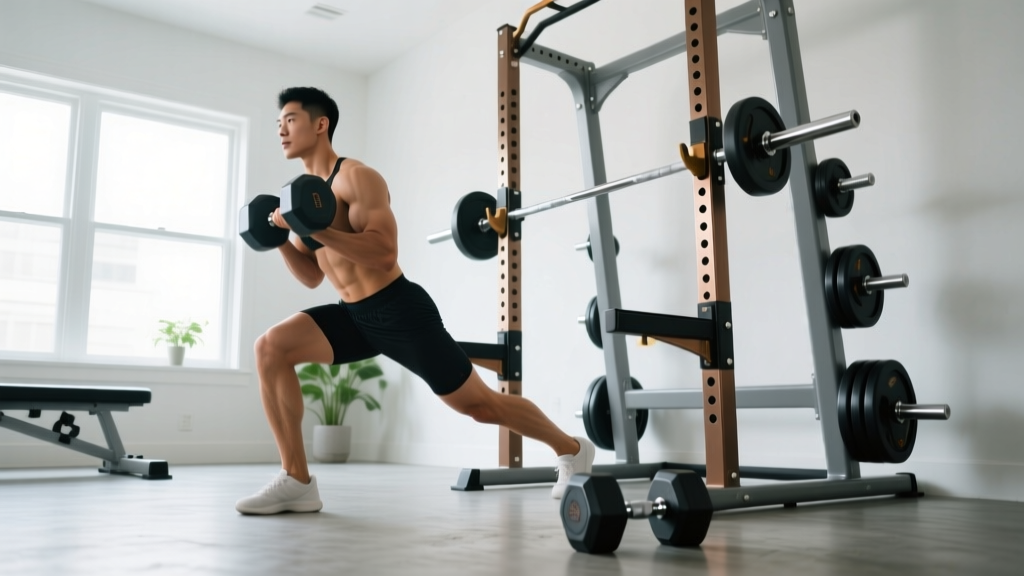
Dumbbell for Beginners: Power Rack vs Squat Rack vs Stand Mistakes
Upgrading from a dumbbell for beginners? Avoid costly mistakes when choosing between a power rack, squat rack, and squat stand for your home gym.

Every lifter starts somewhere. For many, that starting point is a basic dumbbell for beginners—perhaps a 20-pound neoprene hex weight or an entry-level adjustable set like the Bowflex SelectTech 552. But as your strength progresses, the ceiling of a beginner dumbbell setup becomes painfully obvious. You need heavier loads, barbell movements, and, most importantly, a safe structure to support them.
Transitioning from free-standing dumbbells to a dedicated racking system is a major milestone. However, the home gym market in 2026 is saturated with options, and confusing a power rack with a squat stand can lead to wasted money, garage space nightmares, or severe injury. This troubleshooting guide breaks down the most common mistakes lifters make when upgrading their home gym, and how to choose the right rig for your specific needs.
Mistake 1: Misidentifying the Big Three
The most frequent error new buyers make is using the terms 'power rack,' 'squat rack,' and 'squat stand' interchangeably. They are fundamentally different pieces of engineering, each with distinct failure modes and spatial requirements.
| Feature | Power Rack (Full Cage) | Squat Rack (Half Rack) | Squat Stand (Dual Posts) |
|---|---|---|---|
| Structure | 4 to 6 uprights, fully enclosed | 2 main uprights, rear storage | 2 independent uprights |
| Safety Mechanism | Internal pin-and-pipe or straps | External spotter arms | External spotter arms |
| Avg. Footprint | 48' x 48' to 53' x 53' | 48' x 48' (plus arm clearance) | 40' x 40' (highly variable) |
| 2026 Price Range | $700 - $1,500+ | $500 - $900 | $250 - $450 |
| Best For | Heavy solo lifting, kipping, bands | Olympic lifts, space-saving | Tight spaces, strict budgets |
If you are moving past a dumbbell for beginners and plan to squat heavy without a spotter, a squat stand with short external spotter arms is a massive risk. You must upgrade to a full power rack or a half rack with extended safeties.
Mistake 2: Ignoring Upright Dimensions and Steel Gauge
Not all steel is created equal. When browsing specs, you will see numbers like 2x2, 2x3, and 3x3. These refer to the cross-sectional dimensions of the steel tubing in inches.
The 11-Gauge vs. 14-Gauge Trap
Many budget squat stands on Amazon use 14-gauge or even 16-gauge steel. While 14-gauge steel can technically hold 500 pounds of static weight, it lacks the rigidity required for dynamic loading. When you re-rack a 225-pound barbell with force, 14-gauge 2x2 uprights will flex, wobble, and eventually fatigue at the weld joints.
Expert Rule of Thumb: For any lifter squatting over 225 lbs, strictly look for 11-gauge steel. The Rogue RML-390F Power Rack uses 11-gauge 3x3 tubing, which has become the gold standard for home gym durability and attachment compatibility in 2026.Mistake 3: The Hole Spacing Trap
Hole spacing dictates how precisely you can set your J-cups for bench pressing and squatting. This is where many buyers get burned by purchasing incompatible attachments.
- Standard Spacing (2-inch to 3-inch): Common on budget racks like the Rep Fitness PR-1100. It forces you to make larger jumps when adjusting safety heights, which can result in the bar resting too high (dangerous) or too low (defeating the purpose of the spotter).
- Westside Hole Spacing (1-inch): Features 1-inch spacing through the critical bench and squat zones. This allows for micro-adjustments to safety straps and J-cups, ensuring the barbell is caught exactly 1-2 inches below your sticking point.
'If you buy a rack with 2x2 uprights and 1-inch holes, you are severely limiting your attachment ecosystem. Most premium monolifts, lat pulldown modules, and belt squat attachments are engineered exclusively for 3x3 tubing with 5/8-inch hardware.' - Garage Gym Reviews
Mistake 4: Overlooking Tipping Hazards and Spotter Arm Mechanics
A squat stand is essentially two heavy metal pillars resting on rubber feet. If you fail to bolt them down or use counterbalance weights, they become a tipping hazard.
The Re-Racking Physics Problem
When you finish a heavy set of squats and forcefully push the barbell forward into the J-cups, the kinetic energy transfers through the uprights. On a freestanding squat stand, this forward momentum can lift the rear of the base, causing the entire rig to tip forward onto the lifter.
Troubleshooting the Tip:
- Bolt it down: Use 3/8-inch lag bolts into concrete or structural wood joists.
- Counterbalance: If bolting isn't an option (e.g., renting a garage), you must load the rear storage pegs with at least 100-150 lbs of bumper plates to anchor the center of gravity.
- Upgrade to a Power Rack: A 4-post cage inherently prevents forward tipping due to its rear footprint and crossmember stabilization.
Troubleshooting Matrix: Fixing Your Current Rack Setup
Already bought a rack and experiencing issues? Use this diagnostic matrix to troubleshoot common home gym failures.
| Symptom / Failure Mode | Likely Cause | Actionable Fix |
|---|---|---|
| J-cups scratch the barbell knurling | Missing or worn UHMW plastic liners | Replace with 3x3 UHMW sandwich J-cups; avoid bare metal-on-metal contact. |
| Safety straps sag and absorb bar momentum | Straps installed too loosely or degraded | Switch to pin-and-pipe safeties or ratchet-tighten straps; ensure straps are rated for dynamic drops. |
| Pull-up bar shakes violently during kipping | Using a 2-post squat stand | Stop kipping immediately. Squat stands cannot handle lateral shear forces. Upgrade to a bolted 4-post rack. |
| Cannot attach resistance bands for squats | No low band pegs or crossmembers | Install aftermarket band pegs on the base uprights, or use heavy dumbbells to anchor bands on the floor. |
Final Verdict: Matching Your Rack to Your Training Age
Leaving the era of the dumbbell for beginners behind is an exciting phase of your fitness journey, but it requires a mature approach to equipment investment. If your ceiling height is under 84 inches and your budget is strict, a heavy-duty 11-gauge squat stand bolted to the floor is a viable starting point. However, if you plan to train alone, push your 1-rep max, or incorporate dynamic movements, the full power rack is not just a luxury—it is a non-negotiable safety requirement.
Measure your space, verify the steel gauge, check the hole spacing, and never compromise on safety spotter mechanics. Your home gym should be a place of progression, not a site of preventable structural failure.
More gear to consider
All reviews
Olympic vs Standard Plates & How to Get Pecs with Dumbbells
Kettlebell Budget: Cast Iron vs Competition & Dumbbell Leg Raise

Barbell Collar vs Clamp: Securing Lifts Beyond a Dumbbell Squat GIF

Heavy Dumbbell Training Spaces: Cast Iron vs Competition Kettlebells
Cast Iron vs Competition Kettlebells: Upper Chest Workout Dumbbell?