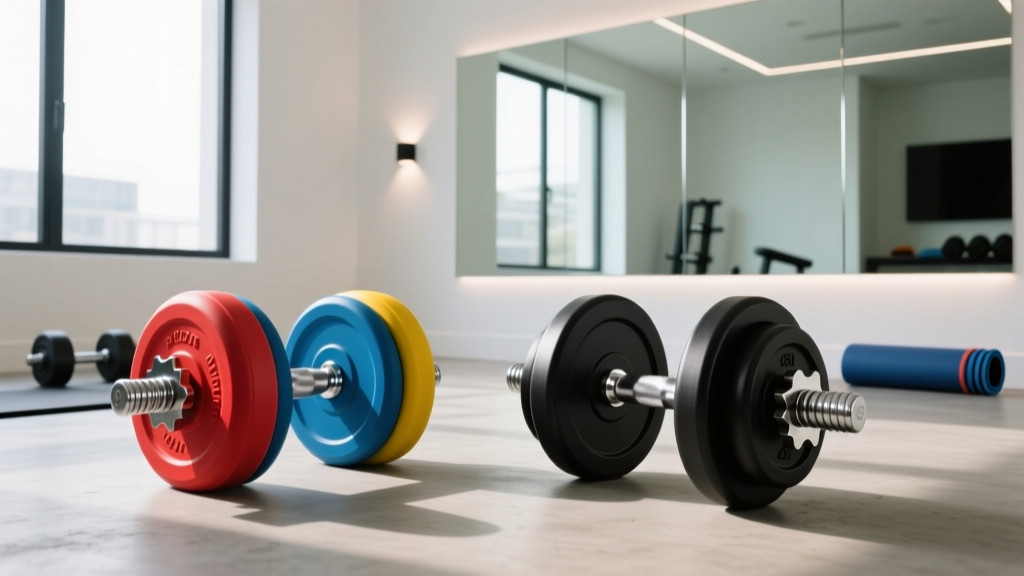
Budgeting for the Best Dumbbell Arm Workouts: Bumper vs Iron Plates
Discover the true cost of bumper vs iron plates. We break down the budget to build the ultimate setup for the best dumbbell arm workouts and heavy lifts.

The Home Gym Budget Dilemma: Arm Day vs. The Big Lifts
When outfitting a garage gym in 2026, lifters often hyper-focus on acquiring the exact gear needed for the best dumbbell arm workouts—such as specialized cable attachments, ergonomic EZ-curl bars, or high-end adjustable dumbbells. Meanwhile, the purchase of Olympic weight plates is frequently treated as a generic afterthought. You just need round, heavy things to put on the bar, right? Wrong.
The decision between buying bumper plates and traditional cast iron plates is one of the most significant financial choices you will make for your home gym. It affects your floor integrity, your noise levels, your barbell whip, and surprisingly, your ability to perform heavy isolation movements. According to BarBend's comprehensive guide on plate materials, the physical properties of rubber versus iron dictate entirely different training experiences. But from a purely financial perspective, how do these two options break down when you factor in hidden costs, longevity, and versatility?
In this value analysis, we will dissect the true cost-per-pound of bumpers versus iron, reveal the hidden expenses of floor damage, and explain why your choice of plates directly impacts your ability to execute the best dumbbell arm workouts using plate-loaded handles.
Bumper Plates vs. Cast Iron: The True Cost-Per-Pound Breakdown
To understand the value proposition, we must first look at the raw acquisition costs. Pricing in the fitness equipment industry has stabilized in 2026, but the gap between virgin rubber and cast iron remains substantial. Below is a breakdown of standard Olympic plate pricing based on current market averages from major retailers like Rogue, Rep Fitness, and Titan.
| Plate Material | Avg Cost Per Pound (2026) | Thickness (45lb Plate) | Durability & Drop Rating | Best Use Case |
|---|---|---|---|---|
| Basic Cast Iron | $1.50 - $2.00 | ~1.2 inches | High (Chips/Rusts if dropped on concrete) | Powerlifting, Bodybuilding, Budget Gyms |
| Crumb Rubber Bumper | $2.25 - $3.00 | ~3.25 inches | Medium-High (Bounces, edges fray over time) | Garage Gyms, CrossFit, General Fitness |
| Virgin Rubber Bumper | $3.50 - $5.00+ | ~2.15 inches | Very High (Dead bounce, competition grade) | Olympic Weightlifting, Commercial Gyms |
| Urethane | $6.00 - $9.00+ | ~1.5 inches | Extreme (Virtually indestructible) | Premium Commercial Facilities |
If you are building a standard 300-pound plate set (one pair each of 45s, 25s, 10s, 5s, and 2.5s), a basic cast iron set will cost you roughly $450 to $550. A comparable crumb rubber bumper set will push you into the $750 to $900 range. On the surface, cast iron is the undisputed budget champion. However, raw acquisition cost is only the first layer of the value analysis.
The 'Sleeve Real Estate' Problem: Why Iron Wins for Arm Day
Here is where the intersection of plate selection and the best dumbbell arm workouts becomes critical. Many budget-conscious lifters opt for plate-loaded dumbbell handles (like the Rogue Loadable Dumbbell or Titan T3 Loadable Handles) instead of spending $400+ on a pair of Nuobell or PowerBlock adjustable dumbbells. Plate-loaded handles are incredibly cost-effective, but they come with a severe physical limitation: sleeve length.
A standard Olympic barbell sleeve is about 16 inches long. A loadable dumbbell sleeve, however, is typically only 6.5 to 8 inches long. This is where the thickness of your plates dictates your training capabilities.
⚠️ The Bumper Plate Bottleneck: A standard 45lb crumb rubber bumper plate is roughly 3.25 inches thick. If you put one on each side of a 7-inch dumbbell sleeve, you have completely maxed out the sleeve length, leaving no room for the collars. Your maximum weight per dumbbell is capped at roughly 100 lbs (45lb plate + 10lb handle + collar).Now, consider cast iron. A 10-pound cast iron plate is only about 0.8 inches thick. A 2.5-pound iron plate is a mere 0.4 inches thick. If you are performing heavy eccentric bicep curls, tricep extensions, or unilateral rows—movements that form the foundation of the best dumbbell arm workouts—you need the ability to micro-load and stack plates on a short sleeve. With a set of iron plates, you can easily stack three 10-pound plates and a 5-pound plate on a single dumbbell sleeve, allowing for highly specific, progressive overload during isolation movements.
As noted in the ExRx exercise directory for arm biomechanics, precise load management and incremental weight jumps are vital for hypertrophy in smaller muscle groups like the biceps brachii and triceps brachii. Bumper plates simply cannot offer the granular loading required for optimal arm training on plate-loaded handles.
Hidden Costs: Floor Damage, Acoustics, and Maintenance
While cast iron wins on upfront pricing and sleeve real estate, it introduces hidden costs that can obliterate your budget if you are not prepared. Garage Gym Reviews' breakdown of drop-testing and durability highlights the kinetic energy transfer differences between rubber and iron.
1. The Subfloor Tax
Cast iron does not absorb shock; it transfers it directly into the ground. If you are deadlifting 400 pounds and dropping the bar, or performing heavy dumbbell drop-sets during arm workouts, iron plates will crack un-reinforced concrete and shatter standard plywood subfloors. To mitigate this, iron plate users must invest in high-density flooring. A proper setup requires 3/4-inch thick horse stall mats (typically $60 to $85 per 4x6 mat) layered over plywood. If you skip this, a single dropped 45-pound iron plate can cause $500+ in concrete spalling and foundation repair.
2. The Acoustic Penalty
Bumper plates are inherently sound-dampening. Cast iron plates clanging together, or hitting a metal barbell sleeve, generate high-decibel, high-frequency noise. If your garage gym is attached to your home, or if you have close neighbors, the acoustic footprint of iron plates may force you to limit your training hours, indirectly costing you consistency and gains.
3. Rust and Maintenance
Unless you are buying premium machined steel or chrome-plated iron (which pushes the cost up to $3.50+/lb, negating the budget advantage), standard cast iron will oxidize. In humid environments or unclimate-controlled garages, iron plates require periodic wire-brushing and a light coat of 3-in-One oil or WD-40 Specialist Corrosion Inhibitor to prevent rust transfer to your hands and clothing.
Value Verdict: How to Allocate Your 2026 Equipment Budget
So, how do you maximize value? The smartest approach for a comprehensive home gym is a hybrid allocation strategy. You do not need to choose just one material; you need to buy the right material for the right job.
- The Heavy Compound Core (Buy Bumpers): Purchase a pair of 45lb and a pair of 25lb crumb rubber bumper plates. Use these for deadlifts, power cleans, and snatches where dropping the weight is expected and floor protection is mandatory. Budget: ~$350.
- The Isolation & Accessory Fringe (Buy Iron): Purchase cast iron change plates (pairs of 10s, 5s, and 2.5s). Use these to load your plate-loaded dumbbell handles for the best dumbbell arm workouts, and to add precise increments to your barbell bench press and squats. Budget: ~$120.
- Floor Protection (Buy Mats): Allocate the remaining savings toward two heavy-duty horse stall mats to protect your floor during heavy iron-loaded presses. Budget: ~$150.
Frequently Asked Questions
Can I mix bumper and iron plates on the same barbell?
Yes, but with a major caveat. You should only place the iron plates outside the bumper plates on the sleeve. The bumper plate must sit flush against the barbell collar to absorb the impact of a drop. If you place an iron plate between the barbell and the bumper, the impact force will concentrate on the smaller surface area of the iron plate, which can bend the barbell sleeve or crack the bumper's steel insert.
Do crumb rubber bumpers smell in a closed garage?
They can. Lower-tier crumb rubber bumpers off-gas volatile organic compounds (VOCs) that smell like burning tires. In 2026, most reputable brands (like Rogue Echo or Rep Fitness CR-15) use higher-quality binding agents that minimize this. However, you should still plan to leave your garage door open for the first two weeks after unboxing to allow the off-gassing to dissipate.
Are urethane plates worth the premium for a home gym?
From a pure budget and value perspective, no. Urethane plates offer zero performance advantage over virgin rubber or cast iron; their only benefit is extreme cosmetic durability and a lack of odor. Unless you are running a high-traffic commercial facility where plates are abused by hundreds of members daily, the $6+ per pound cost of urethane is a poor return on investment for a home garage gym.
More gear to consider
All reviews
Budget Breakdown: Loadable Dumbbells for Leg Raises with Dumbbells

Power Rack vs Squat Rack: Space for Side Plank Dumbbell Raises?
Power Rack vs Squat Rack vs Stand: Dumbbell Scaption Setup

Olympic vs Standard Plates for Your Dumbbell Only Arm Workout
EZ vs Straight Bar Comparison & Dumbbell Pull Exercises Care
