Compact Gym Layout: Kettlebell Buying Guide & Inner Chest Exercises Dumbbells
Master your compact home gym layout with our kettlebell buying guide (cast iron vs competition) and space-saving inner chest exercises dumbbells routines.

The Micro-Footprint Challenge: Designing a 50-Square-Foot Strength Zone
In 2026, the paradigm of home gym design has shifted from sprawling garage setups to hyper-optimized micro-footprints. Whether you are converting a 10x10 spare bedroom or a compact apartment alcove, maximizing functional training space without sacrificing equipment variety is the ultimate puzzle. According to the National Strength and Conditioning Association (NSCA), proper equipment spacing is not just about aesthetics; it is a critical safety requirement that dictates movement mechanics and injury prevention.
This guide tackles two of the most spatially demanding categories in free weights: selecting the optimal kettlebell profile for your floor plan, and configuring adjustable dumbbells for targeted isolation work. By understanding the geometry of your equipment, you can build a comprehensive strength zone in as little as 50 square feet.
Kettlebell Buying Guide: Cast Iron vs. Competition for Tight Spaces
When outfitting a small home gym, the physical dimensions of your kettlebells will dictate your storage layout. The debate between cast iron and competition kettlebells is usually centered on grip feel and durability, but from a spatial design perspective, the geometry tells a different story.
The Geometry of Storage: Uniform vs. Variable Sizing
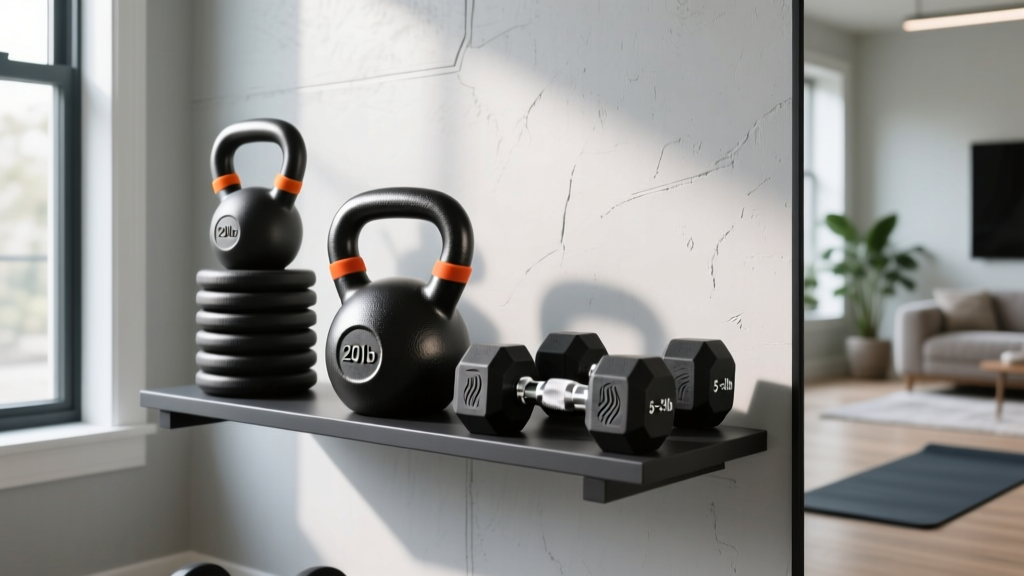
Competition kettlebells (like those from Kettlebell Kings or Vulcan) are manufactured to a strict uniform dimension regardless of weight: 210mm wide x 280mm deep x 330mm tall. This consistency is phenomenal for muscle memory, as an 8kg bell feels identical in the rack position to a 32kg bell. However, for spatial optimization, this uniformity is a nightmare. Because they do not taper, competition bells cannot be nested or staggered. A full set of eight competition bells requires a massive, heavy-duty 3-tier rack spanning at least 4 feet in width and 16 inches in depth.
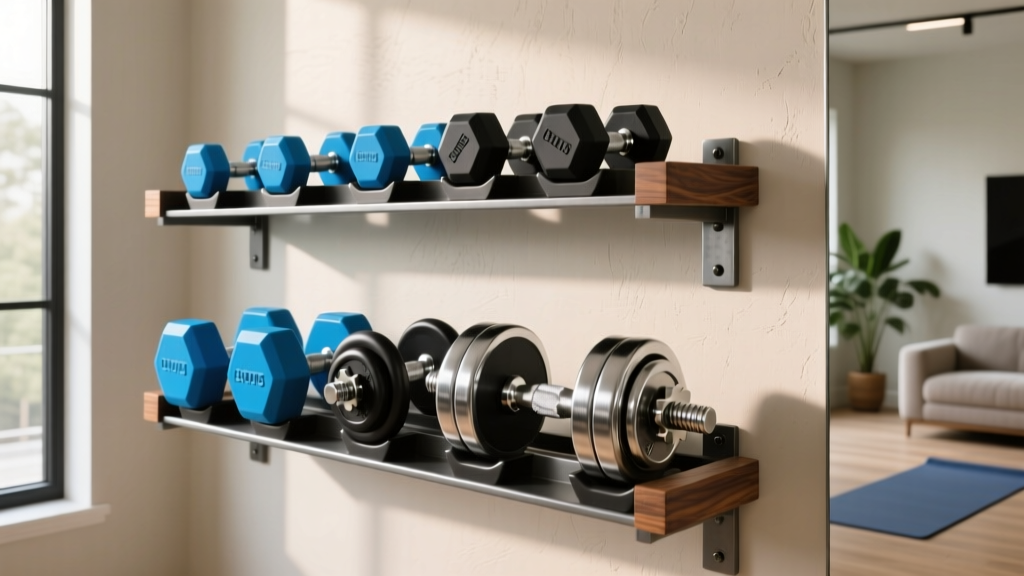
Conversely, cast iron kettlebells (such as the Rogue Fitness Cast Iron line) scale in physical volume as the weight increases. A 16kg cast iron bell is roughly 8x10 inches, while a 24kg bell is 9x11 inches. This variable geometry allows you to utilize triangular or staggered wall-mounted racks, tucking smaller bells beneath the overhang of larger ones, reducing the required shelf depth to a mere 10 inches.
| Feature | Cast Iron Kettlebells | Competition Kettlebells |
|---|---|---|
| Dimensions (16kg) | ~215mm W x 230mm D x 280mm H | 210mm W x 280mm D x 330mm H |
| Shelf Depth Required | 10 - 12 inches | 14 - 16 inches |
| Stackability / Nesting | High (can stagger on triangular racks) | None (requires strict linear spacing) |
| Average Cost (2026) | $1.50 - $2.00 per lb | $110 - $160 per bell (flat rate) |
| Best Layout Application | Wall-mounted racks, tight alcoves | Dedicated floor stands, open garages |
Upper Body Isolation: Inner Chest Exercises Dumbbells for Low-Clearance Rooms
While kettlebells dominate the hinge and squat patterns in a compact gym, upper body isolation requires a different approach. Targeting the sternal (inner) head of the pectoralis major traditionally requires a flat bench and wide lateral clearance for flyes. According to biomechanical data from the ExRx Exercise Directory, maximizing sternal pec activation requires horizontal adduction across the body's midline. In a 6x8 foot room, you simply do not have the 10-foot lateral wingspan required for standard dumbbell flyes.
The solution lies in modifying your equipment and leveraging close-chain, low-clearance inner chest exercises dumbbells routines that keep the weight centered over your torso.
Top 3 Space-Saving Inner Chest Movements
- The Dumbbell Hex Press (Squeeze Press): Performed on the floor or a low bench. You press the dumbbells together over your chest and maintain inward pressure throughout the range of motion. Clearance required: Only 24 inches laterally.
- Close-Grip Floor Press: By tucking your elbows to a 15-degree angle and focusing on the peak contraction lockout, you shift significant tension to the inner pecs and triceps. The floor naturally limits elbow travel, protecting the shoulders in tight spaces. Clearance required: 18 inches laterally.
- Standing Svend Press: Using a pair of light adjustable dumbbells (or 10lb plates), press the weight straight out from your sternum while squeezing your palms together. This isometric hold creates massive inner chest tension without requiring you to lie down at all. Clearance required: 12 inches laterally.
Equipment Selection: Adjustable Dumbbells That Actually Fit
Not all adjustable dumbbells are created equal when it comes to spatial constraints and specific exercise mechanics. When performing inner chest isolation work, the physical length of the dumbbell handle and the shape of the weight blocks dictate your wrist ergonomics.
PowerBlock Elite vs. Bowflex SelectTech 552
For the Hex Press and close-grip movements, the PowerBlock Elite USA is the undisputed king of compact layouts. Its blocky, rectangular dimensions (12" L x 6" W x 6" H) allow the handles to touch seamlessly at the top of the movement, facilitating a true inner-chest squeeze. Furthermore, their stackable footprint means a full 5-50lb set occupies less than 1 square foot of floor space.
Conversely, the Bowflex SelectTech 552 measures 14.5 inches in length with bulky, rounded dials. Attempting a Hex Press with Bowflex bells forces your wrists into an awkward, externally rotated position because the plastic dials collide before the handles can meet. This not only ruins the inner chest contraction but places undue stress on the radiocarpal joint.
Clearance Warning: Never attempt wide-grip dumbbell flyes in a room with less than 36 inches of lateral clearance on either side of your bench. Hitting a wall or drywall with a 30lb dumbbell mid-rep is a leading cause of home gym property damage and rotator cuff injuries.The Ultimate 6x8 Foot Layout Blueprint
To synthesize these concepts, here is a proven layout for a 48-square-foot strength zone (e.g., a 6x8 foot corner) that accommodates both heavy kettlebell ballistics and targeted dumbbell hypertrophy.
Step-by-Step Spatial Mapping
- The Back Wall (Storage Zone): Mount a 3-tier triangular cast iron kettlebell rack at waist height (36 inches off the floor). This keeps the heaviest bells (24kg, 32kg) below the center of gravity, preventing tip-overs, while utilizing the wall's vertical dead space.
- The Left Corner (Adjustable DB Station): Place a compact, 12-inch wide adjustable dumbbell stand housing your PowerBlocks. Position this adjacent to a foldable, wall-mounted utility bench. When not in use, the bench folds flat against the wall, reclaiming 12 square feet of floor space instantly.
- The Center Corridor (Dynamic Zone): Lay down a single 4x6 foot, 3/4-inch thick horse-stall mat. This provides the exact footprint needed for kettlebell swings, goblet squats, and floor-based inner chest presses, while leaving a 2-foot walking perimeter around the mat for safe entry and exit.
"The biggest mistake home gym owners make is buying equipment designed for commercial facilities and trying to force it into a residential footprint. True space optimization means selecting gear whose geometry complements the architecture of your room, rather than fighting it."
— 2026 Residential Fitness Design Report
Final Thoughts on Micro-Gym Engineering
Building a highly functional home gym in a restricted space requires treating your floor plan like a chessboard. By opting for cast iron kettlebells to maximize vertical storage density, and selecting block-style adjustable dumbbells to enable zero-clearance inner chest exercises, you eliminate the spatial compromises that usually plague small-scale setups. Measure twice, buy intelligently, and your 50-square-foot zone will outperform commercial facilities twice its size.
More gear to consider
All reviews
Compact Senior Gyms: Dumbbell Squats for Seniors & Kettlebell Buying Guide

Olympic Barbell Guide: Weight, Knurling & Single Arm Dumbbell Raise

Top Loadable Dumbbells for the Incline Dumbbell Press Exercise

Small Dumbbell Storage: Space-Saving Racks & Layouts
EZ Curl Bar vs Straight Bar Cost & Dumbbell Step Up Workout Value