Collar & Clamp Guide: Upgrading a Shoulder Workout Using Dumbbells
Compare barbell collar and clamp types to safely upgrade from a shoulder workout using dumbbells to heavy overhead presses. Expert specs and 2026 pricing.

The Evolution of Overhead Pressing: Why Hardware Matters
For many lifters, the journey to building boulder shoulders begins with a dedicated shoulder workout using dumbbells. Dumbbells are exceptional for isolating the medial deltoids, correcting unilateral imbalances, and allowing a natural scapular plane of motion. However, as your anterior deltoids and triceps adapt, the fixed weight increments and stabilization demands of heavy dumbbells eventually create a bottleneck for raw systemic strength. This is the exact point where lifters transition to the barbell overhead press (OHP) and push-press.
When you make this transition, or when you begin utilizing loadable dumbbell handles to bridge the gap between fixed weights and barbells, your collar and clamp selection becomes a critical safety variable. According to biomechanics principles outlined in BarBend's overhead press guide, maintaining a rigid barbell system is essential for optimal force transfer and joint safety. A shifting plate during a heavy push-press alters the moment of inertia, creating a dangerous wobble at the apex of the lift. This comprehensive guide breaks down the exact collar types, their failure modes, and real-world pricing in 2026 to ensure your hardware matches your ambition.
⚠️ Safety Warning: Never perform overhead barbell movements or heavy loadable dumbbell presses without securing your plates. A dropped plate from overhead height can cause catastrophic injury or damage to your lifting platform.The 4 Primary Barbell Collar and Clamp Types
Not all collars are created equal. The market is saturated with cheap imitations, but serious lifters rely on specific designs that balance clamping force, weight, and sleeve real estate. Here is the deep-dive on the four main categories.
1. Lever-Lock Aluminum Collars (The Gym Standard)
The undisputed king of commercial and home gyms is the lever-lock aluminum collar, with the Rogue HG-2 Aluminum Collars setting the industry benchmark. Machined from aircraft-grade aluminum with a proprietary nylon insert, these collars grip the sleeve tightly without scratching the zinc or chrome finish.
- Weight: 0.28 lbs per collar.
- Price Range: $35 - $45 per pair.
- Best For: Heavy barbell OHP, powerlifting, and Olympic lifting.
- Failure Mode: The nylon insert can trap fine chalk dust and metal shavings over time. If not wiped down, this debris acts like sandpaper, eventually scratching your barbell sleeves. Additionally, the 1.5-inch thickness eats up valuable sleeve space on shorter loadable dumbbells.
2. Glass-Reinforced Nylon Clamps (The Budget Heavy-Hitter)
Popularized by brands like Lockjaw, these polymer clamps use a dual-lever system to bite into the barbell sleeve. They are incredibly popular for CrossFit and high-rep drop sets because they can be removed in a fraction of a second.
- Weight: ~0.50 lbs per collar.
- Price Range: $30 - $40 per pair.
- Best For: WODs, drop sets, and lifters who frequently change plate loads.
- Failure Mode: Temperature sensitivity. If you train in an unheated garage gym where temperatures drop below 40°F (4°C) in the winter, the nylon polymer can become brittle. The latch mechanism is known to crack under the stress of heavy bumper plate drops in cold environments.
3. Spin-Lock / Threaded Collars (The Precision Choice)
The Proloc collar represents the pinnacle of lightweight precision. Made from solid, high-density plastic with internal threading that matches standard Olympic sleeve grooves, they spin onto the bar and lock flush against the plates.
- Weight: ~0.20 lbs per collar.
- Price Range: $15 - $20 per pair.
- Best For: Micro-loading the overhead press, weightlifting, and maximizing sleeve space on loadable dumbbells.
- Failure Mode: Cross-threading. If you force them onto a damaged sleeve or allow heavy chalk buildup in the threads, the plastic grooves will strip, rendering the collar useless.
4. Spring Clips (The Traditionalist's Trap)
The classic chrome spring clip is what you find in most commercial gyms. They are cheap, lightweight, and require two hands to compress and slide onto the sleeve.
- Weight: ~0.10 lbs per collar.
- Price Range: $5 - $10 per pair.
- Best For: Light accessory work, lateral raises, and emergency backups.
- Failure Mode: Metal fatigue and grip failure. After 500+ compressions, the spring steel loses its tension. Furthermore, if your hands are sweaty or chalky during a heavy shoulder session, compressing the spring clip becomes a slipping hazard. Never use these for heavy push-presses or jerks.
Head-to-Head Comparison Matrix
To visualize how these options stack up for your pressing needs, review the data matrix below.
| Collar Type | Model Benchmark | 2026 Price | Weight (Pair) | Sleeve Footprint | Clamping Force |
|---|---|---|---|---|---|
| Lever-Lock Aluminum | Rogue HG-2 | $35 - $45 | 0.56 lbs | 1.50 inches | Very High |
| Nylon Lever Clamp | Lockjaw Pro | $30 - $40 | 1.00 lbs | 1.75 inches | High |
| Spin-Lock Threaded | Proloc | $15 - $20 | 0.40 lbs | 0.80 inches | Moderate |
| Spring Clip | Generic Chrome | $5 - $10 | 0.20 lbs | 0.50 inches | Low / Degrades |
| Precision Steel | Eleiko Olympic | $85 - $100 | 1.10 lbs | 1.20 inches | Maximum |
The Loadable Dumbbell Constraint: Bridging the Gap
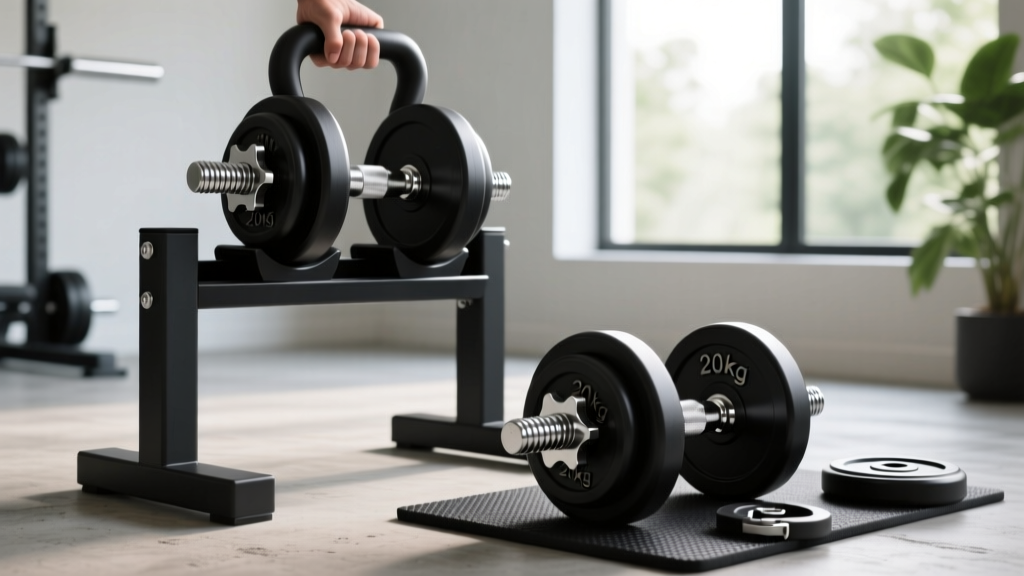
Why discuss barbell collars when the focus is upgrading from a shoulder workout using dumbbells? Because the smartest way to bridge the gap between fixed dumbbells and the barbell OHP is by investing in loadable dumbbell handles (such as the Rogue Loadable Dumbbell Handles or Titan Fitness equivalents).
Loadable dumbbells allow you to incrementally add weight in 2.5 lb or 5 lb jumps, bypassing the massive $300+ jumps required when buying fixed commercial dumbbell sets. However, they introduce a unique spatial constraint: sleeve length.
"The standard Olympic barbell sleeve is roughly 16.3 inches long. A loadable dumbbell handle typically features a sleeve of only 6.5 to 7.5 inches. Your collar choice directly dictates how much weight you can physically fit on the handle."
If you use a thick Lockjaw Pro clamp (1.75 inches) on a 6.5-inch loadable dumbbell sleeve, you are left with less than 5 inches of plate real estate. This severely limits your ability to load heavy bumper plates or multiple iron plates for heavy shoulder presses. In this specific scenario, Proloc spin-lock collars or specialized micro-collars are mandatory. They secure the plates while sacrificing less than an inch of sleeve space, allowing you to maximize the load on your dumbbell shoulder routines.
2026 Expert Buying Framework: Which Should You Choose?
Stop guessing and use this decision tree to select the right hardware for your specific training environment and goals.
- The Heavy Barbell Presser: If your primary goal is maximizing the 1-rep max barbell OHP and you train in a climate-controlled environment, buy the Rogue HG-2. The aluminum construction and nylon insert provide the rigid clamping force necessary to keep plates flush during the violent deceleration of a push-press.
- The Garage Gym CrossFitter: If you frequently drop weights from overhead and need to strip the bar quickly for AMRAP sets, the Lockjaw Pro is ideal. Caveat: If your garage drops below freezing in the winter, bring the collars inside overnight to prevent the nylon from becoming brittle and snapping.
- The Loadable Dumbbell & Micro-Loader: If you are transitioning from fixed dumbbells to loadable handles, or if you are chasing fractional progressions (e.g., adding 0.5 lbs to your OHP), buy Proloc collars. Their slim profile preserves sleeve space, and their lightweight nature ensures you aren't adding unnecessary uncalibrated weight to your lifts.
- The Olympic Weightlifter: If you are competing and require gear that meets IWF tolerances, invest in Eleiko Olympic Collars. The precision steel machining ensures absolute zero lateral play, though the $90+ price tag is strictly for competitive athletes.
Maintenance and Longevity Tips
Even the most expensive collars will fail if neglected. Chalk is the enemy of collar mechanics. For threaded collars like the Proloc, use a stiff nylon brush to clear chalk from the barbell sleeve threads and the collar interior once a month. For lever-lock aluminum collars, wipe the inner nylon ring with a damp microfiber cloth after every heavy pressing session to remove metallic dust. By maintaining your hardware, you ensure that your transition from a shoulder workout using dumbbells to elite-level barbell pressing is safe, precise, and uninterrupted by equipment failure.
More gear to consider
All reviews
Space-Saving Racks for Back and Bicep Dumbbell Exercises

Best Adjustable Dumbbells for the Prone Incline Dumbbell Row

Home Gym Setup: Full Arm Exercises With Dumbbells Using Neoprene

Dumbbell Y Raises: Rubber Hex vs Urethane Maintenance Guide

Best Storage for Your Dumbbell Workout for Bigger Arms (2026)
