Chest Workouts with Dumbbells Standing: Adjustable Setup & Review
Master chest workouts with dumbbells standing. Our 2026 guide compares top adjustable models and provides a complete setup and safety installation walkthrough.

The Biomechanical Case for Standing Chest Presses
When designing chest workouts with dumbbells standing, the biomechanical demands shift dramatically compared to traditional bench variations. Without the stabilization of a bench, your core, obliques, and erector spinae must work overtime to prevent spinal hyperextension and rotational drift. According to kinesiologists, standing upper-body presses require up to 30% more core activation than seated or supine equivalents. This makes them an exceptional tool for functional hypertrophy and athletic conditioning.
However, executing these movements safely requires equipment you can trust implicitly. Adjustable dumbbells are the undisputed kings of the home gym space, but their internal selector mechanisms introduce a margin of failure that fixed hex dumbbells do not have. If a weight plate dislodges during a standing chest press, the risk of injury to your wrists, face, or feet is severe. Therefore, selecting the right adjustable model and performing a rigorous setup and installation walkthrough is non-negotiable.
2026 Adjustable Dumbbell Comparison Matrix
Not all adjustable dumbbells are suited for the dynamic, multi-planar nature of standing chest flys and presses. Below is our 2026 evaluation of the top three contenders, focusing on handle ergonomics, durability, and safety retention.
| Model | Max Weight (per DB) | Handle Knurling & Grip | Retention Mechanism | 2026 Retail Price |
|---|---|---|---|---|
| Nuobell 80lb | 80 lbs | Aggressive steel knurling | Twist-lock pin | $349 / pair |
| Bowflex SelectTech 552 | 52.5 lbs | Smooth plastic/rubber grip | Dial-lock tabs | $399 / pair |
| PowerBlock Elite USA | 50 lbs (expandable) | Urethane cage, flat grip | Selector pin & flex | $389 / pair |
Expert Verdict: For standing chest workouts, the Nuobell 80lb is the superior choice. Its true dumbbell profile allows for natural wrist supination during standing crossovers, and the aggressive knurling prevents grip slip when sweat accumulates. The Bowflex's bulky plastic housing can clash against your wrists during deep standing flys, while the PowerBlock's cage design restricts wrist movement slightly.
Complete Setup and Installation Walkthrough
Purchasing the right equipment is only step one. Adjustable dumbbells require a meticulous initial setup to ensure the selector mechanisms are calibrated and the base stations are positioned for the unique spatial demands of standing exercises.
Phase 1: Unboxing and Base Station Inspection
Before lifting, inspect the storage cradles. Injection-molded plastic trays (common with Bowflex and Nuobell) are prone to hairline fractures during shipping.
- Visual Check: Inspect the bottom rails and corner supports of the tray. If you see white stress marks in the plastic, contact the manufacturer immediately. A cracked tray will cause the dumbbell to sit at an angle, leading to selector pin misalignment.
- Surface Leveling: Place the base station on a flat, high-density rubber mat (minimum 8mm thickness). Uneven floors cause the internal weight plates to bind, making the dial difficult to turn.
Phase 2: Mechanism Calibration and Safety Testing
Never assume factory calibration is perfect. Perform this 5-minute safety walkthrough before your first workout.
- The Zero-Weight Test: Set the dial to the lowest weight (e.g., 2.5 or 5 lbs). Lift the dumbbell smoothly. Listen for the sound of loose plates rattling in the cradle. Any rattle indicates a tab is not fully seated.
- The Max-Load Retention Test: Dial the weight to its maximum capacity. Lift the dumbbell and hold it at chest level. Give it a firm, controlled shake. The housing should feel completely solid.
- The Inversion Test (Crucial for Standing Workouts): While standing over a thick crash mat, slowly turn the dumbbell upside down. The retention mechanism must hold the plates securely against gravity. If a plate shifts even a millimeter, stop and recalibrate.
Phase 3: Spatial Anchoring for Standing Dynamics
When performing chest workouts with dumbbells standing, your footwork and spatial awareness are critical. Unlike a bench press where the weights are racked above you, standing exercises require you to pick up and re-rack the weights at waist level.
⚠️ Safety Warning: Base Station PlacementPosition your dumbbell base station at least 3 feet behind your primary standing workout zone. When fatigued after a heavy set of standing chest presses, walking backward to re-rack the weights creates a severe tripping hazard. Always turn around and face the base station when racking to ensure the dumbbells are seated perfectly flush in the trays before releasing the handles.
Execution: Top Standing Chest Movements & Weight Selection
According to the exercise directories maintained by ExRx.net, standing upper-body pushing movements require careful load management. Because you lack a backrest to push against, the limiting factor is often your core stability and grip strength, not your pectoral muscles.
1. The Standing Squeeze Press (Svend Press Variation)
Hold a single adjustable dumbbell (set between 15-25 lbs) horizontally by the inner plates with both hands. Press it straight out from your sternum, squeezing the pecs together at full extension. This movement is exceptional for inner chest activation and anterior deltoid stabilization.
2. Standing Alternating Chest Fly
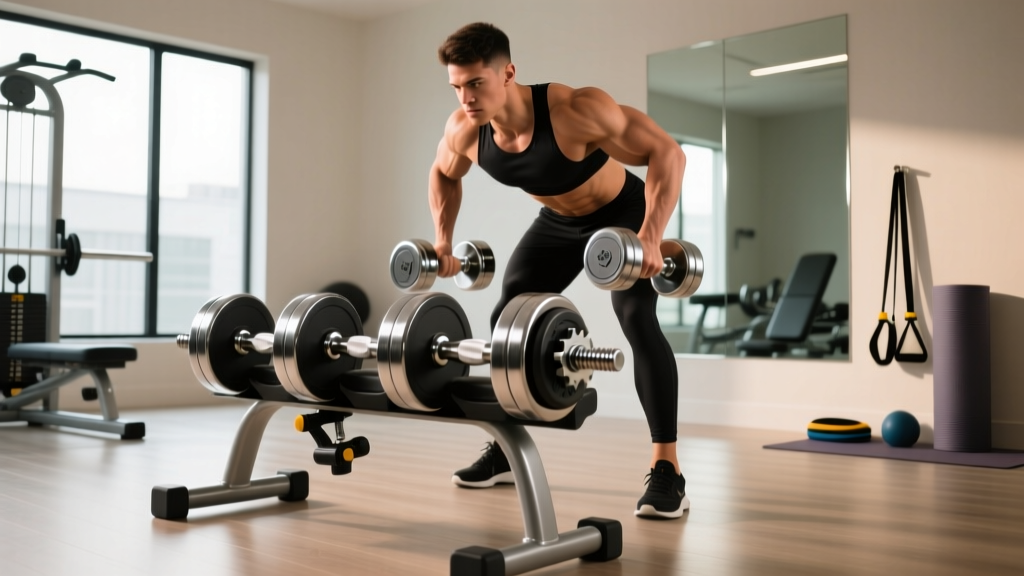
Using lighter adjustable settings (10-20 lbs), hinge slightly at the hips. Perform alternating flys, focusing on the eccentric stretch. The Nuobell's compact profile shines here, as the plates won't collide with your forearms at the bottom of the movement.
3. The Banded Standing Chest Press
For advanced lifters, loop a resistance band around the handles of your adjustable dumbbells and anchor it behind you. Pressing against the combined resistance of the iron and the band's variable tension curve mimics the strength demands of athletic pushing (e.g., blocking in football or striking in MMA). Educational resources from the American Council on Exercise (ACE) frequently highlight band-accommodated resistance as a premier method for overcoming sticking points in standing presses.
Maintenance and Failure Mode Troubleshooting
Adjustable dumbbells are precision instruments. Treat them like power tools, not cast-iron anvils. Here is how to troubleshoot common failure modes that could compromise your standing workouts.
| Failure Mode | Root Cause | Expert Troubleshooting Fix |
|---|---|---|
| Dial refuses to turn | Dumbbell not fully seated in the tray; plates are misaligned. | Never force the dial. Return the DB to the tray, push down firmly on the handle to align the plates, and try again. |
| Rattling noise during reps | Magnetic retention loss or worn plastic tabs. | Check the underside of the handle. If the magnetic catch is weak, contact warranty support immediately. Do not use for standing presses. |
| Weight drops mid-rep | Handle released partially, disengaging the safety lock. | Maintain a full, wrapped grip. Avoid resting the DB against your thigh during standing exercises, as thigh pressure can depress the release button. |
"The cardinal sin of adjustable dumbbells is dropping them. Unlike fixed hex dumbbells, a 24-inch drop onto a rubber mat generates enough shockwave force to shatter the internal plastic retention tabs, rendering the $400 investment useless."
— FitGearPulse Equipment Testing Lab, 2025 Durability Report
Final Thoughts on Standing Setup
Integrating chest workouts with dumbbells standing into your routine is a highly effective way to build functional, athletic muscle. However, the transition from fixed weights to adjustable mechanisms demands respect for the equipment's engineering limits. By selecting a model with an ergonomic handle like the Nuobell, rigorously calibrating the selector dials, and strategically placing your base station to avoid tripping hazards, you create a home gym environment that is both space-efficient and exceptionally safe. Remember to consult the manufacturer's warranty and care guidelines to ensure your investment remains protected through years of heavy, standing resistance training.
More gear to consider
All reviews
Maintaining Racks for Dumbbell Exercises with Exercise Ball Routines

Olympic Barbell Guide: Weight, Knurling & 1 Pound Dumbbells

Power Rack vs Squat Rack Setup: Tricep Workout With One Dumbbell

EZ Curl Bar vs Straight Bar & Rear Delt Fly Dumbbell Bench 2026 Trends

Barbell Collars Compared & Standing Dumbbell Ab Workout Setup