Cast Iron vs Competition Kettlebells & Reverse Grip Dumbbell Bench Press
Optimize your home gym layout with our cast iron vs competition kettlebell guide, featuring space-saving tips for the reverse grip dumbbell bench press.

The 2026 Micro-Gym Dilemma: Ballistics vs. Isolation
As home gym footprints continue to shrink in 2026, the modern lifter faces a unique spatial puzzle: how to accommodate the explosive, wide-swing clearance of kettlebell ballistics alongside the precise, static footprint of dumbbell bench work. Designing a cohesive layout requires more than just measuring floor space; it demands a deep understanding of equipment geometry. This is especially true when comparing cast iron vs competition kettlebells and integrating specialized movements like the reverse grip dumbbell bench press into a compact training zone.
Whether you are outfitting a 10x10 garage bay or a corner of your living room, the physical dimensions of your free weights dictate your rack placement, your swing corridors, and your bench clearance. Below, we break down the exact spatial requirements, storage solutions, and layout blueprints to maximize your training efficiency without sacrificing safety or performance.
Dimensional Breakdown: Cast Iron vs. Competition Kettlebells
The most critical factor in space optimization is understanding how different kettlebell styles occupy physical space. According to Rogue Fitness specifications and international sport standards, the geometry of cast iron and competition bells differs drastically, directly impacting how they are stored and accessed.
| Feature | Cast Iron Kettlebells | Competition Kettlebells |
|---|---|---|
| Bell Dimensions | Variable (scales with weight) | Uniform (280mm x 210mm) |
| Handle Diameter | Thicker (33mm - 40mm+) | Standardized (33mm) |
| Horn Width | Narrower on lighter bells | Wide, uniform window |
| Storage Footprint | Graduated (nests somewhat) | Linear (requires uniform spacing) |
| Avg. 2026 Price | $1.50 - $2.20 / lb | $2.80 - $4.50 / lb |
Space Optimization Insight: Because competition kettlebells maintain the exact same 280mm height and 210mm width regardless of whether they are 8kg or 32kg, they require uniform shelf depths and rack spacing. Cast iron bells, however, grow in physical volume as weight increases. A 16kg cast iron bell might easily fit on a shallow 12-inch wall shelf, but a 32kg cast iron bell will overhang, creating a tipping hazard in tight spaces.
Storage Geometry and Rack Clearances
When designing your free weight zone, rack selection must align with your kettlebell choice. For competition bells, a standard 3-tier A-frame rack with 10-inch tier spacing is ideal. The uniform 280mm height ensures the handle of the bell on the top tier won't collide with the bell on the tier above it.
For cast iron collections, vertical storage pegs or heavy-duty 11-gauge steel horizontal shelves with adjustable heights are mandatory. If you are storing a full set of cast iron bells (8kg to 32kg), allocate a minimum floor footprint of 48 inches wide by 24 inches deep for the rack itself, plus an additional 36 inches of clearance in front of the rack to safely lift the bells out without straining your lower back against adjacent equipment.
Designing the Bench Zone: The Reverse Grip Dumbbell Bench Press
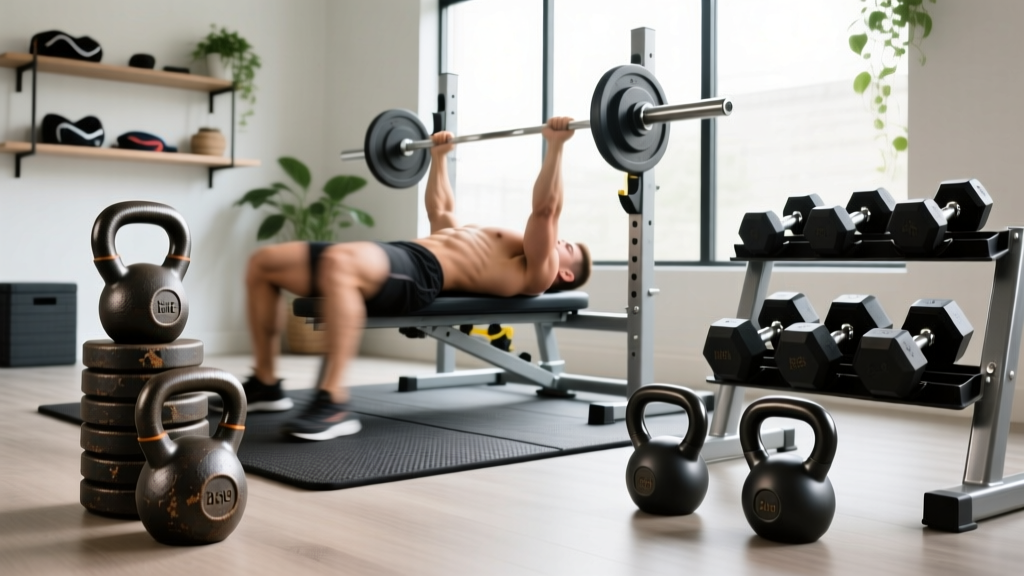
Integrating a bench into a kettlebell-heavy gym requires careful spatial mapping. The reverse grip dumbbell bench press (supinated grip, palms facing toward the face) is a highly effective movement for targeting the upper pectorals and triceps while minimizing shoulder impingement. According to biomechanical data from ExRx.net, the supinated grip forces the lifter to tuck their elbows closer to the torso—typically at a 30 to 45-degree angle—rather than flaring them out at 90 degrees.
Spatial Advantage of the Reverse Grip
Because the elbows remain tucked during the reverse grip dumbbell bench press, the lateral wingspan requirement is significantly reduced. A standard barbell bench press or wide-grip dumbbell press requires up to 65 inches of lateral clearance. The reverse grip variation reduces this lateral clearance requirement to approximately 48 inches. This makes it the perfect pressing movement for narrow home gym corridors or spaces flanked by kettlebell racks.
Clearance Metrics for Safe Execution
While the lateral footprint is smaller, the reverse grip dumbbell bench press introduces unique spatial challenges regarding the dumbbell drop zone and wrist alignment. When planning your layout, ensure the following metrics are met:
- Elbow Drop Clearance: Minimum 8 inches of vertical space between the floor and the lowest point of your elbow travel (requires a standard 17-18 inch bench height).
- Dumbbell Drop Zone: Allocate a 24-inch semi-circle at the head and foot of the bench. Supinated grip dumbbell kick-backs to the thighs require safe, unobstructed floor space to drop the weights without hitting stored kettlebells.
- Head Clearance: If placing the bench near a wall, maintain at least 14 inches of space behind the bench head to accommodate the natural arch and arm extension during the lockout phase.
3 Optimized Floor Plans for Under 80 Sq Ft
Based on NSCA facility design guidelines regarding traffic flow and safety zones, here are three layout blueprints that seamlessly integrate kettlebell storage and a dedicated pressing zone.
Layout 1: The 'T-Shape' Flow (8x10 Room)
Best for: Mixed cast iron and competition bell owners.
Place your kettlebell rack horizontally against the top 8-foot wall. Position your flat bench vertically down the center of the room, forming a 'T' shape with the rack. This provides a 4-foot swing corridor on both the left and right sides of the bench. The narrow lateral footprint of the reverse grip dumbbell bench press allows you to perform the movement without your dumbbells crossing the threshold into the kettlebell swing zones.
Layout 2: The 'Wall-Hugger' Setup (6x12 Galley Space)
Best for: Strict competition kettlebell sport athletes.
Mount a 3-tier horizontal shelf system flush against the long 12-foot wall. Because competition bells are uniform, they slide onto pegs or shelves with zero dead space. Place your bench parallel to the rack, exactly 40 inches away. This 40-inch gap is the exact minimum required for a hardstyle kettlebell snatch or high swing, while also providing just enough room to execute the reverse grip dumbbell bench press with tucked elbows, utilizing the wall behind you as a visual alignment cue.
Layout 3: The 'Corner Anchor' (Square 9x9 Space)
Best for: Heavy cast iron users and power-hypertrophy hybrids.
Anchor a heavy-duty corner kettlebell rack in one 90-degree angle. Place an adjustable bench diagonally across the center of the room, facing the corner. This diagonal orientation maximizes the longest dimension of a square room (the hypotenuse). You can safely drop dumbbells to your sides during the reverse grip dumbbell bench press without risking impact against the cast iron bells stored in the corner rack.
Final Verdict: Budgeting Your Space and Gear
Choosing between cast iron and competition kettlebells ultimately comes down to your spatial constraints and budget. If you have a narrow, uniform shelving system and prioritize consistent handle geometry for high-rep sport work, competition bells are worth the premium ($2.80+ per pound). If you are building a dense, heavy-duty home gym on a budget and need equipment that nests slightly better on varied rack types, cast iron ($1.50 per pound) remains the undisputed king of value.
Regardless of your choice, designing your layout around the specific biomechanical clearances of your core lifts—like the space-saving, tricep-dominant reverse grip dumbbell bench press—will transform a cramped garage into a highly functional, professional-grade training facility. Measure twice, rack once, and lift heavy.
More gear to consider
All reviews
Setup Guide: Olympic vs Standard Plates & Dumbbell Punching

Barbell Collar Types Compared: From Seated Chest Press with Dumbbells to Heavy Squats
Olympic Barbell Buying Guide & Trapezius Workout with Dumbbells
Counterfeit Bowflex Dumbbells: 2026 Storage & Rack Safety Trends

A Beginner's List of Dumbbell Workouts Using Neoprene Weights