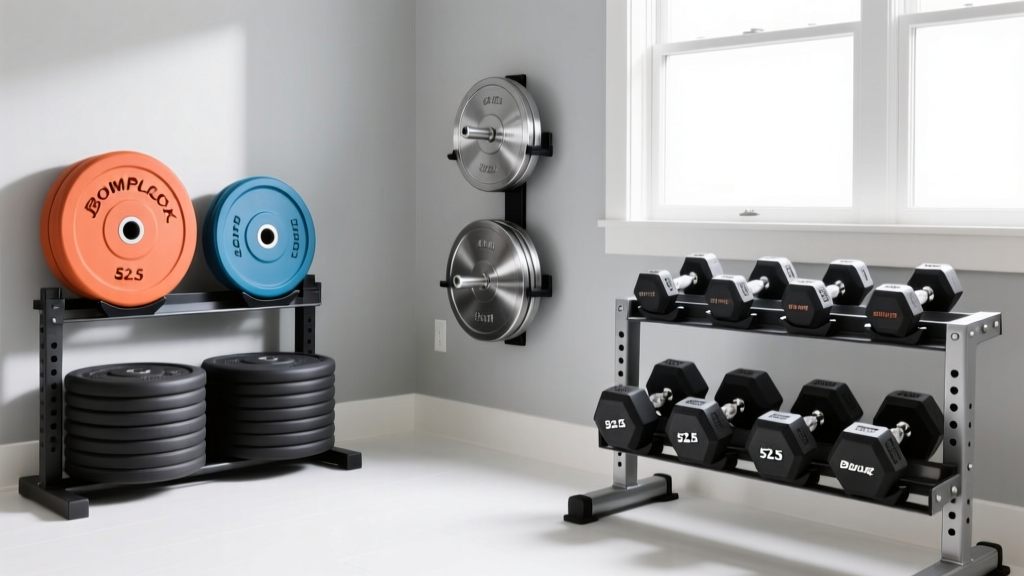
Home Gym Layout: Bumper vs Iron Plates & Bowflex 52.5 Dumbbells
Optimize your home gym layout. Compare bumper vs iron plate footprints and integrate Bowflex 52.5 dumbbells for maximum space efficiency.

The Spatial Dilemma: Bumper Plates vs. Cast Iron
Designing a high-functioning home gym in a limited footprint requires ruthless prioritization. Every square foot of your garage, basement, or spare bedroom must justify its existence. When planning your free weight zone, the foundational decision between bumper plates and traditional cast iron plates extends far beyond mere aesthetics or drop-safety—it fundamentally dictates your storage layout, barbell sleeve capacity, and flooring requirements. As of 2026, with equipment supply chains fully normalized, lifters have unrestricted access to both high-density competition bumpers and precision-machined iron, making spatial optimization the true deciding factor.
Space Optimization Quick Rule
Choose Iron if your primary goal is maximizing barbell sleeve loading capacity and minimizing horizontal storage width on a plate tree.
Choose Bumpers if your programming involves Olympic lifts, deadlift drops, and you have the vertical clearance and floor space for wider, specialized storage racks.
Dimensional Deep Dive: Plate Thickness & Barbell Sleeves
The most critical, yet frequently overlooked, spatial constraint in a home gym is the loadable length of your Olympic barbell sleeves. A standard power bar features 16.3 inches of loadable sleeve space. According to equipment testing by Garage Gym Reviews, the thickness variance between iron and rubber dramatically alters how much weight you can physically fit on the bar before requiring specialized collar extensions.
| Plate Weight | Rogue Echo Bumper (Thickness) | Rogue Machined Iron (Thickness) | Spatial Impact |
|---|---|---|---|
| 45 lbs | 3.25 inches | 1.50 inches | Iron saves 1.75" per plate |
| 25 lbs | 2.15 inches | 1.05 inches | Iron saves 1.10" per plate |
| 10 lbs | 1.05 inches | 0.90 inches | Marginal difference |
The Sleeve Capacity Bottleneck
If you are a strength athlete pushing past 400 lbs on the deadlift, Rogue Fitness Echo Bumpers will consume your sleeve space rapidly. Four 45lb bumpers per side (360 lbs total) plus a 45lb bar equals 405 lbs, utilizing 13 inches of the 16.3-inch sleeve. You are left with barely enough room for a standard spring collar. Conversely, machined iron allows you to load well over 500 lbs on the same barbell while leaving ample room for heavy-duty clamp collars. From a storage perspective, a vertical plate tree holding 300 lbs of iron takes up roughly 40% less horizontal width than a tree holding the equivalent weight in bumpers.
Integrating the Bowflex 52.5 Dumbbells into Your Layout
While your barbell setup demands careful sleeve and tree calculations, your dumbbell station is where the most dramatic spatial reclamation occurs. When space is at an absolute premium, the Bowflex 52.5 dumbbells—officially marketed as the SelectTech 552 (adjusting from 5 to 52.5 lbs in 2.5 lb increments)—serve as the anchor of a high-density layout.
Footprint Math: Adjustable vs. Fixed Dumbbells
To understand the spatial value, we must look at the raw geometry. A traditional commercial 3-tier dumbbell rack holding a 5-50 lb hex dumbbell set (10 pairs) requires a rack footprint of approximately 48 inches wide by 24 inches deep (8 square feet). However, you must also factor in the 'user clearance zone'—the space required to bend down, grip, and lift safely without hitting a wall or rack. This pushes the total functional footprint to nearly 20 square feet.
The Bowflex 52.5 dumbbells measure exactly 16.9 inches long, 8.3 inches wide, and 9 inches high. Placed on their optional compact stand, the functional footprint shrinks to just 24 inches by 18 inches (3 square feet). By replacing a full rack of fixed hex dumbbells with a single pair of Bowflex 52.5s, you reclaim roughly 17 square feet of usable floor space—enough room to add a dedicated plyometric zone or a functional trainer cable machine.
Critical Failure Modes and Placement Rules
Layout Warning: The internal mechanism of the Bowflex 52.5 relies on an ABS plastic dial housing and injection-molded covers. Unlike cast iron hex dumbbells, you cannot drop them. Dropping the SelectTech 552 from shoulder height will crack the dial housing, misaligning the internal gear track and permanently locking the weight plates. Your layout must position the Bowflex cradle away from high-traffic drop zones and barbell paths.
Drop Zones, Flooring, and Acoustic Management
Your choice of plates directly dictates your flooring layout and acoustic treatment, which in turn affects how close you can place your equipment to shared walls.
- Iron Plate Layouts: Require a dedicated, heavily reinforced drop zone. You must invest in 3/4-inch thick vulcanized rubber horse stall mats layered over a plywood subfloor to disperse the sheer point-impact force of cast iron. This zone must be positioned in the dead center of the room to mitigate acoustic vibration transfer to adjacent drywall.
- Bumper Plate Layouts: High-density competition bumpers (like the Rogue KG Competition Plates) are designed to absorb and disperse impact radially. While you still need rubber matting to protect your concrete slab, the acoustic dampening is vastly superior. This allows you to push your deadlift platform closer to garage walls or shared property lines without triggering noise complaints.
The 10x10 Home Gym Floor Plan Blueprint
If you are working with a standard 10x10 foot bedroom or garage bay (100 square feet), here is an optimized layout blueprint integrating machined iron for the barbell and the Bowflex 52.5 dumbbells for accessory work, maximizing open floor space for mobility and stretching.
- The Anchor Wall (0-24 inches): Mount a fold-back wall-mounted squat rack. When folded, it protrudes only 4 inches, reclaiming the 4-foot depth normally lost to a traditional power cage.
- The Barbell Zone (24-60 inches): Place a 4x8 foot raised deadlift platform directly in front of the rack. Use machined iron plates stored on a low-profile horizontal plate tree tucked flush against the side wall to keep the center aisle clear.
- The Accessory Station (Corner Placement): Position the Bowflex 52.5 dumbbell stand in the rear corner, angled at 45 degrees toward the center of the room. This ensures the 16.9-inch length of the dumbbells doesn't impede the walkway when removing them from the cradle.
- The Mobility Void (Center): By eliminating the 8-square-foot traditional dumbbell rack and utilizing a fold-back rack, the exact center of your 10x10 space remains entirely unobstructed, providing a 6x6 foot open zone for kettlebell swings, yoga, and dynamic warm-ups.
Final Verdict: Choosing Your Space Strategy
There is no universal 'best' option—only the best option for your specific architectural constraints. If your home gym is a narrow, single-car garage where horizontal storage width is the primary enemy, machined iron plates paired with a wall-mounted rack and the Bowflex 52.5 dumbbells will yield the highest spatial ROI. However, if your gym is located in a shared living space where acoustic dampening and the ability to safely bail on Olympic lifts are paramount, the wider footprint of bumper plates is a necessary spatial tax for noise control and equipment longevity. Measure your sleeves, map your drop zones, and let the geometry of your room dictate your iron.
More gear to consider
All reviews
Free Weights Longevity: Is Dumbbell Bench Press Better Than Barbell? & Kettlebell Care

Overhead Press Bar vs Dumbbell: Olympic Knurling Guide
EZ Curl Bar vs Straight Bar: Space Layouts for a Boxing Dumbbell Workout

Maintaining Loadable Dumbbells for a Safe 90 lb Dumbbell Bench Press
Compact Gym Layout: Kettlebell Buying Guide & Inner Chest Exercises Dumbbells
