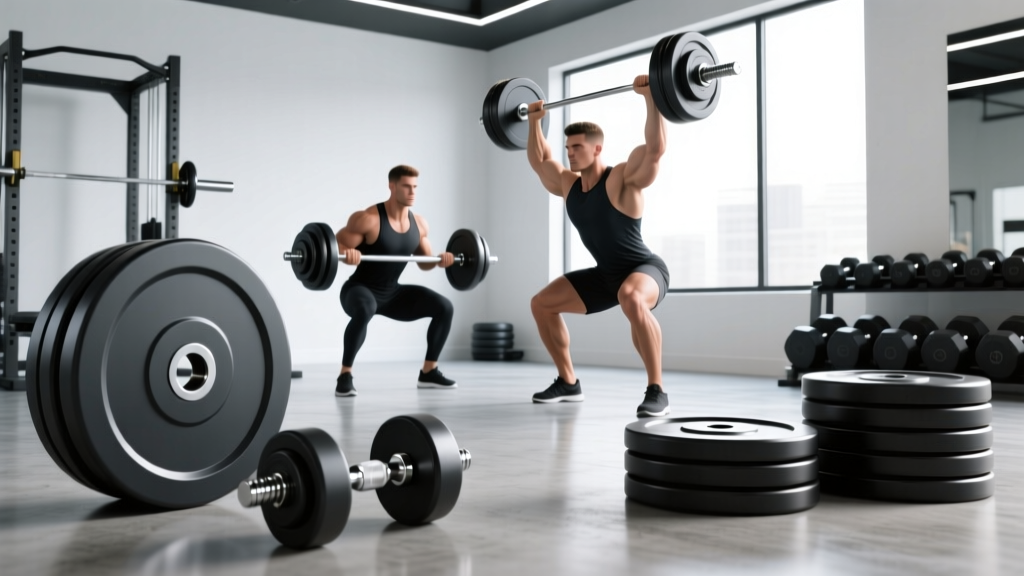
Bumper vs Iron Plates: Upgrading Beyond Renegade Rows with Dumbbells
Transitioning from renegade rows with dumbbells to barbell training? We break down the 2026 budget, value, and ROI of bumper plates vs cast iron plates.

The Progression: Outgrowing Renegade Rows with Dumbbells
When your home gym journey begins, adjustable dumbbells are the undisputed kings of versatility. You can build serious posterior chain strength, anti-rotational core stability, and lat thickness by performing renegade rows with dumbbells. However, as your strength adapts, you will inevitably hit the weight ceiling of even the heaviest commercial adjustable sets—typically maxing out between 52.5 lbs and 90 lbs per hand. Once you are rowing 90 lbs per side for reps, it is time to pivot to a barbell and invest in weight plates.
This transition brings every home gym owner to a critical financial crossroads in 2026: Do I buy traditional cast iron plates or invest in rubber bumper plates? The decision is not just about aesthetics; it is a complex budget breakdown involving cost-per-pound, shipping logistics, floor protection, and barbell sleeve capacity. Below, we dissect the true value and ROI of both options to help you allocate your fitness budget intelligently.
Cast Iron Plates: The High-Density Budget Champion
Cast iron plates have been the standard for over a century. Machined from molten iron and typically finished with a baked enamel or powder-coated layer, they offer unmatched density. If your primary training involves powerlifting (squats, bench presses, deadlifts) and you have a dedicated lifting platform or heavy-duty horse stall mats, iron is the most economical route.
Real-World Pricing & Models (2026 Market)
- Rogue Ohio Steel Plates: The gold standard for basic iron. Priced at approximately $1.75 to $1.95 per pound. A 45lb plate costs around $85. They feature a machine-finished hub for smooth barbell sleeve loading.
- Titan Fitness Cast Iron Plates: A budget alternative, often hovering around $1.20 to $1.40 per pound during seasonal sales. The finish is rougher, and the weight tolerance is a wider +/- 2%, but the raw cost savings are substantial.
- York Legacy Iron: Often found on the used market or specialty retailers, these vintage-style plates offer a classic look but can suffer from rust if kept in unclimate-controlled garages.
While the upfront cost per pound is low, iron plates transfer kinetic energy directly into your floor. Dropping a loaded barbell with iron plates on bare concrete will cause spalling (chipping and cracking of the concrete foundation). You must factor in the cost of a proper 3/4-inch vulcanized rubber matting system (approx. $150-$250) to protect your subfloor. Furthermore, iron plates are incredibly noisy; if you share a wall or live in a multi-story home, the acoustic vibration of racking heavy iron will cause friction with neighbors or family members.
Bumper Plates: Paying for Protection and Performance
Bumper plates are constructed from solid rubber or urethane, featuring a steel or brass inner hub. They are all the same diameter (450mm / 17.7 inches) regardless of weight, meaning a 10lb plate hits the floor at the same time as a 45lb plate when dropped. This makes them mandatory for Olympic weightlifting (snatches, cleans) and high-volume CrossFit-style workouts where the barbell is routinely dropped from overhead.
Material Breakdown & Cost Analysis
Not all bumpers are created equal. The rubber compound dictates the price, the bounce, and the longevity.
- Virgin Rubber (e.g., Rogue Echo, Fringe Sport Black): Priced between $3.25 and $4.50 per pound. These feature a high durometer rating (85-90 ShA), meaning they are dense, have minimal 'dead bounce', and resist tearing. A 260lb set will cost roughly $900 to $1,100.
- Crumb Rubber (e.g., Hi-Temp, Titan Fitness Crumb): Priced between $2.00 and $2.75 per pound. Made from recycled tires, these are thicker, smell strongly of rubber initially, and have a lower durometer (softer). They bounce more and take up significantly more space on the barbell sleeve.
- Urethane (e.g., Eleiko, Rogue Urethane): The premium tier, costing $6.00 to $9.00+ per pound. Urethane resists UV degradation, scuffing, and odor, making it the standard for high-end commercial facilities, though usually overkill for a budget-conscious home gym.
According to equipment testing by BarBend's expert reviewers, virgin rubber bumpers consistently outlast crumb rubber by a factor of 3-to-1 in high-drop scenarios, making the higher initial CPP (Cost Per Pound) a better long-term ROI for aggressive lifters.
Head-to-Head Value Matrix
| Feature | Cast Iron Plates | Virgin Rubber Bumpers | Value Winner |
|---|---|---|---|
| Average Cost Per Pound | $1.40 - $1.95 | $3.25 - $4.50 | Iron |
| 45lb Plate Thickness | ~1.5 inches | ~3.25 inches | Iron (Saves sleeve space) |
| Drop Safety (Overhead) | Poor (High risk of floor/bar damage) | Excellent (Absorbs kinetic energy) | Bumpers |
| Acoustic Profile | Loud, metallic clanking | Dull, quiet thud | Bumpers |
| Freight / Shipping Costs | High (Extremely dense, triggers freight) | Moderate (Bulky but lighter per volume) | Tie (Depends on promo) |
2026 Budget Breakdown: The 250lb Starter Set
To understand the true financial commitment, let us break down a standard 250lb plate package (Pairs of 45s, 25s, 10s, 5s, and 2.5s). Note that prices reflect the 2026 market average before tax and shipping.
Option A: The Iron Route (Rogue Ohio Steel Equivalent)
- 2x 45lb ($85/ea) = $170
- 2x 25lb ($50/ea) = $100
- 2x 10lb ($25/ea) = $50
- 2x 5lb ($15/ea) = $30
- 2x 2.5lb ($10/ea) = $20
- Total Plate Cost: ~$370.00
- Estimated Shipping: $80 - $120 (Iron is notoriously expensive to ship due to density. Always look for free shipping promotions in November/December).
- Grand Total: ~$470.00
Option B: The Bumper Route (Fringe Sport Black / Rogue Echo Equivalent)
- 2x 45lb ($150/ea) = $300
- 2x 25lb ($85/ea) = $170
- 2x 15lb ($55/ea) = $110 (Note: Bumpers rarely use 10s/5s for dropping, 15s are standard)
- 2x 10lb ($45/ea) = $90
- Total Plate Cost: ~$670.00
- Estimated Shipping: Often Free (Many retailers offer free shipping on bumper sets over $500 due to better margin absorption).
- Grand Total: ~$670.00
Expert Insight on Barbell Sleeve Capacity: If you plan on maxing out your deadlift or doing high-rep Olympic lifts, sleeve space matters. A standard Olympic barbell has 16.3 inches of loadable sleeve space. You can fit roughly six 45lb cast iron plates per side (270lbs + bar). However, because virgin rubber 45lb bumpers are over twice as thick, you can only fit about four per side (180lbs + bar). If you are a powerlifter chasing a 500lb+ deadlift, iron is practically mandatory unless you buy expensive, ultra-dense calibrated steel plates.
The Hybrid Strategy: Maximizing Value
For the budget-conscious lifter transitioning from a dumbbell-centric routine (where renegade rows with dumbbells and goblet squats were the norm) into a hybrid powerbuilding program, the smartest financial move in 2026 is the Hybrid Plate Approach.
Purchase your heavy weights in cast iron, and your light weights in bumpers. Here is why this works:
- Buy Iron for the Heavy Lifts: Purchase 4 pairs of 45lb cast iron plates. This gives you 360lbs of working weight for squats and deadlifts at a fraction of the cost of bumpers, and it easily fits on the barbell sleeve.
- Buy Bumpers for the Drops and Technical Work: Purchase a pair of 15lb or 25lb virgin rubber bumper plates. When doing hang cleans, snatches, or high-fatigue metabolic conditioning where you need to dump the bar safely, load the 15lb bumpers on the inside of the collar. Because all bumpers share a 450mm diameter, the 15lb bumper will hit the floor first, protecting the barbell, your floor, and the iron plates from shock damage.
As noted by the equipment analysts at Garage Gym Reviews, this hybrid method can save a home gym owner upwards of $300 on their initial plate package while still providing 90% of the functional utility of a full bumper set.
Final Verdict: Where Should Your Money Go?
Your choice between bumper and iron plates ultimately depends on your training modality and your environment. If your training strictly involves controlled powerlifting, you have a dedicated lifting platform, and you want to maximize every dollar of your budget, cast iron plates remain undefeated in value. The money you save can be reinvested into a higher-quality barbell or a sturdy squat rack.
However, if your programming includes Olympic lifting, CrossFit-style WODs, or you are training in a garage with a sensitive concrete slab and nearby neighbors, the premium paid for virgin rubber bumper plates is a mandatory insurance policy. They preserve your equipment, protect your foundation, and allow you to train with maximum intensity without the fear of catastrophic floor damage. Evaluate your programming, measure your sleeve space, and invest accordingly.
More gear to consider
All reviews
Loadable Dumbbells vs Baby Dumbbells: Budget Breakdown

Boxer Dumbbell Workout Setup: Adjustable Dumbbell Review
Goblet Squat vs Dumbbell Squat: Bumper vs Iron Plate Budget

Olympic Barbell Guide: Weight, Knurling & Double Dumbbell Snatch
Dumbbell Bent Row Troubleshooting: Standard vs Olympic Plates